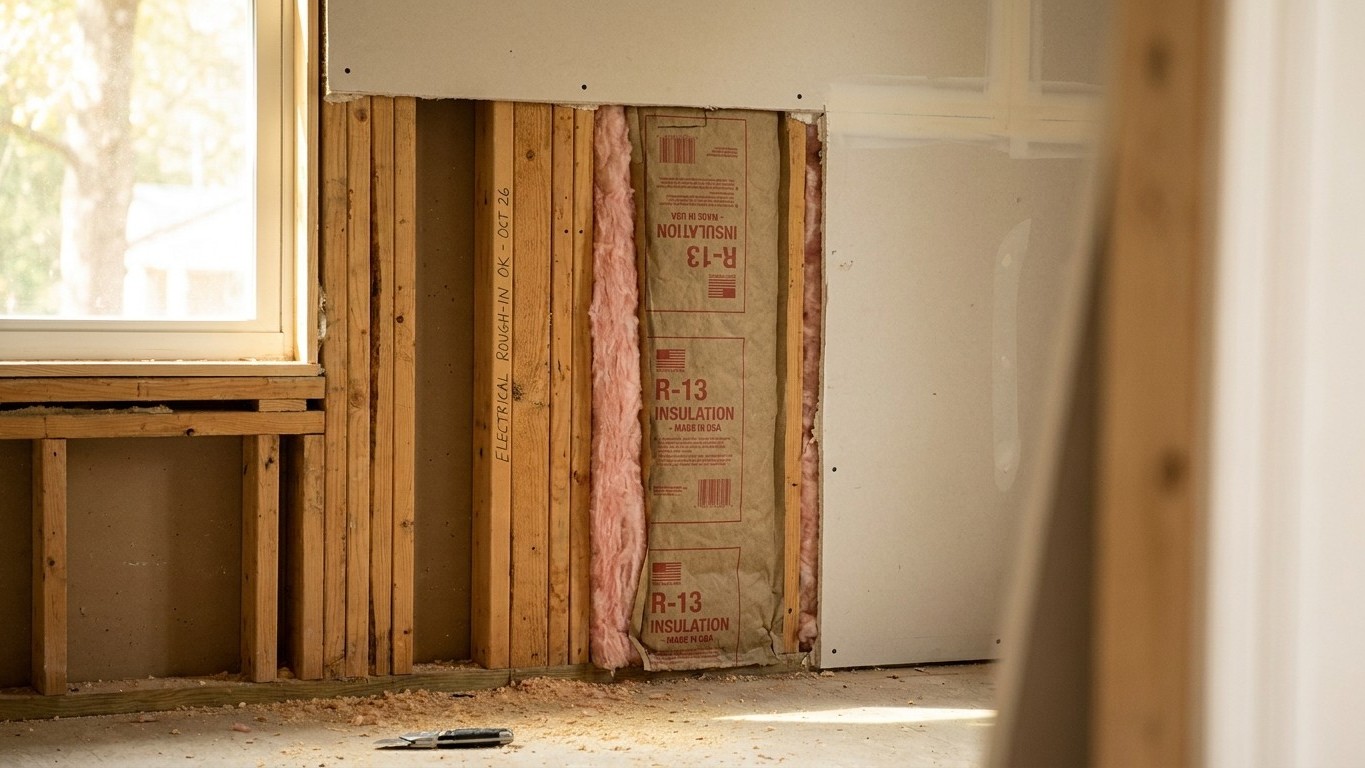

Yes. Massachusetts sits entirely within IECC Climate Zone 5A, and under the 2021 International Residential Code, that zone falls outside the exception that removes the vapor retarder requirement. So a Class-appropriate vapor retarder is expected on the interior side of frame walls here, statewide, county by county, with no split answer to sort through first.
What the code asks for in Massachusetts

Section R702.7 of the 2021 International Residential Code states it plainly: a vapor retarder of the class listed in Table R702.7(2) “shall be provided on the interior side of frame walls.” That’s the base rule everywhere the code applies. Then the code carves out four exceptions, and the one that matters for most of the country reads: “A vapor retarder shall not be required in Climate Zones 1, 2 and 3.”
Massachusetts doesn’t get that exception. The 2021 IECC’s Table R301.1 lists the entire state as “5A (all),” with no county-by-county carve-outs. That’s a rare situation. Plenty of states straddle two or three zones, which means a homeowner in one county faces a different rule than a neighbor sixty miles away. Massachusetts skips that complication. Whether you’re building in Berkshire County or on Cape Cod, the zone designation is the same, and the code language that applies to it is the same.
Because Zone 5A isn’t Zone 1, 2, or 3, the exception doesn’t apply, and the base requirement in R702.7 stands: a vapor retarder of the correct class belongs on the interior side of the frame wall assembly. That word “required” is doing real work here. It’s not a suggestion buried in an appendix. It’s the default expectation for wall construction in a cold, moist climate zone, and it shows up in the same table that determines insulation R-values for the state.
None of this means every wall in every Massachusetts town gets inspected against this exact clause in this exact wording. States and municipalities adopt building codes on their own timeline, sometimes with local amendments, sometimes lagging the latest model code by a cycle or two. The 2021 IRC is the reference document behind this answer, but the code actually enforced on a given job site is whatever the local building department has adopted and amended. That distinction matters more than most homeowners realize, and it’s the reason this page points toward a building department rather than a specific product at the end.
What doesn’t change, regardless of which edition a town has adopted, is the underlying climate logic. Zone 5A means a long, cold, damp heating season, and codes in that kind of zone consistently ask for a vapor retarder on the warm-in-winter side of the wall. That’s the mechanism worth understanding before getting into which class of material actually satisfies it.
Why the answer is the opposite in a warm climate
Here’s the part that makes this a genuinely useful rule rather than an arbitrary box to check. In a cold climate like Massachusetts, the warm, moisture-laden air lives inside the house. In winter, that indoor air is warmer and holds more moisture than the air outside. When it pushes through a wall cavity and hits cold sheathing near the exterior, it can condense there. A vapor retarder installed toward the interior side blocks that indoor moisture before it reaches the cold surface. That’s the entire logic behind R702.7’s base requirement, and it’s why Massachusetts, sitting in Zone 5A, keeps that requirement rather than falling under the exception.
Flip the climate, and the physics flips with it. In a hot, humid state, the outdoor air is the moist one, and the air conditioned indoor air is the cool, dry side. If a builder installs the same kind of impermeable interior vapor retarder in that climate, they’ve put the barrier on exactly the wrong side of the assembly. The U.S. Department of Energy’s Building America program describes what happens next in plain terms: “If the wall contains a vapor retarder on the interior side of the insulation, the water vapor will condense on this cool, impermeable surface,” and the result is “ruined insulation, mold, and structural rot of framing members.”
That’s not a minor performance issue. That’s a wall assembly failing from the inside, with the same conditions that would keep a Massachusetts wall dry causing a warm-climate wall to hold moisture against the framing indefinitely. The code’s Climate Zone 1, 2, and 3 exception exists because of that exact outcome. It’s not a bureaucratic gap or an oversight. It’s a direct response to which direction the water vapor is traveling in a given climate, and the code writes a different rule for the states where it travels the other way.
Massachusetts doesn’t have that problem, at least not in the way a Gulf Coast state does. The moisture drive here runs from the heated interior outward through the wall for most of the year, which is exactly the condition R702.7’s base rule was written to address. The 5,545 heating degree days that Boston Logan racks up annually give some sense of just how long and pronounced that inward-to-outward moisture drive actually is over a typical year, a point worth returning to later. For now, the relevant fact is that the mechanism behind the requirement and the mechanism behind the exception are the same physics, pointed in opposite directions.
The three classes, and why the word matters
Requiring “a vapor retarder” doesn’t mean requiring any specific material. The code sorts vapor retarders into three classes by permeance, meaning how easily water vapor passes through them, and Table R702.7(2) spells out the ranges.
| Class | Example materials | Permeance range |
|---|---|---|
| Class I | Sheet polyethylene, nonperforated aluminum foil | 0.1 perm or less |
| Class II | Kraft-faced fiberglass batts, vapor retarder paint | Above 0.1, up to 1.0 perm |
| Class III | Latex or enamel paint | Above 1.0, up to 10.0 perm |
Sheet polyethylene is a genuinely near-impermeable material, which is why it’s the go-to example whenever someone says “vapor barrier.” But calling it that without qualifying it as Class I glosses over the real issue. The disagreement between a builder in Massachusetts and a builder in a warm-humid state isn’t about whether to have a vapor retarder at all. It’s about which class belongs where, because a Class I product does something very different to a wall assembly than a Class III product does.
Most homeowners already own a Class III vapor retarder without knowing it. Ordinary latex paint falls in that 1.0-to-10.0 perm range, which technically classifies it as a vapor retarder under the code’s own definitions. That’s a far cry from sheet polyethylene, and it behaves nothing like it: a coat of latex paint still lets a meaningful amount of moisture pass through over time, while sheet poly essentially stops it.
One more distinction worth keeping straight: a vapor retarder is not an air barrier. They solve different problems, one dealing with water vapor diffusing through material, the other with bulk air movement carrying moisture through gaps and cracks, and the same sheet of material sometimes does both jobs at once, but not automatically. Confusing the two is common, and it’s part of why this topic gets murky fast.
Where the rule stops
R702.7’s base requirement doesn’t apply everywhere in a house, even one built entirely in Zone 5A. The code lists specific situations where the vapor retarder rule doesn’t reach:
- Basement walls
- The below-grade portion of any wall
- Construction where the accumulation, condensation, or freezing of moisture will not damage the materials involved
The basement exception is the one most Massachusetts homeowners actually run into, since finished basements are common in a state with this much winter. A poured concrete foundation wall holds moisture and releases it slowly, sometimes over years, depending on grading, drainage, and the water table around the house. That assembly needs to be able to dry toward the interior when conditions call for it. Installing an impermeable sheet on the interior face of that wall traps moisture against the concrete instead, with nowhere for it to go. That’s the opposite problem from an above-grade frame wall, and it’s why the code pulls basement walls out of R702.7 entirely rather than just adjusting which class applies. For the mechanics of how a below-grade wall handles moisture differently, the basement wall guide on this site covers that assembly in more depth.
The third exception, covering construction where moisture won’t damage the materials, is deliberately broad and depends on the specific assembly, not a blanket climate rule. It’s not something a homeowner should try to apply on their own judgment; it’s the kind of call a local building official makes when reviewing a particular design.
Who actually decides, in Massachusetts
Everything above describes the 2021 IRC as written. What actually gets enforced on a specific job site in a specific Massachusetts town is whatever code edition that town’s building department has adopted, with whatever amendments it has layered on. States adopt and amend model codes on their own schedule, sometimes staying current, sometimes running a cycle or two behind, and Massachusetts is no exception to that pattern. The only office that can tell a homeowner which exact rule applies to their address is the local building department.
That distinction carries extra weight in a state with a heating season as long as Boston’s. Logan Airport’s official climate normals show about 5,545 heating degree days a year, a figure that measures accumulated heating demand across the year rather than any single temperature reading. That’s a lot of days where indoor air stays warmer and wetter than the air outside, which is precisely the condition the vapor retarder requirement in Zone 5A is built around. It’s also a reminder that this isn’t a minor technical footnote for Massachusetts the way it might be for a state further south.
None of that changes the basic guidance here: this page explains what the model code says and what climate mechanism sits behind it, not what belongs in any individual reader’s own wall. A wall built with the wrong class of vapor retarder for its climate and assembly doesn’t announce the problem right away. It rots quietly, behind drywall and insulation, and the damage usually surfaces years later as a mold smell, a soft spot, or a contractor’s flashlight finding rot where framing should be solid. The local building department, working from the code edition their jurisdiction has actually adopted, is the only reliable source for what a specific project needs.