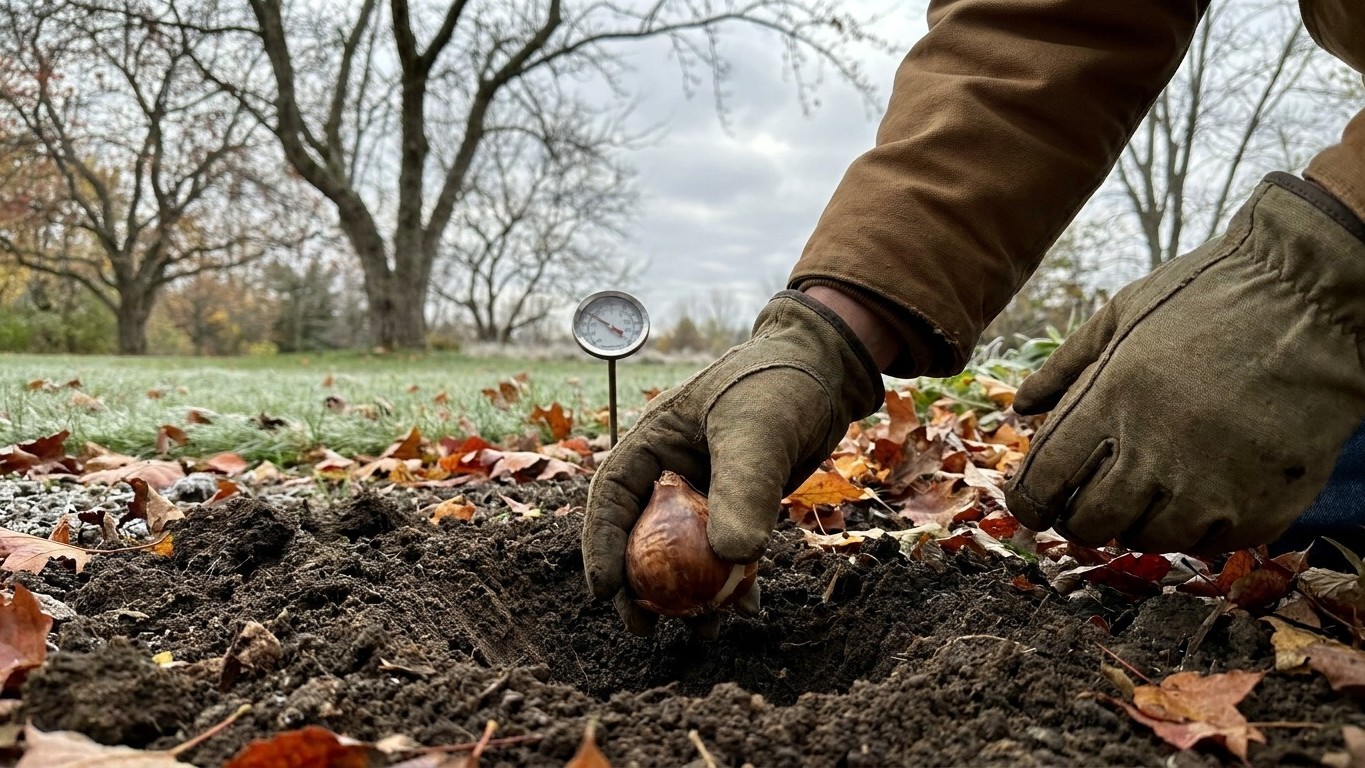

Yes, but only if the bulb’s cold requirement matches what a Michigan winter actually delivers. Most spring bulbs need twelve to fourteen weeks with soil temperatures below 45°F to bloom at all, and Michigan’s winters clear that bar for nearly every classic variety without any pre-chilling. The exceptions, and the exact planting window, are what follow.
When to plant bulbs in Michigan

The planting date follows the ground, not the calendar. Spring bulbs go in once soil temperatures have dropped enough to stop active root competition from summer plants but before the ground locks up hard for winter. In practice, that means aiming for roughly six weeks before the average first fall frost, which in most of Michigan falls between October 6 and October 21, according to the MSU Extension Michigan Garden Calendar. That puts the safe planting window at roughly late September through mid-October for much of the Lower Peninsula, with the Upper Peninsula and far northern counties needing to move a couple of weeks earlier.
Plant too early, while soil is still warm from summer, and bulbs often push top growth before winter arrives. That green shoot then gets hit by the first hard freeze and dies back, weakening the bulb before it has even finished rooting. Plant too late, after the ground has started to freeze, and the bulb goes into winter without enough time to establish roots. The result the following spring is a bulb that comes up stunted, blooms weakly, or simply rots from being disturbed in half-frozen soil.
Why the frost date is a guess, not a guarantee
That October 6 to October 21 range is an average built from decades of NOAA climate data, which means by definition roughly half of all years land outside it. Some Octobers stay mild well past the 21st. Others bring a hard freeze in the first week. The practical fix is to stop watching the calendar and start watching the soil: once nighttime lows are consistently landing in the low-to-mid 40s, that’s the signal to get bulbs in, regardless of what the date on the wall says.
Gardeners in southeastern Michigan, closer to Lake Erie’s moderating effect, sometimes get an extra week or two of workable soil compared with those in the northern counties or higher elevations. That’s not a reason to plant late everywhere. It’s a reason to treat the window as a range and lean toward the earlier end if there’s any doubt. For those who want blooms sooner or missed the outdoor window entirely, Forcing Spring Bulbs Indoors in Michigan is a reliable alternative, and Growing Spring Bulbs in Containers in Michigan offers another option for gardeners without in-ground beds.
Whether your winter is cold enough
This is the question that decides whether a bulb blooms or just grows leaves. A spring bulb isn’t simply dormant over winter, it’s running a biological clock. Cold exposure triggers hormonal changes inside the bulb that convert stored energy into a flower stalk instead of just foliage. Most tulips, daffodils, and hyacinths need twelve to fourteen weeks with soil temperatures below about 45°F to complete that process. Skip it, or cut it short, and the bulb either produces leaves with no flower, or a flower bud so short it never clears the soil line.
Michigan’s coldest month, based on NOAA Climate Normals from 1991 to 2020 at the Detroit reference station, averages a nightly minimum of 19.2°F. That’s not a fluke cold snap, that’s the typical low for the coldest stretch of winter. It confirms that soil across the state stays well below 45°F for a long run, from sometime in November through into March in most years, which is far more than the twelve-to-fourteen-week requirement most bulbs need. The margin here isn’t tight. It’s generous enough that gardeners in Michigan almost never need to pre-chill bulbs before planting, unlike growers in much warmer parts of the country who have to fake winter in a refrigerator.
Where pre-chilling still matters in Michigan is the reverse situation: bulbs bought and stored too long in a warm house, or a fall that runs unusually mild. In that case, twelve weeks in a refrigerator, kept away from apples, pears, and other ripening fruit, can substitute for missing outdoor cold. Ethylene gas from ripening fruit will quietly kill the flower bud inside a chilling bulb without any visible sign until spring, so this isn’t a minor detail to skip.
Cold requirement by species, checked against Michigan
| Bulb | Weeks of cold needed (below 45°F) | What Michigan delivers | Verdict |
|---|---|---|---|
| Tulip | 12–14 weeks | Roughly November through March, well past 14 weeks | Meets requirement with wide margin |
| Daffodil | 12–16 weeks | Same long winter window | Meets requirement with wide margin |
| Hyacinth | 12–14 weeks | Same long winter window | Meets requirement with wide margin |
| Crocus | 8–15 weeks (species dependent) | Same long winter window | Meets requirement comfortably |
| Allium | 8–10 weeks | Same long winter window | Meets requirement comfortably |
A gardener planting tulips somewhere winter never gets this cold has wasted the bulb, not the money on the bulb but the entire season it takes to find out it never bloomed. That’s not a risk in Michigan. The risk here runs the other direction, tender bulbs that can’t survive the cold at all, which is the next question.
Which bulbs suit Michigan
Michigan spans USDA Hardiness Zones 4a through 6b, according to the USDA Plant Hardiness Zone Map’s 2023 update using 1991-2020 normals. That’s a wide enough range to cover nearly every classic spring bulb sold at garden centers, though gardeners in the northern tip of the state are working with a meaningfully colder zone than those near Detroit.
- Tulips (Tulipa) — hardy zones 3 to 8
- Daffodils (Narcissus) — hardy zones 3 to 9
- Crocus — hardy zones 3 to 8
- Hyacinths — hardy zones 4 to 8
- Alliums — hardy zones 3 to 9, depending on species
- Snowdrops (Galanthus) — hardy zones 3 to 7
- Grape hyacinth (Muscari) — hardy zones 4 to 8
Every one of those ranges comfortably overlaps Michigan’s 4a-6b span, which is why they’re the standbys sold in nearly every fall bulb display in the state.
What disappoints, and how
Bulbs rated for zones 8 through 10, like freesia, ranunculus, and anemone coronaria, are the ones that let gardeners down here. These aren’t true hardy bulbs, they’re tender corms that expect a winter far milder than anything Michigan offers. Left in the ground, they rot in the wet, freezing soil before spring even arrives. Sometimes they manage one showy first-year bloom from stored energy in the corm, then fail to return the following season once that reserve is spent, a pattern gardeners often mistake for their own mistake rather than a mismatch of climate.
Hardiness ranges aren’t hard lines, either. A bulb rated to zone 7 sitting right at the edge of Michigan’s zone 6b in a sheltered spot near a south-facing foundation wall might survive several winters. The same bulb in an exposed, windswept bed a few miles away is far less likely to make it. Zone maps describe averages across a wide area, not a guarantee for any single backyard.
What digs them up here
Squirrels and voles aren’t random about which bulbs they raid. It comes down to chemistry. Daffodils and members of the onion family, including alliums, contain compounds that make them bitter or mildly toxic to rodents, so they’re left alone almost entirely. Tulips and crocus have no such defense and are treated as a food source, often dug up within days of planting or eaten as they sprout in spring.
- Bulbs squirrels and voles typically take: tulips, crocus
- Bulbs squirrels and voles typically leave alone: daffodils, alliums, hyacinths, snowdrops, grape hyacinth
For the vulnerable bulbs, the one measure that consistently works is a physical barrier: laying galvanized wire mesh flat over the planting bed, pinned down at the edges, until the ground freezes solid. Rodents can’t dig through it, and once the soil is frozen they’ve moved on to easier food anyway. Repellent sprays and granules marketed for this purpose tend to wash off with the first rain or watering, which is exactly when a newly planted bed needs the protection most.
Where to check for your own county
Every figure in this guide, the frost dates, the 19.2°F coldest-month minimum, the hardiness zone range, describes Michigan as a whole or leans on Detroit as a reference point. A state stretching from the Ohio border to the tip of the Upper Peninsula covers several degrees of latitude and multiple hardiness zones at once, and a planting window built around one reference city can run two to three weeks off at either edge of the state.
Michigan State University’s Extension service, available at canr.msu.edu/outreach, keeps county-level guidance that accounts for those local differences, from Lake Michigan’s moderating effect on the western coast to the shorter growing season farther north. Checking with a county office before finalizing a planting date is the difference between a guide written for the state capital and one that actually fits the soil in a specific backyard.