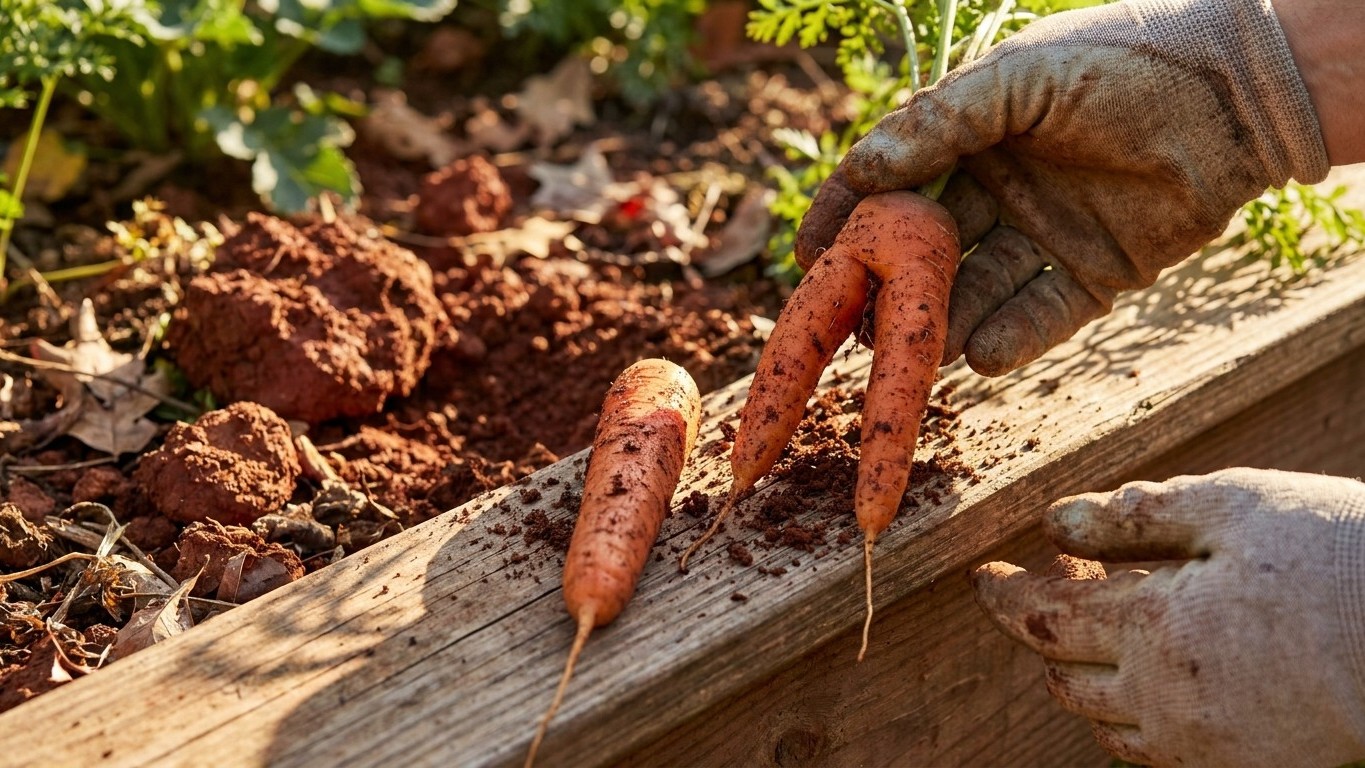

Michigan’s official state soil, the Kalkaska series, is sandy and loose enough that a carrot growing in it would have little reason to fork. But that soil sample comes from a statewide survey, not your backyard, and forking is a texture problem that shows up in compacted, rocky or clay-heavy ground no matter what state you’re in.
The short answer
The Kalkaska series became Michigan’s legally designated state soil, a Spodosol that formed under conifer forests across the sandy outwash plains that cover much of the state’s northern half. USDA’s Soil Survey Geographic Database records the surface horizon of the 332 mapped components of this series as 86 percent sand, 5 percent clay and 9 percent silt, with a surface pH around 4.7, which counts as strongly acid. Drainage class is listed as somewhat excessively drained.
Run those numbers against what a carrot actually wants. Utah State University Extension puts it plainly: carrots want deep, sandy, well-drained soil rich in organic matter, and heavy or rocky soil is what makes the root fork. A texture that’s 86 percent sand with almost no clay is about as far from “heavy” as soil gets, and “somewhat excessively drained” means water moves through fast rather than pooling around a taproot and deflecting it sideways. On texture alone, the Kalkaska profile leans toward the kind of ground carrots tend to grow straight in.
The acidity is a separate story. A surface pH of 4.7 is strongly acid, well outside the comfortable range for most garden vegetables, and soil that acidic will need lime worked in before it supports much of anything reliably. That’s a fertility and nutrient-availability issue, though, not the mechanical issue that causes forking. A carrot can grow crooked or stunted in acid soil, but the specific defect called forking, where the root splits into two or more legs, comes from something physical blocking or deflecting the tip, not from pH.
One more caution belongs here before anyone reaches for a lime bag. The organic matter figure attached to this series sits around 75 percent, and that number describes a natural forest floor: a layer of accumulated needle litter and decomposing organic material that built up over a long stretch of time under trees, not something a cultivated vegetable bed will ever show. Once ground gets cleared, tilled and planted, that surface layer is gone. So the pH and organic matter values here describe the mapped, undisturbed soil series, not a number you should expect a soil test kit to return from a dug garden bed.
None of this is a diagnosis of your yard. Michigan spans hundreds of soil series, from heavy clay lakebed soils in the Thumb to sand plains in the northern Lower Peninsula to whatever mix of subsoil and fill a builder left behind a new house. The Kalkaska series tells you what the state as a whole tends toward, sandy and acid and fast-draining, and nothing more specific than that. If your own ground runs heavier than that, Utah State University Extension’s fix stands regardless of location: work in plenty of compost, double dig the bed to loosen compaction at depth, or skip the argument entirely and grow in a raised bed filled with soil you control.
The test that settles it in your own garden
State soil surveys are a starting point, not a verdict on the twelve-inch strip where you’re planning to sow carrots this year. The only way to know if your ground will fork a carrot is to go outside and check it directly.
- Dig a hole at least a foot deep where you plan to plant, straight down, and set the soil aside in a pile so you can see it in cross-section.
- Look at the sides of the hole for depth to any hardpan, rock layer or dense clay band. Carrots need that depth clear and loose; a barrier a few inches down is exactly what splits a taproot into two legs.
- Pick out and count any stones or rocks in the excavated soil. Rocky ground is one of the two conditions Utah State University Extension names as a direct cause of forking, right alongside heavy soil.
- Grab a handful of moist soil from the pile and squeeze it. Sandy soil falls apart when you open your hand; heavy clay soil holds a ribbon shape and feels sticky; loam sits somewhere in between and crumbles gently.
- Fill the hole back in loosely and pour water in it, then watch how the water behaves over the next while. Water that vanishes almost immediately points to fast, sandy drainage. Water that sits and lingers points to compacted or clay-heavy ground, the kind that needs compost, double digging, or a raised bed before carrots go in.
- Repeat the dig in more than one spot in the bed. Soil texture can change over just a few feet, especially near a foundation, driveway or old fill area, so one hole doesn’t speak for the whole row.
Do this once before you commit a whole row of seed to the ground. It costs nothing but a shovel and a few minutes, and it answers the forking question far better than any state map can.
What goes wrong here
- Forking in heavy ground. Clay-heavy or compacted soil, or soil with buried rocks and construction debris, deflects the growing taproot and splits it into two or more legs. Utah State University Extension’s fix is to work in plenty of compost and double dig the bed to loosen and enrich the soil at depth; where the ground stays heavy no matter what you add, building a raised bed with soil you control sidesteps the problem entirely.
- Poor germination during a hot, dry stretch. Carrot seed is small and sits shallow, and it dries out fast once the surface bakes, especially in loose, fast-draining sandy ground like the Kalkaska profile that dominates much of the state. Keeping the seedbed consistently moist until seedlings are up, with a light mulch or a board laid over the row until germination starts, keeps that thin layer of soil from drying out between waterings.
- Splitting from uneven watering. A root that grows through a dry spell and then gets soaked, or the reverse, can crack along its length as it swells unevenly. A steady watering routine rather than feast-or-famine soakings keeps the root growing at a consistent rate and avoids the sudden swelling that causes a split skin.
- Stunted or misshapen roots in shallow or acid soil. Where soil is shallow, strongly acid or otherwise unimproved, roots can grow short and blunt rather than long and straight even without classic forking. Because carrots are sown directly in place and never transplanted, there’s no second chance to fix bad ground after the seed goes in, which makes the digging and testing worth doing before, not after, sowing.
Common questions
What exactly causes a carrot to fork?
Utah State University Extension names heavy soil and rocky soil as the two direct causes. Either condition physically blocks or deflects the growing root tip, forcing it to split into two or more legs instead of growing down as one straight taproot.
Is Michigan’s soil generally good for carrots?
The state’s official soil, the Kalkaska series, runs 86 percent sand with very little clay and drains fast, a texture that leans toward what carrots prefer. But that figure describes one mapped series representing the whole state; Michigan holds hundreds of soil series, and clay-heavy or rocky ground exists throughout the state regardless of what the statewide soil looks like.
My soil test shows heavy clay. What do I do?
Follow the same fix Utah State University Extension gives for any heavy or rocky ground: work generous amounts of compost into the bed and double dig it to loosen the soil at depth before sowing. Where the clay doesn’t loosen up enough even after that, a raised bed filled with a looser mix sidesteps the problem completely.
How long until carrots are ready after I sow them?
Carrots are sown directly in the ground, never transplanted as seedlings, so the days to maturity run from the seeding date. Utah State University Extension puts that window at 70 to 100 days, depending on the growing conditions and how the crop is managed through the season.