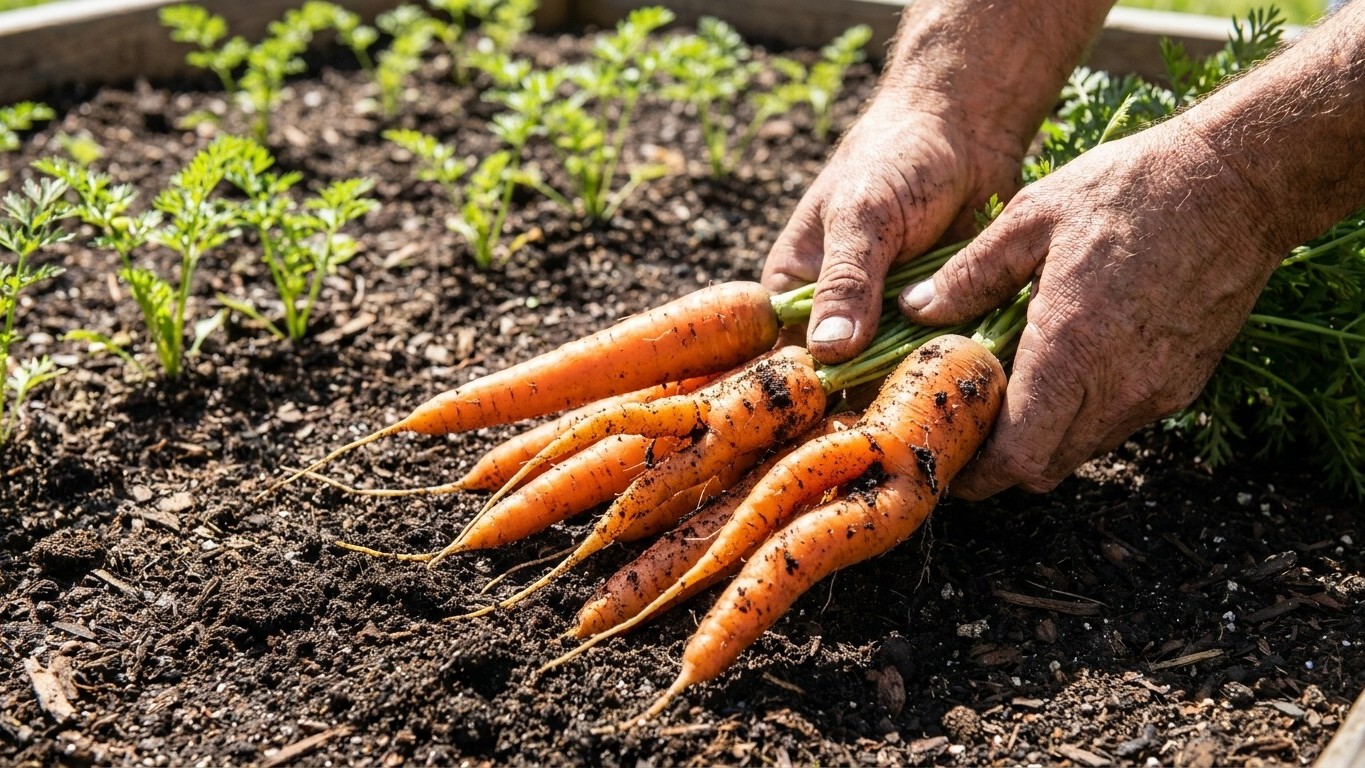

Carrots go into the ground as seed, never as transplants, about two to three weeks before your last spring frost date because the seed germinates fine in cool soil. But frost date is only half the equation. Michigan’s ground, on average, runs sandy and strongly acid according to USDA soil survey records, and that changes how deep you can sow, how fast the bed dries out, and whether a straight root is even possible without amending first.
The short answer
Michigan’s official state soil is the Kalkaska series, a sandy Spodosol that USDA soil scientists named to represent the state’s ground back in 1990. The representative numbers for its surface layer run 86 percent sand, 5 percent clay, and 9 percent silt, with a surface pH around 4.7, which is strongly acid, and a soil classified as somewhat excessively drained. Organic matter at the surface averages about 75 percent, which sounds generous until you realize that figure describes a natural layer of forest litter and duff under conifers, not a tilled garden bed. A cultivated vegetable plot will never carry organic matter anywhere close to that number; it’s a marker of undisturbed woodland soil, not something to expect from your raised bed or your tilled row.
What does that mean for carrots? Utah State University Extension is blunt about what the crop wants: deep, sandy, well-drained soil rich in organic matter. Heavy or rocky ground makes the root fork, and the fix for heavy soil is generous compost worked in with double digging, or building a raised bed instead of fighting the native ground. On texture alone, Kalkaska-type soil is actually closer to what carrots want than a clay-heavy state would be. Sand doesn’t compact around a growing root the way clay does, and forking from sheer density is less likely here.
The catch is drainage speed and reserve moisture. “Somewhat excessively drained” means water moves through fast, and with almost no clay to hold onto nutrients or water between rains, a bed starting from ground like this needs real organic matter dug in, not the leftover forest litter the survey figure describes, but finished compost added by hand. Skip that step and you’re not fighting forked roots so much as a bed that dries out before the seedlings can establish.
None of this is a verdict on your yard specifically. Michigan spans hundreds of mapped soil series, and Kalkaska is a statewide representative figure, not a diagnosis of any one garden. River bottoms run heavier and richer, hill country varies block by block, and any lot where a builder scraped topsoil and brought in fill dirt can differ completely from the county soil map. Treat the state soil as a starting assumption about what the region’s ground tends to do, then confirm it where you actually garden.
The test that settles it in your own garden
A soil survey tells you what’s typical for the county. It doesn’t tell you what’s under your tomato bed. The only way to know that is to go dig, and it takes less time than a trip to the garden center.
- Dig a hole about a foot deep in the bed you plan to sow. Carrots need depth to grow straight, so note where the loose, workable soil ends and where you hit dense clay, buried rock, or a compacted hardpan layer left by past construction or heavy equipment.
- Look at what comes out of the hole. Pull out any stones, chunks of buried debris, or old root mats. Anything solid in the root zone is a future forked carrot; if you’re finding rocks every few inches, that bed needs clearing or a raised frame instead.
- Feel the texture with your hands. Grab a handful of moist soil and squeeze it into a ball. Sandy soil falls apart and won’t hold a shape. Clay stays balled up and feels slick or sticky when smeared between your fingers. Loam sits in between, holding together loosely but crumbling with a light poke.
- Watch how water moves through it. Dig a small test hole, fill it with water, and let it drain, then fill it again and watch what happens the second time. Water that vanishes almost immediately points to sandy, fast-draining ground that will need more organic matter to hold moisture for germinating seed. Water that sits for a long stretch points to compacted or clay-heavy soil that needs loosening, raised beds, or both.
- Repeat the dig in more than one spot. Soil can change from one end of a yard to the other, especially near foundations, old driveways, or wherever fill dirt was brought in.
Do this before you buy seed, not after the first disappointing harvest. It costs nothing but a shovel and twenty minutes, and it tells you more than any map ever will.
What goes wrong here
- Forking in heavy or rocky ground. Any patch of clay, buried stone, or compacted fill splits a growing root into two or three legs instead of one straight carrot. Utah State University Extension’s fix is direct: work in plenty of compost and double dig the bed, or skip the native soil argument entirely and build a raised bed filled with a loose, sandy mix.
- Poor germination during a hot, dry stretch. Carrot seed sits shallow, close to the surface, and sandy ground that’s somewhat excessively drained (the exact description of Michigan’s representative soil) dries out fast once the weather turns warm. Seed that dries before it sprouts simply won’t come up. Keep the seed bed consistently damp through germination with light, frequent watering, and a thin layer of mulch helps slow moisture loss between waterings.
- Splitting from uneven watering later in the season. A carrot that grows through a dry spell and then gets hit with a heavy soaking (or a big rain after weeks of neglect) can crack or split along its length as it swells too fast. The remedy is a steady watering rhythm from germination through harvest rather than a feast-or-famine schedule, especially in fast-draining sandy ground that doesn’t hold a reserve on its own.
Common questions
Is Michigan’s sandy soil actually good for carrots, or a problem?
The texture itself, being sandy rather than heavy clay, works in a carrot’s favor since roots push through loose ground more easily and fork less from density alone. The tradeoff is that sandy, somewhat excessively drained ground dries out fast, so it needs organic matter added to hold moisture, not to loosen structure.
Do I need to test my own bed even if the county map says sandy soil like Kalkaska?
Yes. The Kalkaska series is a statewide representative figure covering hundreds of components across the state, not a measurement of any single yard. Fill dirt, old construction sites, and river-bottom ground can all sit completely outside that pattern within the same county.
What if my dig test turns up heavy clay instead of sand?
Follow the same guidance Utah State University Extension gives for any heavy or rocky soil: work in generous compost and double dig the bed before sowing, or build a raised bed filled with a looser mix if the native ground is too dense to correct easily.
Can I fix acidic soil for carrots?
The surface pH figure recorded for Kalkaska, around 4.7, describes that specific mapped soil series, not necessarily your garden’s pH. A home soil test is the only way to know your bed’s actual pH before deciding whether any adjustment is worth making.