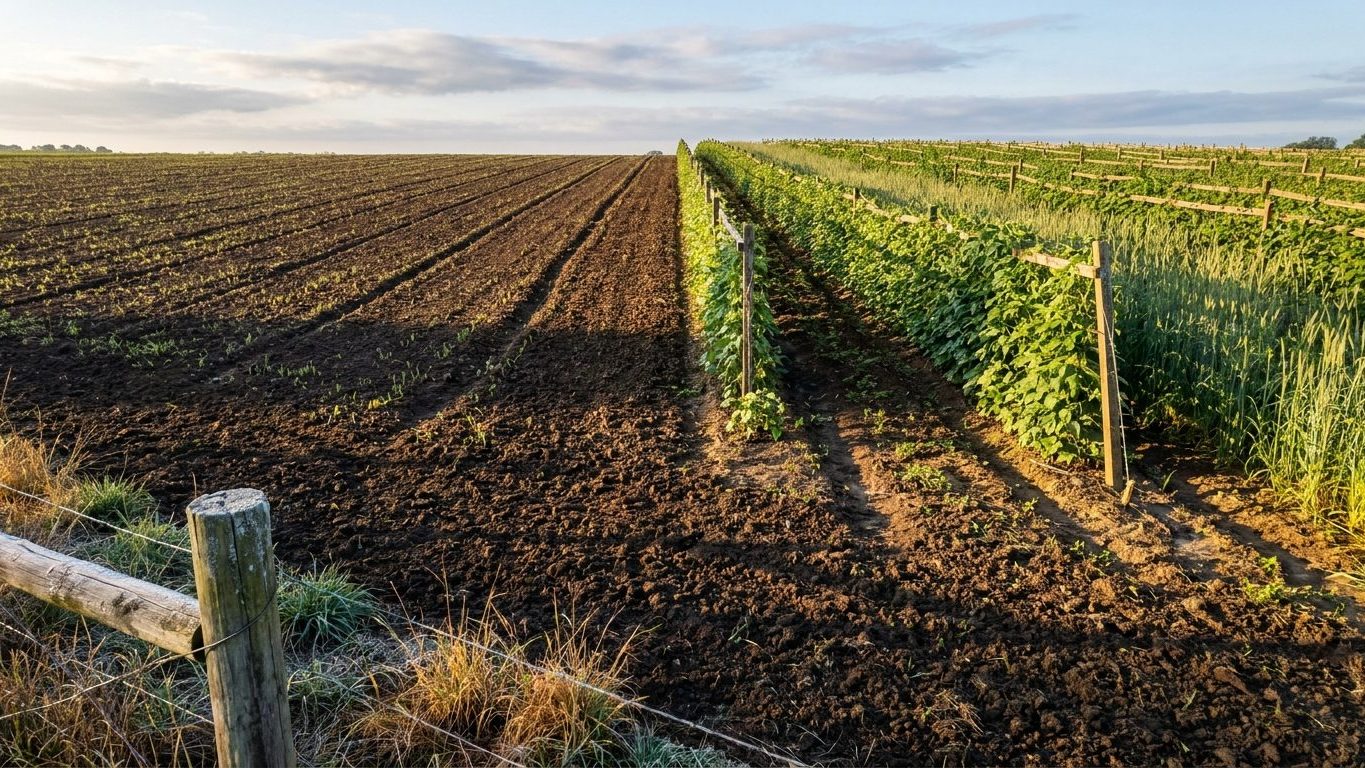

Most Michigan cover crops go in between late summer and the first fall frost. A second, smaller window opens in spring once the last frost has passed. Those two anchors shift by a couple of weeks depending on where you garden, so treat any single date below as a starting point, not a deadline.
The short answer for Michigan
Sow cover crops in Michigan from late summer up to the first fall frost, which falls between October 6 and October 21 in zone 6a. In spring, sow after the last frost: around April 30 in the Detroit area, and early to mid May across most of the Lower Peninsula. Hardy species such as winter rye can go in right up against the fall deadline, while frost-tender ones such as buckwheat have to wait until frost is behind you.
| Marker | Date | Where it applies |
|---|---|---|
| Last spring frost | Around April 30 | Detroit area |
| Last spring frost | Early to mid May | Most of the Lower Peninsula |
| First fall frost | October 6 to October 21 | Zone 6a |
Those dates come from MSU Extension, and each one is a probability of frost, not a promise. They come from past weather records and mark the point where a freezing night becomes unlikely in spring, or likely in fall. A freeze can still arrive before the fall date or after the spring one. The 15-day spread in the fall range is itself a reminder of how loose the target is.
The mechanism behind the fall window is simple. A seed needs warm enough soil to germinate, then enough time to put down roots and some leaf before growth stops. Every week you sow ahead of the first frost buys that growth. Plan around the early end of the range, October 6, because the later date is the best case, not the typical one.
Winter is the second filter. In the Detroit reference record (NOAA, 1991-2020), the mean daily minimum of the coldest month is 19.2°F. That is an average night low, not the record low, so a real cold snap goes well below it. A plant that must live through a Michigan winter needs to be chosen with that in mind. The Best Cover Crops for Michigan sorts species by what survives, and Cover Crops for Michigan Gardens covers the wider case for growing them at all.
What will not work here
Sowing frost-tender cover crops on the first warm afternoon of April. The Detroit-area last frost is around April 30, and across most of the Lower Peninsula it runs into early to mid May. A string of 65-degree days in mid-April is exactly when gardeners get caught, and a seedling of buckwheat or another tender type does not survive a hard freeze. Wait for the frost date, then add a few days if the forecast looks unsettled.
Planting slow-establishing covers after a late harvest. If tomatoes, peppers or corn stay in the bed until the first week of October, you have already spent much of the window that runs from October 6 to October 21. Anything that needs weeks of warm weather to get going, such as most clovers and vetches, will be a thin, struggling stand by the time the ground freezes. Winter rye is the usual exception, because it germinates in cool soil and keeps growing in cold weather. Late sowing still produces less top growth than early sowing, though.
Counting on oats to overwinter. Oats are a popular fall choice precisely because they usually die over a Michigan winter and leave a mulch that is easy to plant into. With a coldest-month mean low of 19.2°F in Detroit, that winterkill is the expected outcome in most of the state. That is useful if you want it and a letdown if you were hoping for a living cover in March.
Trusting marginally hardy species. Crimson clover is the common example, and it tends to winterkill in much of Michigan. It may come through a mild winter in the south, but one hard January wipes the stand out. The zone range for the state runs from 4a to 6b, so a type that survives in one corner can fail in another.
Treating the frost dates as a fixed calendar. They are odds, and they describe the Detroit area and the zone 6a range. This page does not carry frost dates for the Upper Peninsula or the northern Lower Peninsula, so it will not guess at them. A bed that sits in a low spot where cold air pools can freeze earlier in fall and later in spring than the date suggests. Sowing to the day on the calendar, without looking at the ground, is the most reliable way to waste a bag of seed.
What changes across Michigan
Michigan is not one garden. The USDA Plant Hardiness Zone Map (2023 edition, based on 1991-2020 normals) places the state anywhere from zone 4a to zone 6b. That is built on a single variable, the average annual extreme minimum temperature, and it is a spread of several zones. There is no single answer for the whole state, and the dates in this article are a Detroit-area and zone 6a picture.
Gardeners in the northern Lower Peninsula and the Upper Peninsula should shift in one direction. The first fall frost comes earlier there, so the fall sowing window closes sooner and the safe moment to sow is earlier in the season. In spring, the last frost comes later, so frost-tender covers go in later. The page does not have the exact dates for those areas, so use them as a direction, not a number. The same logic runs in reverse along the southern edge of the state, where the season is longer and the fall window stays open a bit later.
Cold tolerance matters more as you go north. A species that comfortably handles the Detroit reference winter can fail in a zone 4a winter. Rye is the safest bet at the cold end. Anything that sits at the edge of its range farther south is a gamble farther north.
Which zone you are in is not something this page can tell you. Look up your own location on the USDA Plant Hardiness Zone Map and use that as your starting point. Then adjust for the local factors the map does not capture: elevation, a slope, a lakeshore, a sheltered yard.
Where to check this for your own county
Your state extension service is the next stop. MSU Extension is Michigan’s land-grant extension service, with staff in the counties, and it publishes the frost-free dates this page draws on. Look there for two things: the planting calendar for your county, and the cover crop varieties that have been trialled in your county, not just in the state as a whole.
The difference matters. Michigan runs from the Detroit area to the Upper Peninsula, and a calendar that is right for one is wrong for the other. A county recommendation beats a state one, because it rests on local soils, local frost records and local trial results. This page is the state one. It tells you the shape of the season; your county office can tell you where in that shape you actually sit.
When you look, check the species as well as the dates. Extension guidance is usually written crop by crop, so find the entry for the cover crop you plan to grow and use that timing, not the timing for a different one. If your county has variety trial data, note which stands came through the winter and which did not. That information is worth more than any general date range.
Checking this against your own garden
Your own observations outrank every date on this page. A calendar describes averages across a region, and your garden is one specific patch of ground. Three things are worth watching, and none of them needs equipment.
- Soil warmth, by feel. Push a bare hand a few inches into the bed in spring. If it feels cold and clammy, germination will be slow no matter what the calendar says. Beds that warm early are usually well-drained or sun-facing. A bed that stays cold is telling you to push spring sowing later.
- The first male flowers. Squash and cucumber plants produce a flush of male blooms before the female ones. When they show up, the garden has warmed enough for tender crops. Comparing the date across years tells you whether your site runs ahead of or behind the regional picture.
- The first true leaves. Seedlings put out a pair of seed leaves, then the first true leaves. Note how long that takes after a fall sowing. A slow stand heading into October tells you the window was tighter than you thought.
Keep a few notes from year to year. After two or three seasons, your own dates will be more useful than the state ones.
The Moon calendar is a separate, older custom: see when to plant cover crops by the moon, written as tradition rather than fact.
Common questions
Can I still sow cover crops after the first fall frost in Michigan?
This page does not give a firm cutoff. The first fall frost falls between October 6 and October 21 in zone 6a, and germination and growth slow sharply after it. Winter rye is the species most often used for late sowing. Check with your county extension office for the latest date they recommend locally.
Is April 30 safe for spring sowing?
Only in the Detroit area, where the last spring frost is around April 30, and even there it is an average, not a guarantee. Across most of the Lower Peninsula the last frost comes in early to mid May. Frost-hardy covers can go in earlier, but tender ones should wait.
Which species should I choose?
That depends on whether you want a cover that survives winter or one that dies back. The Best Cover Crops for Michigan goes through the options by type.
Do these dates apply in the Upper Peninsula?
No. The frost dates here describe the Detroit area and zone 6a, and this page does not have dates for the Upper Peninsula. The state spans zones 4a to 6b, so a northern gardener should expect an earlier fall frost and a later spring one, then confirm the actual dates locally.