
Cover crops in Michigan go in the ground once the soil has dried and warmed past the last frost risk, typically late April to mid-May depending on where you garden, and come out mechanically before the ground freezes solid, usually in October. The species you pick depends on how much of that window you actually have, and how cold your winters run.
When the soil is warm enough in Michigan
The question every Michigan gardener asks first is simple: what date? MSU Extension puts the last spring frost around April 30 in the Detroit area, sliding to early or mid-May across most of the rest of the Lower Peninsula. That’s the number to write on the calendar, but it’s not quite the number that matters for cover crops.
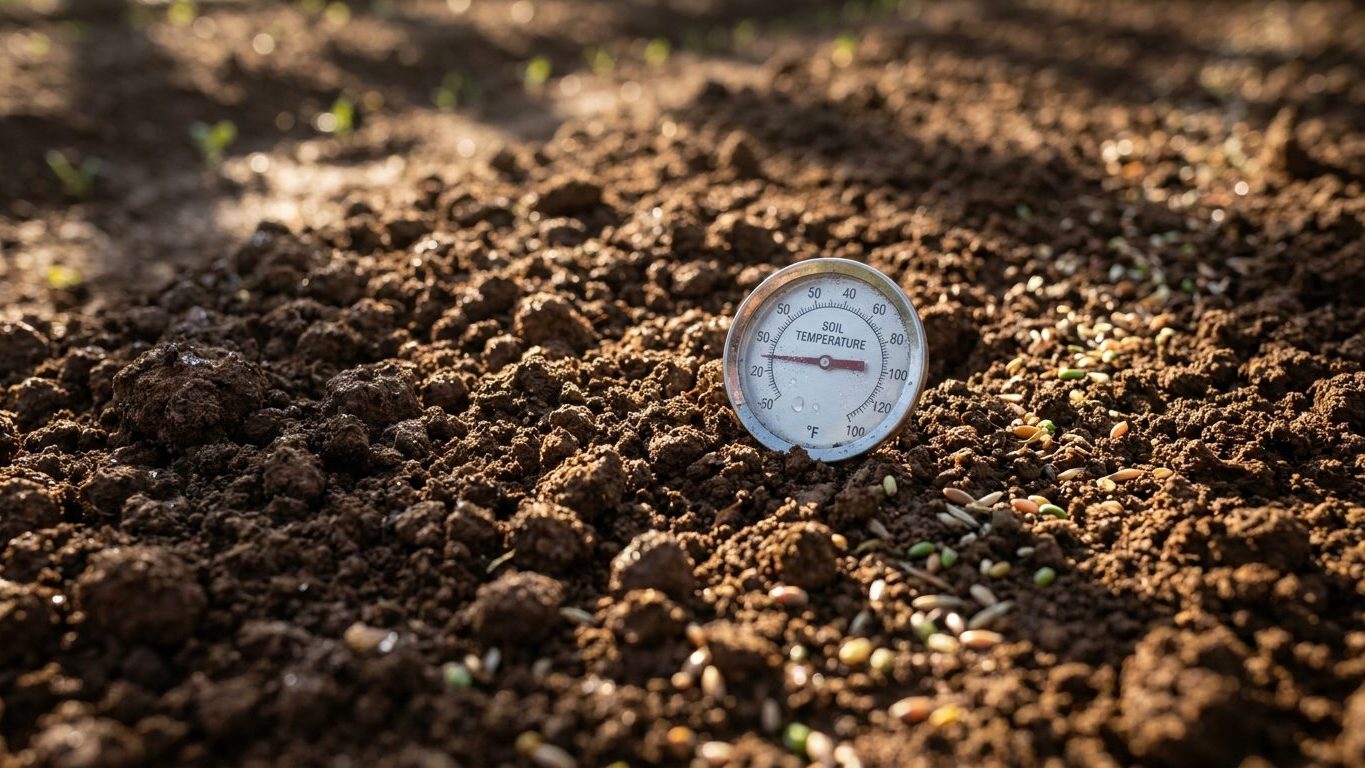
Frost date is a proxy, not the real trigger. Cover crop seed doesn’t care what the air did last night. It cares whether the soil itself has warmed enough to germinate, and soil lags behind air temperature by days, sometimes by a couple of weeks, depending on how wet and how shaded that patch of ground has been all spring. A frost-free date tells you the danger to tender growth has mostly passed. It doesn’t tell you the dirt is ready to work. Wait until a handful of soil crumbles instead of clumping, and you’re closer to the real starting line than any date on a chart.
One more thing worth saying plainly: a frost date is a probability, built from decades of averages, not a guarantee stamped on this particular spring. Some years the last frost near Detroit comes well before April 30. Some years it doesn’t.
Cool-season versus warm-season species
Once the soil’s ready, the choice splits along temperature lines. Cool-season grasses and small grains germinate readily in the 50s Fahrenheit and tolerate a light frost afterward, which makes them forgiving of an early gamble. Legumes sown for their nitrogen contribution generally want slightly warmer soil to nodulate well. Broadleaf cover species bred for quick ground cover split the difference, but all of them share one trait that matters more than the calendar date: they need soil moisture at germination, and an April sowing into dry, crusted ground will sit and do nothing no matter how warm the air gets.
How much seed to put down isn’t a fixed number you can carry from one garden to the next. It shifts with the species, whether you’re broadcasting or drilling, how fine your seedbed is, and how thick a stand you actually want. That’s a conversation for MSU Extension, not a blanket figure printed on a website that’s never seen your soil. When it’s time to take the cover crop out, mowing, crimping, or simply letting a hard frost finish the job does the work without reaching for a chemical termination.
How long the season lasts here
Stretch a line from the earliest likely last spring frost to the earliest possible first fall frost and you get the shortest realistic version of Michigan’s frost-free window. Near Detroit, that’s roughly April 30 to October 6, the early end of MSU Extension’s zone 6a fall frost range of October 6 to October 21. Do that math and you land close to 160 days, call it a little over five months. In the cooler parts of the Lower Peninsula, where spring frost risk hangs on into early or mid-May, the window compresses slightly on one end but the later fall frost date, up to October 21, buys some of it back.
That length matters more than it looks like on paper. A five-month window is long enough to sow a cover crop after an early vegetable harvest, let it grow through summer, terminate it, and still slide in a fall planting before the ground shuts down for winter. It’s also long enough that gardeners further south in the state, closer to that October 21 date, can push a second cover crop sowing where a shorter-season gardener only gets one shot.
One shot changes the decision-making. If you’re only sowing once, the timing of that single planting has to account for both the crop you’re covering for and the frost that will eventually kill or terminate it, which means checking root development before you assume a fall-sown cover crop has established enough to survive winter, rather than trusting it purely on days-since-planting. Gardeners working a tighter window, whichever end of the state they’re on, do better transplanting the crop that follows the cover rather than direct-seeding it, since transplants buy back weeks the calendar didn’t give them.
Anyone stacking two or more cover crop or vegetable rounds into a single Michigan season should work from the site’s guide to succession sowing rather than guessing at overlap, since the margin for error shrinks the closer you get to either frost date.
Heat and water in Michigan
This page doesn’t have a station-level count of days above 90°F or a summer rainfall total for Michigan, and rather than guess at numbers that vary widely across a state bordered by four Great Lakes, it’s more useful to point at what actually decides a cover crop’s fate here: winter, not summer.
Two figures do that work. The first fall frost, arriving anywhere from October 6 to October 21 depending on where you are in zone 6a, sets the hard deadline for the last useful sowing date of the year. Sow later than that and a cover crop simply won’t establish enough growth before the cold shuts it down. The second figure, the mean daily minimum of the coldest month at 19.2°F, recorded by NOAA at the Detroit reference station, is the number that separates cover crops that overwinter as living plants from those that collapse into a frost-killed mulch on their own.
That distinction is the whole game in a territory like Michigan, sitting across USDA hardiness zones 4a to 6b. A species that shrugs off a mean minimum in the high teens will still be green and growing in April, requiring you to terminate it yourself by mowing or crimping before it goes to seed. A species that can’t handle that cold dies back on its own sometime in winter, leaving a dead mulch on the surface that never needed your intervention at all. Neither outcome is better across the board, it depends on whether you want a spring job or a hands-off finish.
Because that 19.2°F figure comes from Detroit specifically, and the hardiness range spans two full zones across the state, a gardener up in the colder 4a pockets should expect species that reliably winter-kill near Detroit to survive there instead, adding an unplanned spring task. Where summers do run cool and damp, and the Great Lakes’ moderating influence keeps Michigan from the punishing heat spells drier inland states see, the more common headache isn’t drought stress but mildew and slow ripening on crops that like it hot and dry, a pattern worth watching for rather than the reverse.
Which cover crops suit Michigan
Reasoned from what this territory actually offers, three type categories fit differently.
A cool-season grass or small grain type that germinates fast and tolerates a light frost fits the state’s shoulder seasons well, since it can go in as soon as the soil is workable in spring and again after a fall harvest without much daylight left to spare. A legume type, chosen for its nitrogen contribution through root nodulation, works best sown early enough that it builds real biomass before termination, since the amount of nitrogen it eventually releases depends on how much plant material it produced and when you cut it down, not on a number you can look up in advance. A broadleaf type valued for rapid ground cover and weed suppression earns its place in that five-month window by filling gaps between other plantings faster than either of the other two.
Given the mildew and slow-ripening risk that shows up in cooler, damper stretches of the state, disease resistance within whichever type you choose matters more here than it would in a drier climate, and that’s exactly the kind of detail a statewide website can’t responsibly hand you.
- Cool-season grasses and small grains: fast germination, frost-tolerant, good for both spring and fall windows
- Legumes: nitrogen contribution tied to biomass and termination timing, not a fixed figure
- Broadleaf ground-cover types: fastest canopy closure, useful for short gaps between plantings
What this page won’t do is name a specific cultivar, and that refusal is itself the honest answer. Variety trials run by MSU Extension test named cultivars against Michigan’s actual winters and actual disease pressure, county by county, in a way a general silo page never can. The same office is the right place to ask about seeding rates too, since the correct rate shifts with species, seeding method, and seed source, and a number pulled from an unrelated climate makes the planting worse, not better. When it comes time to end the season, mowing, crimping, or simply letting the coldest month finish the job stays the reliable, chemical-free way to close it out.