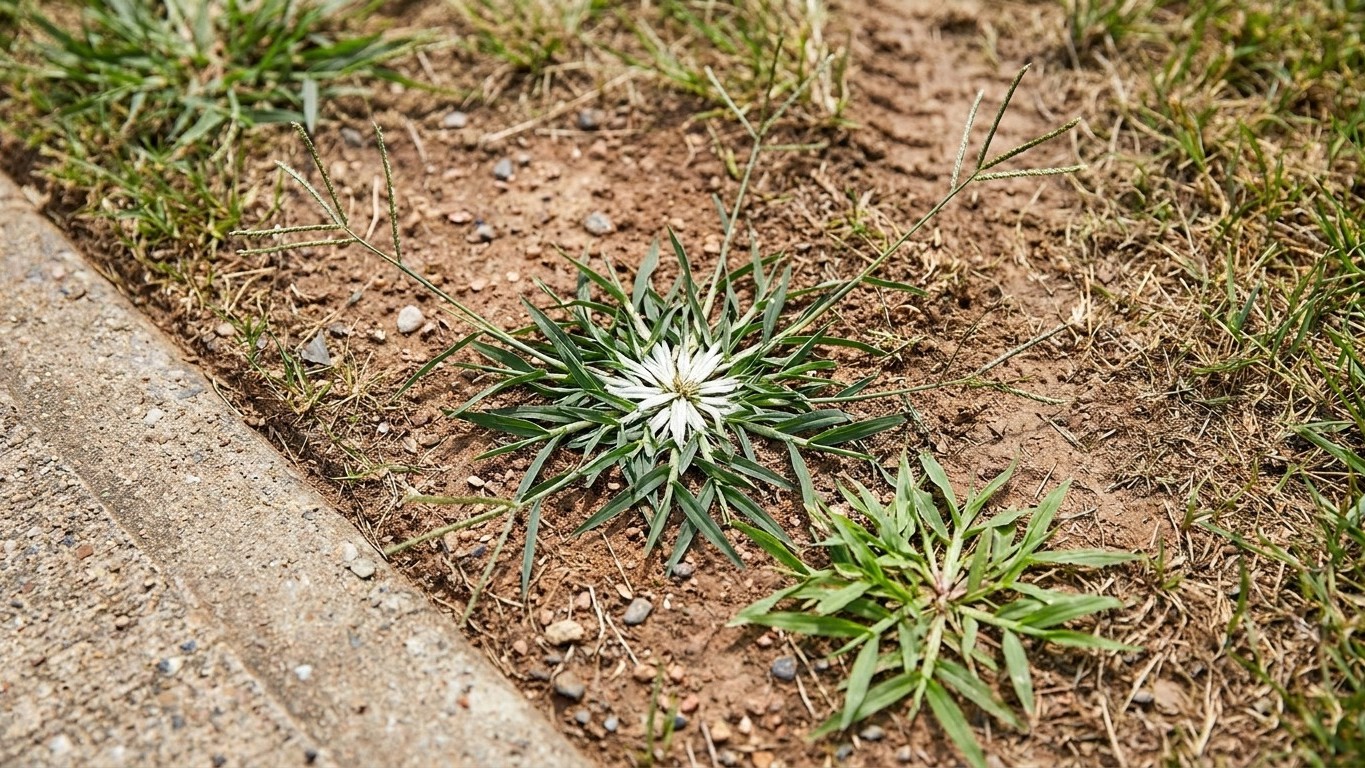

Most Michigan lawns never need dethatching. If a spade-cut wedge shows more than 0.75 inch of brown, spongy thatch, the best window is late summer into early fall, with seed down well ahead of the first frost. Spring is the fallback, once the frost danger has passed. Measure first, because power raking a healthy lawn tears out grass that was doing fine.
Do you need to dethatch at all?
Thatch is the layer of dead and living stems, roots and crowns that piles up between the green blades and the soil surface. A thin layer is useful. It cushions foot traffic and insulates the crowns. Under 0.5 inch counts as healthy, and the lawn needs nothing from you. Trouble starts above 0.75 inch, when the layer turns spongy enough to hold water at the surface, shed fertilizer, and keep new roots from reaching mineral soil.
How to measure it
Cut a small wedge with a spade or a sharp knife, lift it out, and look at the side profile. You want the brown, springy band sitting between the green growth above and the dark soil below. Hold a ruler against it. Check three or four spots, because thatch is rarely even. Shady corners, slopes and areas that got heavy fertilizer often run thicker than the middle of the yard. Treat each zone separately, and dethatch only the sections that cross 0.75 inch.
Why most lawns pass
Clippings left on the lawn are not the culprit, despite the old myth. They break down quickly. The real builders are stems and roots that decompose slowly, and the usual causes are heavy nitrogen feeding, constant shallow watering, and soil that is low on the earthworms and microbes that break the layer down. Kentucky bluegrass, which spreads by underground stems, builds thatch more readily than a bunch-forming grass like tall fescue. If your lawn is mostly fescue or ryegrass, you are less likely to hit the threshold at all.
If your wedge shows less than 0.75 inch, skip the machine. Topdress with compost, aerate when the soil is compacted, and ease off the fertilizer. If you are comparing how other states handle the same question, the Dethatching a Lawn guide covers the basics, and the regional pages show how timing shifts with climate, such as When to Dethatch a Lawn in Massachusetts.
The season to do it in Michigan
Michigan lawns are cool-season lawns. The recommended species are fine fescues, Kentucky bluegrass, perennial ryegrass, rough bluegrass and tall fescue. They grow hardest in the cooler weather of spring and fall, which is exactly when a stressed, torn-up lawn can recover. That biology sets the calendar: dethatch when the grass is actively growing and not fighting heat.
A warm-season grass will not hold here, and the reason is the winter. Those species go dormant when temperatures drop and depend on a long, hot summer to build the reserves to survive the cold months. A Michigan winter outlasts what they can tolerate, so they thin out or die. That is why a Utah or southern-style dethatching schedule, built around early summer, does not transfer. The When to Dethatch a Lawn in Utah page shows how a different climate changes the answer.
Early fall is the first choice
The MSU Extension Michigan Garden Calendar puts the first fall frost between October 6 and October 21 for zone 6a. Treat that as the deadline you work back from, not the target. Dethatching strips the lawn open and leaves bare soil, and you want seed in the ground early enough to germinate, fill in and harden off before that window. Late summer into early September gives seedlings the most growing time, and fall weeds are slowing down by then while the soil is still warm from summer.
The frost range applies to zone 6a. Northern Michigan and the Upper Peninsula run colder and see frost sooner. Check with your local MSU Extension office, which you can find through MSU Extension, rather than borrowing a southern Lower Peninsula date for a lawn near Marquette or Traverse City.
If it is already October
Today is October 10, which sits inside that frost range. A lawn with measured thatch above 0.75 inch can still be handled, but any dethatching that leaves bare patches is risky now, because seed laid this late may not establish before winter. If thatch is only a little over the line, wait. Spring is the second window, after the last frost. MSU Extension lists that as around April 30 in the Detroit area and early to mid May across most of the Lower Peninsula. A spring job competes with crabgrass for the open soil, so plan to seed quickly and hold off on pre-emergent herbicide, which would block your grass seed too.
Rake, power rake, or core aeration
Three tools handle thatch, and they fit different thicknesses. Picking the right one matters as much as picking the right month.
| Method | Best for | Effort and risk |
|---|---|---|
| Dethatching rake | Small lawns with thatch just over 0.75 inch | Hard work, but gentle on grass and soil |
| Power rake (vertical mower) | Larger lawns with a clearly thick, spongy layer | Fast, but can scar the turf and leaves heavy debris to clear |
| Core aeration | Thatch near the threshold, plus compacted soil | Least damage, and it feeds the microbes that break thatch down |
A dethatching rake is a short job on a small yard. The tines are curved and sharp, and you pull them through the grass in overlapping passes so they lift the dead layer without digging deep. Expect a surprising pile. Cover a small area at a time and rake the debris off before the next section so you do not smother live grass.
A power rake does the same thing with spinning blades, and many rental shops carry one. It earns its fee on larger lawns with a thick layer, but it can slice into healthy turf if set too deep, so start shallow and make a test pass. Run it across the lawn in one direction, then cross it at a right angle only if the first pass left plenty behind. Wet soil makes a mess and torn sod, so work when the ground is moist but not soggy.
Core aeration is the option I would try first on a lawn that sits just past the line. It pulls small plugs out of the soil, opens the thatch to air and water, and lets soil microbes get at the dead material. Aeration does not remove thatch the way a rake does, but at moderate levels it can slow the buildup and fix the compaction that often goes with it. It also prepares a ready-made seedbed, since seed that falls into the holes makes good soil contact.
What the lawn needs afterwards
The weeks after dethatching decide whether the lawn thickens or goes patchy. Thinned grass leaves gaps, and gaps fill with whatever seed is closest, usually weeds. Overseed right away, while the soil is still open.
Seed rates are quoted per 1,000 square feet for a new lawn. Overseeding an existing lawn uses half those amounts. More seed is not insurance, because seedlings crowd each other, compete for water and thin out on their own, leaving weak, disease-prone turf.
| Grass | New lawn (per 1,000 sq ft) |
|---|---|
| Tall Fescue | 6 to 8 lb |
| Fine Fescues | 4 to 6 lb |
| Rough Bluegrass | 2 to 3 lb |
| Kentucky Bluegrass | 1 to 3 lb |
| Perennial Ryegrass | 4 to 10 lb |
For overseeding, halve the figures. Tall fescue, for example, goes down at 3 to 4 lb per 1,000 square feet. Those ranges come from several university extension programs, and where the sources differed, the range covers them. Match the species to what you already have, or to the conditions: fine fescues for shade, Kentucky bluegrass for sunny, high-traffic yards.
After seeding, keep the surface evenly damp. Short, frequent watering beats one soaking while the seed is germinating, and then you taper off to deeper, less frequent watering as roots establish. Hold the fertilizer until seedlings are growing, and go easy on nitrogen, since a heavy feeding is how a lot of thatch got built. Mow once the new grass has grown to your usual mowing height, with a sharp blade, and do not scalp it.
Common questions
Can I dethatch a Michigan lawn in summer?
It is a poor time. Summer heat stresses cool-season grass, and a dethatched lawn cannot cope with open soil, drying wind and no recovery growth. Wait for early fall, when the grass is growing again and nights are cooler.
How do I know if my thatch is too thick?
Cut a spade wedge and measure the brown, spongy layer between the green growth and the soil. Under 0.5 inch is healthy. Above 0.75 inch is the point to act. Between the two, you can usually leave it and focus on aeration and lighter feeding.
Is spring or fall better for Michigan?
Fall is better. The soil is warm, weed pressure is dropping, and seed has time to establish before winter. Spring works as a backup, after the last frost. Just plan for crabgrass competition.
Do I need to overseed after dethatching?
Usually yes, if the process left thin or bare areas. Use half the new-lawn seed rate for your species. If the grass is still dense, a light overseeding is enough.