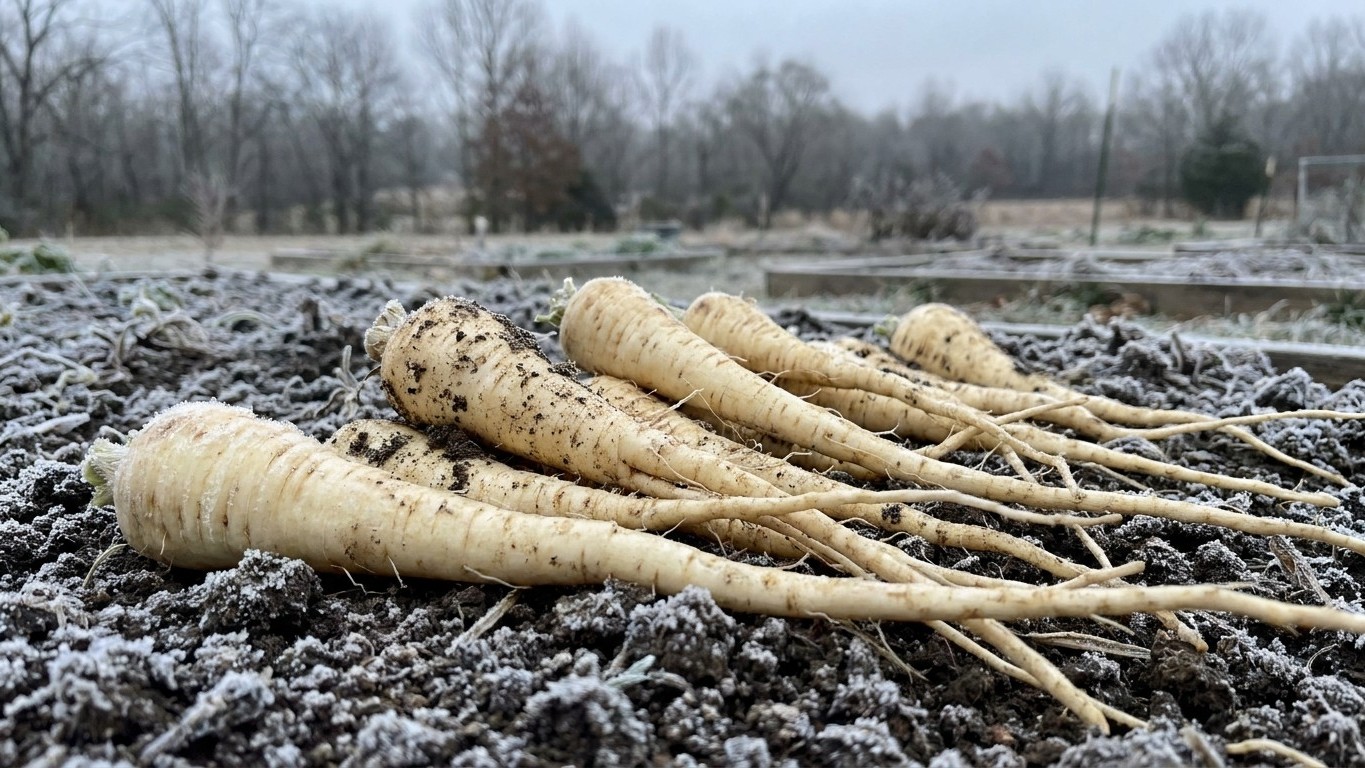

Yes. Massachusetts gives parsnips exactly what they need to turn sweet: a run of genuinely cold weeks after the roots mature, not just a mild dip below freezing. The coldest month here averages a daily minimum of 23.1°F, cold enough and long enough to convert the stored starch in a parsnip root into sugar. Sow in spring, leave the roots in the ground through fall, and the frost does the rest.
The short answer
The question that decides everything for a parsnip grower isn’t “what zone am I in.” It’s “does my winter deliver several weeks of hard, reliable cold.” Hardiness zones tell you what a plant can survive. They say nothing about whether a root vegetable sitting in the ground will actually sweeten. Those are two different questions, and conflating them is the most common mistake in parsnip advice.
Massachusetts answers the sweetening question with a clear yes. NOAA’s 1991-2020 Climate Normals, using the Boston reference station, put the average daily minimum temperature for the coldest month at 23.1°F. That’s not a record low or a fluke cold snap. It’s the typical low, night after night, across the coldest stretch of winter. A root left in that kind of ground doesn’t just brush against frost once and move on. It sits through repeated freezing cycles, and each one pushes the starch-to-sugar conversion further along.
The mechanism is straightforward. A parsnip root stores energy as starch while it’s growing through summer and early fall. Starch has no sweetness to speak of, which is why a parsnip pulled in August tastes bland and a little woody. Cold changes the chemistry. When soil temperatures drop into the 20s and stay there through repeated freeze-thaw cycles, the plant converts that starch into simple sugars as a kind of natural antifreeze, a response that lowers the freezing point of the cell fluid and keeps the root from rupturing. The by-product of that survival strategy is the flavor gardeners are after: nutty, faintly sweet, nothing like the flat taste of an unchilled root.
Massachusetts doesn’t deliver a token frost and call it done. Inland areas and the Berkshires run colder than the Boston-area reference numbers used here, which means the sweetening window is, if anything, even more assured away from the coast. The coastal fringe near Boston is the mildest pocket in the state, and even there the coldest-month average minimum sits well below freezing. There’s no realistic scenario in this state where a parsnip left in the ground through late fall fails to hit a proper frost.
None of that means every parsnip crop here turns out sweet automatically. Timing still matters. Pull the roots too early, before the season’s cold has had a chance to work, and you’ll get a fine parsnip that never got the chance to convert. The climate provides the cold. The gardener still has to leave the roots in place long enough to use it.
Does the season fit?
Parsnips are sown directly in the ground, never transplanted, and the clock starts at seeding, not at germination. Here’s how the Massachusetts calendar lines up against a crop that needs 100 to 120 days to mature.
- Sowing window. Utah State University Extension recommends sowing 2 to 3 weeks before the last spring frost. In Massachusetts, the last spring frost falls between April 1 and April 8, which puts the sowing window in mid-to-late March.
- Germination lag. Parsnip seed is slow. Expect 14 to 21 days before you see any seedlings at all. A gardener who sows in mid-March won’t see green until early April, and that’s normal, not a sign of failed seed.
- Maturity date. Counting 100 to 120 days forward from a mid-to-late March sowing lands maturity somewhere between late June and late July.
- The gap before frost. The first fall frost in Massachusetts arrives between November 3 and November 14. That leaves roughly three to four and a half months between a mature root and the first freezing night, a wide cushion with nothing forcing an early harvest.
- The sweetening stretch. Once the roots reach maturity, they can simply stay in the ground. There’s no need to rush a harvest before winter shuts the garden down, because the season here runs well past the point of maturity and straight into the frosty weeks the crop needs to sweeten.
Add it up and the fit is comfortable, not tight. A grower who sows on schedule has months of slack between “the root is mature” and “the ground freezes solid,” which is exactly the kind of buffer that lets a parsnip sit through repeated frosts without any risk of the season running out first.
What goes wrong here
- Forked roots from heavy or stony ground. Massachusetts soils vary widely, but a lot of yards sit on compacted clay or glacial till full of small stones. A taproot that hits a rock or a hardpan layer splits and grows around it, producing the twisted, multi-pronged roots that are hard to peel and unpleasant to cook with. The fix is physical, not chemical: double dig the bed at least 12 to 15 inches deep before sowing, and pull out stones as you go. Deep, loose, sandy soil is what Utah State University Extension points to as the target texture.
- Forked roots from overwatering. This is a separate cause from soil texture, and it gets confused with it constantly. A parsnip root that sits in consistently soggy ground, even loose soil, tends to branch rather than drive straight down. Water deeply but infrequently, and let the top few inches of soil dry between waterings once seedlings are established.
- A late sowing that runs the season too tight. Missing the mid-to-late March window and sowing in May pushes maturity into September or later, which shrinks the comfortable gap before frost. It won’t usually kill the crop in Massachusetts given how much slack the season has, but it removes the cushion and raises the odds of pulling roots before they’ve had enough cold exposure. Sow on schedule, in the 2-to-3-week window before the last frost date.
- Harvesting too early and never getting the sweetness. The climate here isn’t too mild to sweeten a parsnip, but a gardener can still undercut the process by pulling roots the moment they look big enough. Leave them through several hard frosts, ideally into November, before digging.
Before you harvest, know this: parsnip foliage and roots aren’t just another vegetable to handle bare-handed. According to NC State Extension’s Plant Toolbox, “All parts of this plant contain furocoumarins which can make skin sensitive to light causing burns so be sure to wear gloves, long sleeves and long pants when dealing with it.” That’s every part of the plant, not just the leafy tops.
The reason this catches people off guard is that the burn doesn’t come from the sap alone. It takes sap on the skin plus sunlight hitting that same patch of skin. Furocoumarins are photosensitizing compounds: they sit inert until ultraviolet light activates them, at which point they can damage skin cells and produce a burn that looks and feels like a bad sunburn, often blistering, in exactly the shape of wherever the sap touched. That’s why it shows up hours after a bright afternoon spent pulling tops or digging roots, and why the person affected often has no idea what caused it until they trace it back to the garden. Washing the area afterward doesn’t undo exposure that’s already happened in sunlight. The only real protection is preventing skin contact in the first place: gloves, long sleeves, and long pants whenever you’re handling parsnip foliage or roots on a sunny day.
Checking this against your own county
Everything above uses statewide frost data, and Massachusetts has real variation between the mild coastal strip and the colder Berkshires or inland valleys. If you garden away from the Boston area, your last spring frost may run later and your first fall frost earlier than the dates given here, which shifts your sowing window and your harvest date by a week or more in either direction.
For numbers specific to your county, including local frost dates and soil guidance, contact your local office of UMass Extension at ag.umass.edu. They maintain county-level advice built on the same NOAA climate data referenced here, adjusted for local conditions your yard actually experiences.
Common questions
Can I leave parsnips in the ground all winter in Massachusetts?
Many gardeners do, mulching heavily over the row once the ground starts to freeze, and dig roots through winter as needed. The frosty weeks that pass while the roots sit there are exactly what builds the sweetness.
What variety sweetens best in Massachusetts?
The sourced guidance here doesn’t name a specific variety, and no variety recommendation is given on this page. Sweetening comes from cold exposure after maturity, a factor tied to climate and timing rather than to any one named cultivar.
Why hasn’t my parsnip sweetened even though it’s frozen a few times?
A single light frost isn’t enough. The starch-to-sugar conversion needs repeated exposure to sustained cold, several weeks of it, not one overnight dip. Given Massachusetts’s coldest-month average minimum of 23.1°F, the cold is there. Give it more time in the ground before judging the flavor.
Do I need to wash parsnip sap off my skin right away to avoid a burn?
Washing after the fact doesn’t reverse damage that’s already occurred once sap and sunlight combine. The safeguard is preventing skin contact in the first place, gloves, long sleeves, and long pants, rather than treating exposure after it happens.