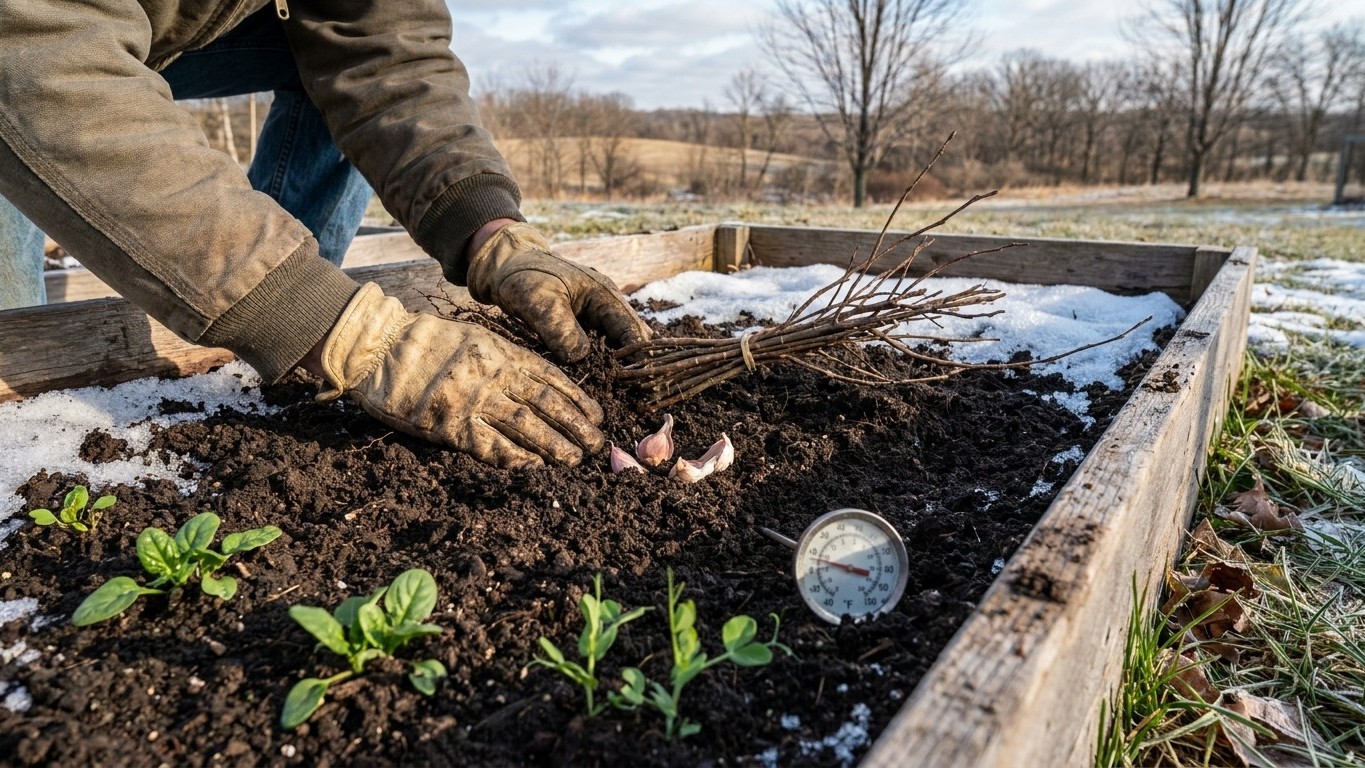

March in Michigan sits six to nine weeks before the last frost across most of the state, so open-ground planting stays largely off the table. The honest answer: garlic and shallots already in the ground keep growing untouched, bare-root trees and dormant plants go in once soil is workable, and hardy greens like spinach and peas can go into southern Michigan ground late in the month if conditions cooperate. Everything else waits under cover or indoors until the frost window closes in late April or May.
What goes in the ground in March

The calendar says March, but soil temperature and moisture decide what actually survives, not the date on the wall. MSU Extension puts the last spring frost around April 30 in the Detroit area, with early to mid May the norm across most of the Lower Peninsula. That means March opens six to nine weeks ahead of that closing bell, and Michigan’s soil at that point is frequently still frozen at depth, waterlogged from snowmelt, or sitting well below the roughly 40°F threshold most seeds need to germinate without rotting.
For that reason, direct-sowing into open ground in early or mid March is a losing bet almost everywhere in the state. USDA places Michigan across hardiness zones 4a to 6b (USDA Plant Hardiness Zone Map, 1991-2020 normals), and even in the milder 6a/6b pockets near the southern border and the Lake Michigan shoreline, soil that looks thawed on top can still be a frozen slab a few inches down.
What does work this month:
- Garlic and shallots planted in fall need no action now beyond checking that mulch hasn’t heaved with freeze-thaw cycles.
- Peas and spinach can go directly into the ground in the last week or two of March in southern Michigan, but only when the soil crumbles in your hand instead of clumping into mud.
- Bare-root fruit trees, raspberry canes and roses can be planted as soon as the ground is workable and not saturated, ideally before buds swell.
- Cold frames and low tunnels let you push lettuce, kale and spinach into the ground weeks before the open garden would tolerate them.
- Forced rhubarb or chicory from dormant crowns kept in a dark, cool space gives an early indoor harvest while the outdoor beds are still bare.
Skip anything warm-season. Beans, squash and corn seed dropped into March soil simply sits and rots long before the ground warms enough to sprout it.
What to start under cover
Indoor seed-starting in March works backward from the frost window, not forward from the first day of the month. Using the Detroit-area date of around April 30 as a reference, and early to mid May for much of the rest of the Lower Peninsula, count the weeks a crop needs before it goes outside, then subtract from that local frost date rather than from any fixed calendar day.
Tomatoes and peppers typically need six to eight weeks of indoor growth before they’re ready to transplant after the frost danger passes, which puts a March start right on schedule for most of the state. Onions and leeks started from seed want closer to ten to twelve weeks, so a March sowing still gets them to a workable transplant size by the time the ground and air cooperate, though it’s tighter than an ideal calendar would allow. Broccoli and cabbage fall in between, generally wanting six to eight weeks before they go into the garden as young, cold-tolerant transplants.
| Crop | Weeks needed indoors | Common failure mode |
|---|---|---|
| Tomatoes, peppers | 6 to 8 weeks before outdoor move | Started too early: leggy, rootbound stems |
| Onions, leeks | 10 to 12 weeks before outdoor move | Started too late: thin, undersized bulbs |
| Broccoli, cabbage | 6 to 8 weeks before outdoor move | Started too early: bolts once transplanted |
The two failure modes bookend each other. Start too early and you end up babysitting rootbound, leggy seedlings on a windowsill for weeks past their prime, stretching toward light and losing vigor before they ever touch soil. Start too late, particularly with onions and leeks, and you run out of runway, transplanting undersized starts that never catch up to a proper harvest size before fall.
What is ready to pick
Outdoors, March gives Michigan gardeners little to nothing fresh from open beds. Kale, leeks and parsnips left in the ground over winter, especially under a thick layer of mulch or snow cover, can still be dug once the soil around them softens enough to work a fork in without breaking tools. Brussels sprouts that weathered the winter on the stalk often taste sweeter after repeated freezes, a genuine upside to leaving them standing rather than a consolation prize.
Cold frames pull their weight here. Spinach, lettuce and mâche tucked under glass or plastic through the coldest months are usually the first real greens of the season, ready whenever leaves reach a usable size, no fixed date required.
Indoors, sprouts and microgreens fill the gap in a week or less from seed, giving fresh, crunchy volume to a kitchen that otherwise has nothing green to show for the season.
Storage crops need a walk-through now, not a wait-and-see. Check squash for soft spots or a wrinkled, deflating rind. Potatoes that have sprouted eyes or gone soft and dark should come out before they spread rot to the rest of the bin. Onions with a sour smell or mushy neck are past saving and should be pulled and composted rather than left to affect the crop around them.
The jobs that matter this month
March carries a full list of work that has nothing to do with putting seed in dirt, and every item on it has a real deadline attached.
Pruning, ordering and prepping
Dormant pruning of fruit trees, grapevines and berry canes should happen before buds break, while the plant’s energy is still stored in roots rather than pushing into new growth. Cut after buds swell and you remove the season’s fruiting wood along with the deadwood. Seed catalogs move fast in late winter and early spring, and popular varieties, especially heirloom tomatoes and specialty peppers, sell out before the ground even thaws, so ordering now beats scrambling in April with a picked-over list.
Soil, tools and structure
A soil test run now gives results back in time to amend before the main planting window opens, rather than guessing at fertility after the fact. Turning compost piles as they thaw speeds decomposition and gets finished material ready for spring beds. Tools left dull and rusty from fall storage cost real time and clean cuts once pruning and bed prep pick up, so a sharpening and oiling pass now pays for itself within the first few uses. Raised bed frames, trellises and fencing that took winter damage are far easier to repair while beds sit empty than once seedlings are in the ground and every misstep risks trampling a row.
Stored crops deserve one more pass beyond the initial check: a weekly walk through the root cellar or pantry catches the one soft potato or weeping onion before it takes down the rest of the bin.
What not to do in March
The most common mistake is trusting a warm afternoon over the soil itself. A 65°F day in March doesn’t mean the ground six inches down has caught up, and direct-sown beans, squash or corn seed dropped into soil that’s still in the 30s or low 40s simply sits and rots before it ever germinates.
Uncovering mulched perennials or cold frames too early after a mild stretch is the second classic error. Michigan’s freeze-thaw pattern this time of year means a warm week is routinely followed by a hard refreeze, and crowns or new growth exposed too soon can take real damage from a cold snap that the plant would have shrugged off if left protected.
Nitrogen fertilizer applied too early is the third trap. Feeding dormant or barely-waking plants before active root growth resumes either pushes soft, frost-vulnerable growth at the worst possible moment or simply washes away before roots are active enough to use it. Hold off until you see real new growth, then feed.
Finally, working wet soil because it’s finally accessible does long-term damage. Digging or tilling ground that’s still saturated compacts the structure and can take a full season to recover. If a handful of soil forms a muddy ball instead of crumbling apart, it’s not ready, no matter how tempting the open weekend looks.
Checking this against your own county
A state-wide answer for Michigan is a starting point, not an instruction for a specific backyard. USDA hardiness zones across the state range from 4a to 6b, and that spread alone means a gardener near the Ohio border is working with a frost calendar weeks ahead of someone in the northern Lower Peninsula or the Upper Peninsula. Elevation and Lake Michigan’s moderating effect shift local frost dates further still, sometimes delaying spring warm-up right along the shoreline even as inland spots a few miles away thaw sooner. Before acting on any date in this article, check it against MSU Extension’s outreach resources for county-level guidance.
Common questions
Can I plant grass seed in Michigan in March?
Cool-season lawn seed generally wants soil consistently above 50°F to germinate reliably, which most of Michigan doesn’t reach until later in spring. March seeding usually means the seed sits dormant waiting for warmth, with no advantage over waiting.
Is it too early to start tomato seeds indoors in March?
Not for most of the state. Tomatoes generally need six to eight weeks indoors before transplant, and with the last frost falling around April 30 near Detroit or early to mid May elsewhere, a March start lines up well with that window.
What vegetables tolerate frost in Michigan?
Spinach, peas, kale and other hardy greens can handle light frost once established, which is why they’re the exceptions worth direct-sowing late in March when soil is workable, while tender crops like tomatoes and beans cannot.
Should I remove mulch from garden beds in March?
Not all at once. Pulling mulch too early exposes crowns and new shoots to a hard refreeze after a mild spell. Pull it back gradually and only fully once new growth is clearly underway and the freeze-thaw pattern has settled.