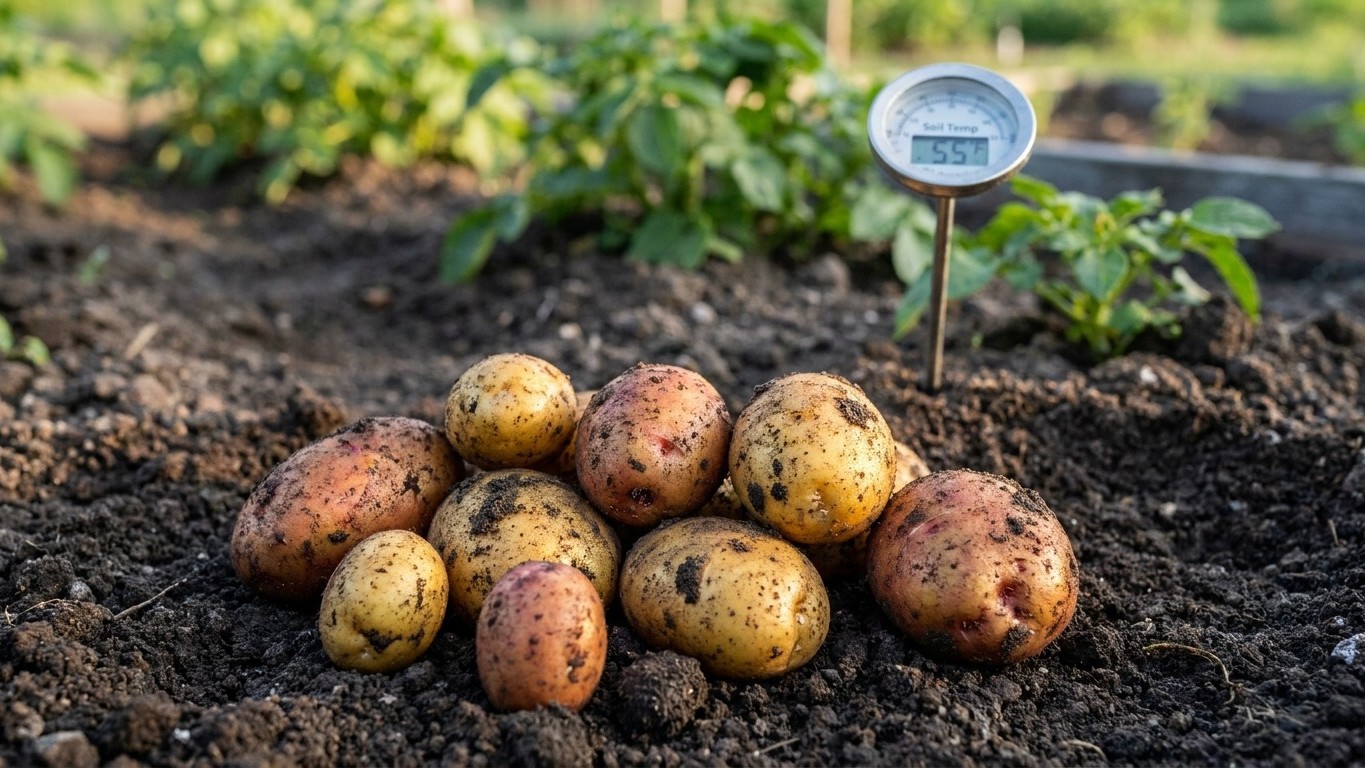

Early and mid-season potato varieties fit Michigan best, because the state’s soil crosses 50°F while frost risk is still active, and that narrow window favors potatoes that size up before summer heat slows tuber growth. Late-season types can work in the northern Lower Peninsula, but they’re a harder bet south of Grand Rapids.
The short answer
In the Detroit area, the last spring frost lands around April 30, according to MSU Extension’s Frost-Free Dates data. Across most of the rest of the Lower Peninsula, that date slides to early or mid May. That single figure is the anchor for every potato decision a Michigan gardener makes, because potatoes go in the ground 14 to 21 days before the last frost date, once soil temperature hits 50°F, per Utah State University Extension and the University of Maine Cooperative Extension. Work backward from April 30 in a place like Detroit, and seed potatoes are going into the ground in mid-April, sometimes even while a light frost is still possible above the soil line. That’s fine. It’s the soil temperature that matters for planting, not the air.
What decides which varieties actually suit the state isn’t frost tolerance at planting. It’s what happens later, when soil temperatures climb. Both Utah State and Maine’s Extension services are blunt about the ceiling: tuber set and fill shut down once soil temperatures rise above 90°F. Watering more doesn’t reverse it. The plant simply stops putting size on the tubers it already started. Michigan’s Lower Peninsula runs warm enough in July and August that soil can cross that line, especially in sandy fields with little shade or mulch, which happen to be common in the state’s potato-growing counties.
That’s why early and mid-season varieties are the safer default almost everywhere in the state. They set their tubers and size them up while spring soil is still cool, ahead of the hottest stretch of summer. Late-season varieties need a longer cool window on both ends of the season, and in southern Michigan, that window is short. Farther north, where summers run cooler and the growing season stretches later without the same heat spikes, late-season types have a more realistic shot.
None of this is about frost hardiness of the variety itself. It’s about matching the plant’s tuber-bulking period to the stretch of the calendar when Michigan soil actually stays under 90°F. Get that timing right, and the specific variety matters far less than most garden advice suggests.
What actually decides it
The heat ceiling, not the frost date
The frost date tells a gardener when it’s safe to plant. It says nothing about whether the crop will finish well. That second question is answered by counting how many days a given piece of ground is likely to sit above 90°F once tubers are forming, usually mid-summer. A garden in a low-lying, shaded spot with heavier soil holds more moisture and runs cooler than a raised bed of loose sandy loam baking in full sun. Same county, same frost date, different outcome, because the heat ceiling is a soil-level threshold, not a regional one. A gardener working a plot the sources here don’t mention only needs to ask one question: how many days will this specific soil likely sit above 90°F between tuber set and harvest? Fewer such days favors any season class. More of them pushes the decision toward early and mid-season varieties, because those types finish their sizing before the hottest stretch typically arrives.
Why the planting window is fixed, not flexible
Potatoes go in the ground once soil hits 50°F, and that’s 14 to 21 days ahead of the last frost date, per Utah State and Maine’s Extension bulletin. That’s a mechanism, not a suggestion: seed potatoes tolerate cool soil and a light frost on emerging foliage far better than they tolerate a late start. Planting late doesn’t just shorten the growing season on paper. It pushes the entire tuber-bulking period closer to the hottest weeks of summer, which is exactly the stretch that can push soil past 90°F. A three-week delay in planting can be the difference between a crop that finishes sizing in cool soil and one that stalls in hot soil. That’s the real reason “plant early” matters more for potatoes than for most other vegetables: the penalty for lateness isn’t a smaller harvest window, it’s a direct collision with the heat ceiling.
Why season class matters more than variety name
Neither Utah State nor Maine’s Extension publishes a days-to-maturity number for named varieties, and for good reason: that number shifts with soil, weather, and region. What both sources do publish is season class, early, mid-season, or late, and that’s the useful unit for planning. An early variety finishes its bulking quickly after emergence, which means more of that bulking happens in still-cool soil. A late variety needs a longer cool stretch, which is harder to find south of the state’s mid-line. That’s the lens to apply to any variety this page doesn’t name.
How to do it
- Find the last spring frost date for the nearest reference city; use around April 30 for the Detroit area, or early to mid May for most of the rest of the Lower Peninsula, per MSU Extension.
- Check soil temperature directly with a soil thermometer at planting depth rather than guessing from air temperature.
- Plant seed potatoes once soil reaches 50°F, which lands 14 to 21 days before the local last frost date, per Utah State University Extension and the University of Maine Cooperative Extension.
- Choose an early or mid-season variety for southern and central Michigan locations, where summer soil is more likely to cross 90°F before a late variety finishes bulking.
- Consider a late-season variety only in cooler northern locations, and only where the soil stays reliably under 90°F through the tuber-fill period.
- Buy certified seed potatoes rather than saving tubers from a grocery store or a prior home crop, since uncertified seed can carry viruses that no amount of good soil or timing will fix.
- Mulch or hill soil around developing plants to buffer soil temperature swings as summer heat builds.
- Match the variety to its intended use, since some are grown mainly for baking, others for boiling, roasting, or salads, and that use is published information worth checking before buying seed.
What goes wrong
- Planting by the calendar instead of the soil. A gardener waits for a date on a calendar rather than checking soil temperature, and plants into ground still below 50°F, delaying emergence for no benefit. Check soil temperature directly instead of relying on the date alone.
- Choosing a late-season variety in a hot, southern Michigan yard. The plant needs a long cool stretch to finish bulking, but soil crosses 90°F before that happens, and tuber sizing stalls with no way to restart it. Swap to an early or mid-season variety, which finishes its bulking before the hottest weeks arrive.
- Planting late to “play it safe” after frost. Waiting well past the safe planting window pushes the entire tuber-bulking period closer to peak summer heat, raising the odds of hitting the 90°F ceiling before the crop finishes. Plant at the recommended 14- to 21-day mark ahead of the last frost date instead.
- Using saved or grocery-store tubers as seed. Uncertified seed potatoes can carry viruses that stunt growth and reduce yield regardless of how well the timing and soil were managed. Buy certified seed potatoes each season.
- Assuming one frost date applies statewide. A gardener in northern Michigan uses the Detroit-area frost date and plants three or more weeks too early for their actual local conditions. Use the frost date for the nearest reference location, not a single statewide figure.
- Watering harder once soil crosses 90°F, expecting it to fix stalled tubers. Extra water doesn’t reverse the heat-driven shutdown of tuber set and fill. Focus instead on choosing a season class and planting window that avoid the heat ceiling in the first place.
Common questions
Can late-season potato varieties grow anywhere in Michigan?
They’re a realistic option mainly in the cooler northern parts of the state, where soil is less likely to hold above 90°F through the tuber-fill period. In warmer southern and central locations, an early or mid-season variety is the safer match, per the heat-ceiling mechanism described by Utah State University Extension and the University of Maine Cooperative Extension.
Is it better to plant potatoes before or after the last frost date?
Neither, exactly. Potatoes go in once soil temperature reaches 50°F, which typically falls 14 to 21 days before the last frost date, not on the frost date itself. In the Detroit area, with a last frost near April 30, that puts planting in mid-April in many years.
Does a light frost after planting kill the potato crop?
That specific threshold isn’t published in the sources used here, so no figure is given for how much frost young potato foliage can tolerate. What is published is the planting rule itself: soil at 50°F, 14 to 21 days ahead of the last frost, which already builds in some frost risk to emerging plants.
Why does soil temperature matter more than air temperature for potatoes?
Tubers form and grow underground, so it’s the soil, not the air, that controls both planting timing (the 50°F threshold) and the summer shutdown point (the 90°F ceiling). A thermometer pushed into planting-depth soil gives a far more useful reading than a glance at the forecast.