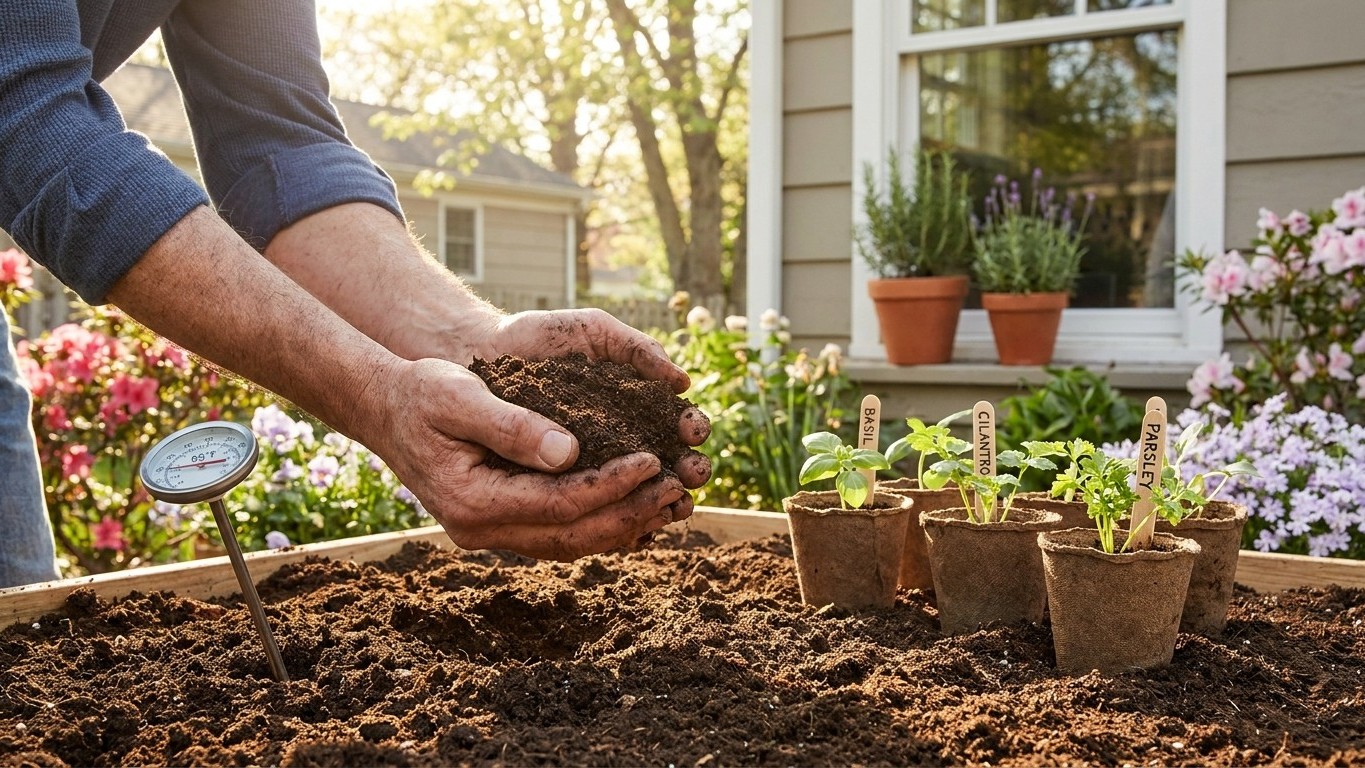

Herbs grow well across Michigan once the soil warms in mid-to-late spring, but the state’s real challenge isn’t summer heat, it’s winter cold. With hardiness zones ranging from 4a to 6b, most culinary herbs need pots, mulch, or annual replanting rather than a permanent spot in the ground. Timing, species choice, and a clear read on the season length make the difference between a thriving herb bed and a disappointing one.
When the soil is warm enough in Michigan
Frost date vs. soil temperature
The question every Michigan gardener asks first: when can I put herbs in the ground? The state’s last spring frost lands around April 30 in the Detroit area, and early to mid May across most of the Lower Peninsula, according to MSU Extension’s frost-free date data. That date is useful, but it answers the wrong question. Herbs don’t respond to frost. They respond to soil temperature, and soil warms on its own schedule, lagging weeks behind the air.
A frost date is a probability, not a promise. Roughly half the years in any given location see conditions that don’t match the average exactly, sometimes running colder well past that date. Treat it as a planning marker, not a calendar guarantee.
Cool-season vs. warm-season herbs
Warm-season herbs, the Mediterranean types bred for hot, dry hillsides (basil is the familiar example), sit and sulk if planted the moment frost risk passes. Soil in the low 50s doesn’t push them forward; it stalls them. Waiting one to two weeks past the last frost date, until nighttime lows stay reliably milder, gives these herbs a faster start than an early, cold-soil planting ever will.
Cool-season herbs handle the opposite situation well. Parsley, cilantro, and chives tolerate cooler soil and can go in several weeks before the last frost date, sometimes as soon as the ground can be worked. Chives in particular tend to return on their own once established, which changes how a gardener plans the bed from year one.
Sage carries a long-standing medicinal reputation in folk use; this page doesn’t evaluate that reputation, only the growing conditions the plant needs. The same applies to a few other herbs with traditional associations attached to them: the focus here stays on soil, timing, and species behavior, not on what a plant is claimed to do once picked.
Raised beds and containers warm faster than open ground, often by a week or more, since they drain better and sit above grade. For gardeners trying to get warm-season herbs off to an early start without gambling on a mild spring, that head start matters more than any date on a calendar. Checking soil temperature directly, rather than relying on the frost date alone, is the more reliable habit to build.
How long the season lasts here
The season in southeast Michigan
In the Detroit area, where the last spring frost lands around April 30, the first fall frost doesn’t arrive until somewhere between October 6 and October 21, a range MSU Extension ties to the state’s zone 6a pockets. Subtract one from the other and the growing window runs roughly 159 to 174 days, close to six months of frost-free ground. That’s a long season by Midwest standards, and it changes what’s worth planting and how many times.
A window that long supports a second sowing of fast-growing herbs after the first planting bolts or gets harvested hard. Cilantro tends to run to seed quickly once the weather warms, so a gardener working within that six-month window can plant it again in mid-summer for a fall crop, rather than treating one spring sowing as the only chance of the year. The same logic applies to basil and other warm-season herbs killed by the first real fall cold snap: a mid-to-late-summer sowing, timed to mature before that October frost, is realistic here in a way it isn’t everywhere.
Elsewhere in the Lower Peninsula
Areas farther north and west, where the last spring frost holds into early or mid May, don’t get the same six months. Fall frost dates aren’t specified for those colder zones, so no precise season length applies there, but the general pattern holds: a later start, combined in most cases with an earlier fall cutoff, means the growing window is meaningfully shorter than in the Detroit area, and a second sowing becomes a tighter bet.
That length also affects whether transplanting is worth the trouble. In a six-month window, starting warm-season herbs indoors and setting out strong transplants makes sense, since there’s enough season left afterward to recover from transplant shock and still produce a full harvest. In a shorter window, every week counts, and it’s worth checking root development closely before setting plants out rather than assuming they’re ready on a fixed schedule. For the mechanics of timing a repeat planting, the site’s guide to succession sowing covers the details that don’t fit here.
Heat and water in Michigan
Summer: humid, not scorching
Ask about Growing Herbs in most of the country and heat is the first constraint. In Michigan, it barely registers. The state doesn’t see the stretch of extreme heat days that shapes gardening further south, and summers here run humid rather than scorching. That combination, warm but rarely brutal, cool and damp more often than dry, means the herbs most at risk aren’t the ones that wilt in July. They’re the ones that rot at the root or develop mildew on damp leaves before they ever face real heat stress.
Basil, oregano, and other Mediterranean herbs bred for dry, sun-baked ground don’t love Michigan’s humidity. Good airflow between plants, well-drained soil, and morning sun that dries dew off the leaves quickly matter more here than shade cloth or extra watering. A cool, wet stretch in July does more damage to these herbs than a hot one ever would, encouraging fungal disease rather than scorch.
Winter: the number that matters
The bigger factor isn’t summer at all. It’s winter, and it’s the one variable that reorganizes the entire herb bed. Michigan spans USDA hardiness zones 4a to 6b, a range built on the average annual extreme minimum temperature. That’s a wide spread for one state, and it means the zone at a reader’s own address, not the state average, is what determines what survives outdoors.
In the Detroit area, the coldest month averages a daily minimum of 19.2°F, according to NOAA’s 1991-2020 climate normals. That figure, not an occasional record cold snap, is what decides whether a woody perennial herb makes it through winter in the ground. Rosemary is hardy only in the warmer end of that zone range and often doesn’t survive an outdoor Michigan winter at all; thyme and sage tolerate more cold but still benefit from mulch or a sheltered spot in the coldest zones. Parsley and cilantro sidestep the question entirely, since they’re grown as annuals here regardless of zone.
That single number, the coldest month’s average minimum, is why so many Michigan herb gardeners split their beds in two: perennial herbs suited to their zone go in the ground permanently, while tender perennials that can’t handle 19°F nights spend summer outside in pots and winter indoors on a sunny sill.
Which herbs suit Michigan
Herbs suited to a Michigan season
Match the herb to the constraint, and Michigan’s constraints are clear enough by now: a growing season that runs long in the southeast but shortens heading north, summers that are humid rather than scorching, and winters cold enough to kill most woody Mediterranean herbs left unprotected outdoors.
| Herb type | Season fit | Michigan winter | Humidity risk |
|---|---|---|---|
| Cool-season (parsley, cilantro, dill, chives) | Early planting, tolerates cool soil | Grown as annuals; hardiness rarely a factor | Low to moderate |
| Warm-season, tender (basil) | Needs warm soil; benefits from a second sowing in long-season areas | Killed by first frost; not winter-hardy | High; needs airflow and spacing |
| Woody Mediterranean (thyme, sage, oregano, rosemary) | Slow start; established plants tolerate the full season | Zone-dependent; reliable outdoors only in milder zone 6b pockets | Moderate to high; airflow reduces mildew |
Cool-season herbs fit the state well because they tolerate the cooler soil of an early spring planting and don’t mind a damp summer. Woody Mediterranean herbs need the most thought: in the milder pockets toward zone 6b, some establish as perennials with mulch and a sheltered site, while in the colder 4a and 5a areas, treating them as annuals, or growing them in containers that move indoors for winter, is the more reliable approach. Basil rewards a wait for genuinely warm soil and repays a second sowing in a long-season area, but it’s also the herb most likely to suffer in a cool, wet July, so spacing that lets air move through the plants matters more for basil in Michigan than in a drier state.
Why this page won’t name a variety
None of this points to a specific variety, and that’s deliberate. Which particular strain of thyme or basil performs best against local disease pressure changes from one growing season to the next, and claims made without local trial data aren’t worth much. MSU Extension runs outreach programs that track how specific varieties perform in Michigan conditions, trial data this page doesn’t have and shouldn’t pretend to. A gardener choosing between several sage varieties at a local nursery gets a better answer from an extension horticulturist than from any generic list, since that answer accounts for the specific zone, soil, and disease pressure of the reader’s own address rather than the state as a whole.