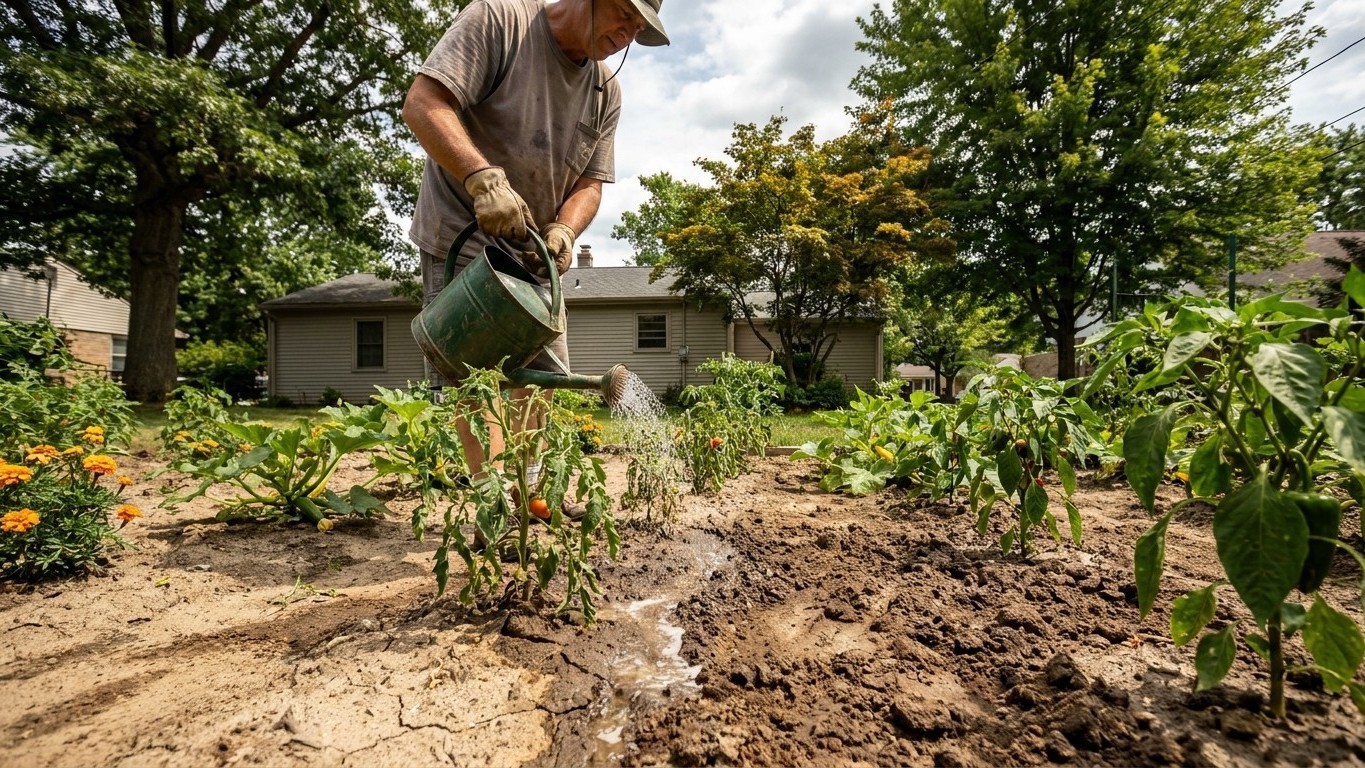

Michigan gardens don’t face a true dry season, but that doesn’t mean the sky does the work for you. Between the state’s short, humid stretches of 90-degree heat and its patchwork of sandy and clay soils, how much you water and how often depends less on a fixed formula and more on your specific ground, your specific week, and whatever your local water utility currently allows.
What the climate asks of you

Start with one number that’s actually measured: 10.3 days a year reach 90F or higher at the Detroit reference station, based on NOAA’s 1991-2020 Climate Normals. That’s a low number by national standards, and it matters more than people think. It means Michigan gardens rarely face the kind of sustained, bone-dry heat that forces daily watering in the Southwest or the Plains. Instead, the state’s challenge is inconsistency: weeks of adequate rain followed by a sudden hot, dry stretch that catches a garden off guard.
Michigan doesn’t have a single dry month the way California or Arizona does. Rainfall here is distributed across the growing season rather than concentrated or absent, which is exactly why so many Michigan gardeners get surprised by a two-week gap with no rain in July. The old assumption, that “it rains enough here,” is the trap. A garden bed still wants roughly an inch of water a week whether the calendar says Michigan or Kansas. When the sky doesn’t deliver it in a given stretch, Watering Through a Dry Spell in Michigan becomes the gardener’s job instead.
Soil texture changes the math further, and it changes block to block in this state. Sandy ground, common across much of the northern Lower Peninsula and parts of west Michigan, drains fast: an inch of rain can pass through the root zone within a day or two. Heavier clay loams, more typical in southeast Michigan, hold water far longer but also stay saturated longer after a storm. That means two gardens twenty miles apart, both getting the same rain, can need completely different watering schedules that same week.
Why the frost dates matter here too
The state’s growing season is bookended by frost dates that vary by hundreds of miles of latitude. The Detroit area sees its last spring frost around April 30, while early to mid-May is typical across most of the Lower Peninsula, according to Michigan State University Extension. Fall frost arrives October 6 to October 21 in zone 6a. That’s a real range: a gardener in Traverse City is working with a shorter, cooler season than one in Ann Arbor, and USDA Plant Hardiness Zones across the state run from 4a to 6b, another wide spread that should make anyone skeptical of a single “Michigan” watering rule.
How much, how often
Deep and infrequent beats shallow and daily, every time. A quick five-minute sprinkle each evening feels productive, but it only wets the top inch or two of soil. Roots respond by staying near the surface, where they’re exposed to heat and dry out faster on the next hot afternoon. This principle applies just as much to Watering Pots and Containers in Michigan, where soil volume is limited and moisture disappears even faster. A deep soak, by contrast, pushes water down six or more inches, and roots follow it there, into cooler, more stable soil that buffers the plant against a bad week.
The simplest way to know if it’s time to water isn’t a schedule, it’s your finger. Push it two inches into the soil near the base of the plant. Dry at that depth means water. Still cool and slightly damp means wait a day. A garden trowel works just as well for raised beds or denser soil where a finger won’t easily tell you much.
A watering routine for Michigan conditions
- Check soil moisture two inches down before turning on a hose, using a finger or trowel rather than guessing from the surface.
- Water in the early morning, ideally before 9 a.m., so plants have hours to absorb moisture before evaporation and afternoon heat set in.
- Aim water at the base of the plant, not the leaves, to cut down on fungal disease that thrives in Michigan’s humid summers.
- Deliver about one inch of water per week, adjusted for whatever rain already fell, split into one or two deep sessions rather than daily light ones.
- On sandy soil, shorten the interval and water every second or third day in shorter sessions, since the ground can’t hold a full week’s worth.
- On clay soil, extend the interval and let the top few inches dry out between waterings, since clay holds moisture far longer and waterlogged roots will rot before they dry.
- Never work or soak clay soil while it’s already wet, since compacting damp clay destroys its structure for the rest of the season.
Ten point three days of 90-degree heat a year sounds mild, but a heat spike combined with a dry week is still enough to stress shallow-rooted plants fast. That’s the scenario this routine is built for, not the rare heat wave itself but the ordinary dry stretch between rains that Michigan’s uneven summer pattern practically guarantees.
Restrictions and rules
Michigan doesn’t operate under the kind of statewide mandatory watering restrictions common in drier Western states, but that doesn’t mean rules don’t exist locally. Many municipal water utilities across the state, particularly in the Detroit metro area and other larger systems, can and do impose temporary watering schedules or odd-even day restrictions during periods of high demand or drought stress on the water system. These rules change from summer to summer and from one utility to the next, and they’re rarely publicized outside a bill insert or a local news mention.
Since Michigan doesn’t face a single defined dry season, the timing of restrictions is harder to predict than in a state with a known summer drought. A hot, dry stretch in any given July could trigger a local advisory even if the season overall ends up close to normal rainfall. The only reliable move is checking directly with your local water provider or municipal utility before setting up any regular watering schedule, rather than assuming last year’s rules still apply.
For guidance specific to your county, including current best practices and any regional advisories, Michigan State University Extension’s outreach office is the most consistent statewide resource, and it can typically point you to the right local water authority for actual restriction details.
Using less
Cutting water use in a Michigan garden isn’t about watering less overall, it’s about wasting less of what you already give it. A few techniques do most of the heavy lifting, and they stack well together.
- Mulch, two to three inches deep: slows evaporation from the soil surface enough that beds can often go an extra day or two between waterings, especially on sandy ground that dries out fast.
- Drip irrigation or soaker hoses: deliver water straight to the root zone instead of the air and leaves, cutting losses to evaporation and wind drift that a sprinkler can’t avoid.
- Group plants by water need: keep drought-tolerant natives away from thirsty vegetables and annuals so you’re not overwatering one group to satisfy another on the same zone.
- Work organic matter into the soil: compost improves both extremes, helping sandy soil hold moisture longer and helping clay soil drain and breathe better.
- Rain barrels, where local ordinances allow them: an inch of rain falling on a 1,000-square-foot roof produces roughly 600 gallons of runoff. Since Michigan’s summer rain arrives in scattered events rather than a predictable wet or dry month, a barrel can fill fast after a storm and then sit empty for a week or two until the next one, so it’s a useful supplement to a hose, not a replacement for one.
None of these techniques alone solves a dry week, but combined they can meaningfully cut how often you’re standing outside with a hose. Mulch and drip irrigation together tend to make the biggest visible difference in a typical Michigan backyard, mostly because they attack the two biggest sources of waste: bare soil losing water to the air, and sprinklers watering the sidewalk along with the flowerbed.
Common questions
Does Michigan get enough rain that gardens don’t need supplemental watering?
Not reliably. Rainfall is spread across the growing season rather than concentrated, but dry stretches of a week or two happen most summers, and a garden bed still needs about an inch of water weekly regardless of how the season averages out.
How do I know if my soil is sandy or clay?
Squeeze a handful of moist soil. If it falls apart immediately, it’s sandy and drains fast. If it holds a ball shape and feels sticky, it’s clay-heavy and holds water much longer. Soil texture varies significantly across the state, so test your own yard rather than assuming based on region.
Are there statewide watering restrictions in Michigan?
No statewide mandatory restrictions exist, but local water utilities, especially in the Detroit metro area, can impose temporary schedules during high-demand or drought periods. Check with your municipal water provider before assuming any rule applies.
Is it safe to water in the evening if mornings don’t work with my schedule?
Morning is better because it gives foliage time to dry before nightfall, reducing fungal disease risk in Michigan’s humid summers. Evening watering isn’t disastrous, but wet leaves overnight increase the odds of mildew and blight, particularly on tomatoes and other susceptible vegetables.