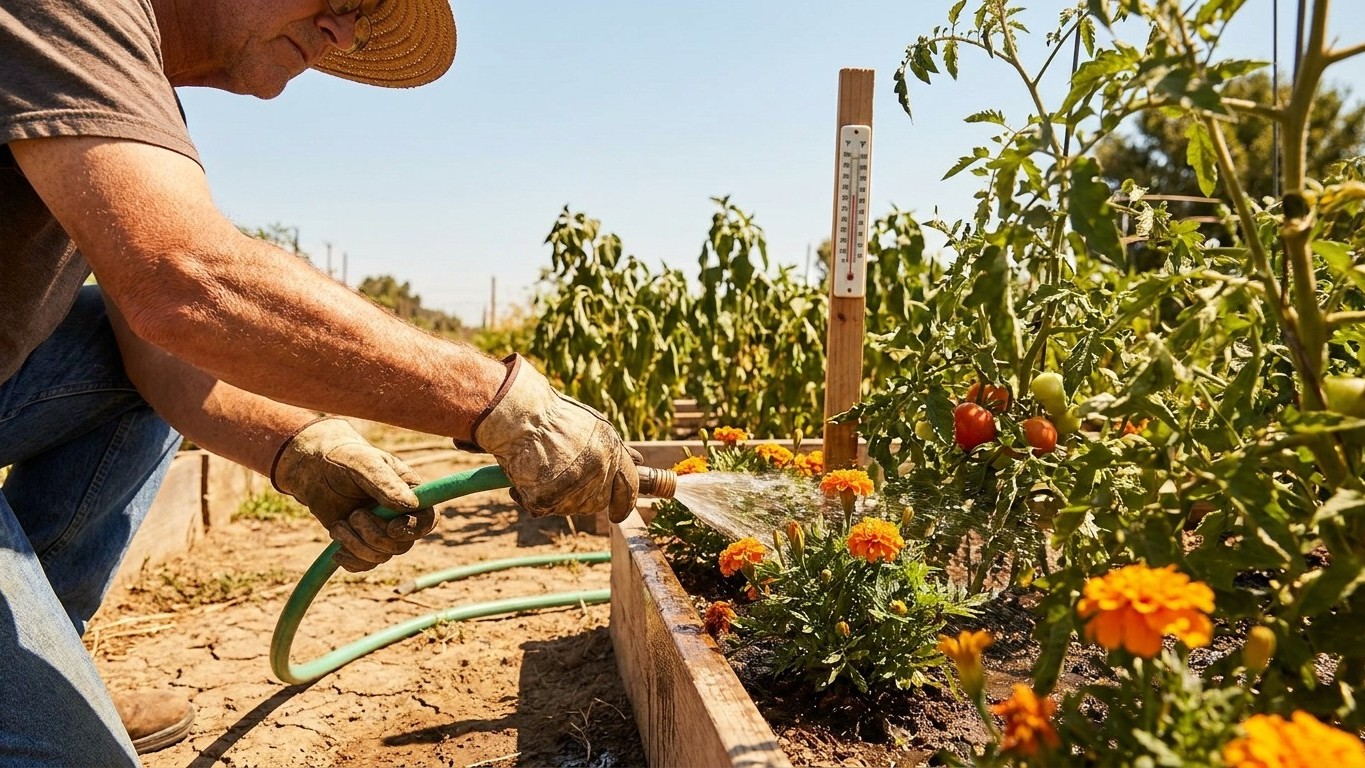

An inch of water a week is the target for most garden beds, but Michigan’s driest summer stretch delivers less than that from the sky alone. In August, the state’s driest summer month, rainfall averages 3.26 inches for the whole month, roughly 0.76 inches a week. The gardener has to make up the rest by hand, and how much depends on soil, heat, and how the water goes down.
What changes here

Two numbers set the terms for watering in Michigan. The driest summer month, August, brings 3.26 inches of rain on average. And the state sees 10.3 days a year at or above 90F. Put together in one sentence: a garden here gets less rain exactly when the heat is pulling the most moisture back out of the ground, so the gap a gardener has to fill widens right when it matters most.
Do the arithmetic and the gap becomes concrete. A bed wants about an inch of water a week. August’s 3.26 inches spread across roughly 4.3 weeks in the month works out to about 0.76 inches a week from rainfall alone. That leaves close to a quarter inch a week that has to come from a hose or a sprinkler if the plant is going to get what it needs. It isn’t a huge gap on paper, but it lands during the same stretch when 90-degree days push evaporation rates up and pull water out of leaves faster than roots can replace it.
June and July aren’t much wetter. NOAA’s 1991-2020 normals put June at 3.26 inches and July at 3.51 inches, so the entire growing season sits close to that same weekly shortfall. There’s no single wet month a Michigan gardener can count on to carry the dry ones. The 10.0 inches that falls across the full June-through-August stretch, against 34.3 inches over the whole year, tells the same story: summer isn’t the wet season here, whatever the green landscape outside might suggest.
Soil texture decides how far that shortfall goes before a plant notices. The same rain, or the same hose water, drains through sandy ground within a day and needs replacing sooner; it sits in heavy clay for the better part of a week, which changes the whole rhythm of when to water rather than how much falls from the sky. A rain gauge staked in the actual bed, not a memory of last week’s storm, is the only way to know which side of that line a particular yard sits on.
How to water when it matters
The method that works in Michigan’s climate isn’t complicated, but it runs against instinct. Deep, infrequent soakings beat a daily light sprinkle because they train roots to grow downward, chasing moisture that lingers lower in the soil profile long after the surface has dried in the day’s heat. Watering at the base, rather than overhead, gets water to those roots directly instead of losing a share to evaporation before it ever reaches the ground. And morning watering lets any moisture that does land on leaves dry off in daylight, rather than sitting overnight where fungal disease takes hold.
Checking the soil matters more than checking a calendar. The surface can look bone dry or misleadingly damp while root depth tells a different story. Pushing a finger two inches down, or slicing in with a trowel, shows the truth: if it’s dry at that depth, it’s time to water; if it’s still cool and moist, it can wait another day.
Soil texture sets the schedule from there. Sandy ground, common in parts of Michigan, holds little water and drains fast, so it asks for shorter soakings more often. Heavy clay holds a week’s worth of moisture but turns waterlogged and starves roots of oxygen if it’s watered again before it’s had the chance to dry out.
A practical sequence to start from, adjusted against what that finger test actually shows:
- Water two to three times a week during August’s driest stretch, delivering about a third of an inch each time to close the roughly quarter-inch weekly gap left by rainfall.
- Water at the base of the plant, using a soaker hose or drip line where possible, rather than an overhead sprinkler.
- Water in the early morning, before the heat of the day sets in, so any splashed foliage has hours to dry.
- Check soil moisture two inches down with a finger or trowel before each scheduled watering, and skip it if the ground is still moist.
- On sandy soil, shorten the interval between waterings; on clay, lengthen it and reduce the volume to avoid pooling.
That third-of-an-inch, twice-or-three-times-a-week starting point is just that, a starting point. A raised bed, a container, or a slope will all drift from it fast, and only a hand in the dirt settles the real answer.
What goes wrong
Watering a little bit every day
A daily light sprinkle feels responsible, but it keeps moisture in the top inch of soil and never drives it down to where roots actually live. Roots respond by staying shallow, chasing that surface water, which leaves the whole plant more exposed once a 90-degree afternoon bakes that thin top layer dry within hours.
Watering the leaves in the evening
An evening watering session seems convenient after a long day, but wet foliage that sits overnight without sun or wind to dry it becomes an open invitation for fungal disease. Powdery mildew and blight both take hold fastest in that window of standing moisture and cooling temperatures.
Trusting a passing thunderstorm
A hard summer downpour can look like it solved the watering problem, but a fast, heavy storm often runs off the surface faster than it soaks in, especially on compacted or clay-heavy ground. Sinking a finger two inches down after the storm passes is the only way to know whether it actually reached root depth or just wet the top half-inch.
Skipping the mulch
Bare soil left exposed after watering gives the sun a straight path to pull that moisture right back out. A two-to-three-inch layer of mulch slows that evaporation and buys the root zone extra days of moisture between waterings, which matters most during the stretch of 90-degree days that push evaporation rates highest.
Watering on a fixed schedule regardless of soil
Given how unevenly Michigan’s rainfall lands between sandy and clay ground, treating every bed the same way is the mistake that costs the most here. A schedule built for clay will drown a sandy bed, and one built for sand will waterlog clay before it’s had the chance to dry.
Local help
Watering restrictions vary by city, township, and water provider, so a call or a check of the local utility’s website is the fastest way to know what’s currently allowed. For soil testing, plant recommendations, and season-specific guidance tailored to Michigan conditions, the Michigan State University Extension is the state’s land-grant resource for gardeners.
Common questions
How often should I water my garden in Michigan during August?
Two to three deep soakings a week is a reasonable starting point, adjusted by checking soil moisture two inches down before each watering rather than following a fixed calendar.
Is Michigan’s summer rainfall enough for a vegetable garden?
Not on its own. August’s average of 3.26 inches works out to roughly 0.76 inches a week, short of the inch most vegetable beds need, so supplemental watering fills the remaining gap.
Does sandy or clay soil need more frequent watering in Michigan?
Sandy soil drains fast and needs shorter, more frequent watering. Clay holds moisture for close to a week but risks waterlogging if watered again before it dries.
What time of day is best to water in Michigan’s heat?
Early morning. It lets any water on the leaves dry off before evening, cutting the risk of fungal disease, and gets moisture into the soil before the day’s heat, including the 10.3 days a year that reach 90F, drives evaporation.