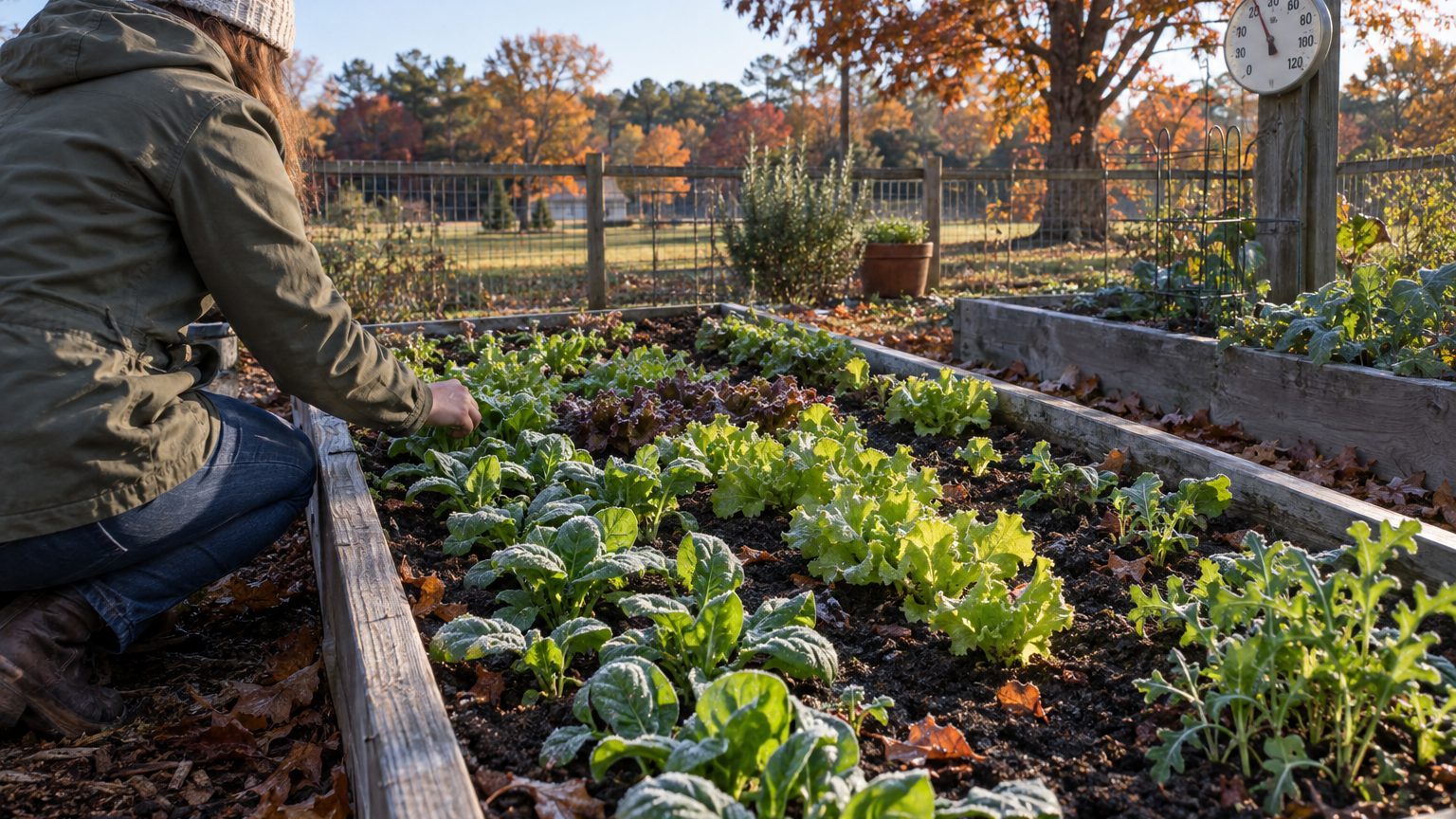

Sow winter salads in Minnesota in late summer and early fall, early enough that the plants are close to full size before the first fall freeze. Spring sowing is a separate job with a separate calendar. The dates below come from the Twin Cities, the mild corner of the state, and the rest of Minnesota has to shift from there.
The short answer for Minnesota
Work backward from the first fall frost. In the Twin Cities, that window runs from October 11 to October 23, and the last spring frost falls between April 17 and April 30. Both ranges come from NOAA’s 1991-2020 Climate Normals for the Minneapolis reference station, and both are probabilities of the same thing: a 32°F freeze. The band covers dates where the chance of that freeze sits between 30 and 70 percent. Early in the band, a freeze is still more likely not to happen. By the late end, it is more likely than not. You can read the raw numbers in the NOAA station file.
A frost date is not a deadline for sowing. It marks the point past which plants stop growing quickly, and everything you want to harvest in winter has to be built before then. A seed packet gives days to maturity, and that number assumes warm, long days. Fall days are neither. Take the packet number, count back from October 11, and then move your sowing date earlier again to cover the slowdown. Growth in the weeks around the frost window is much slower than the packet suggests, and by late fall it nearly stops.
That is the whole mechanism behind a winter salad. You are not growing greens through December. You are parking nearly mature plants in a cold frame, low tunnel or hoop house in October, then picking from them slowly as the weather turns. Sow too late and you are parking seedlings, which will sit there and do very little. The Winter Salads for Minnesota Gardens guide covers the growing methods. This page deals only with timing.
Spring sowing works differently. The April 17 to April 30 window is when soil starts to open up, and hardy greens can go in around then. Those plants will bolt in summer heat, so they are a spring crop, not a winter one. A winter harvest comes from the late-summer sowing.
What will not work here
Sowing in October. In the Twin Cities, the first fall frost window opens on October 11. A seed that goes into the ground after that sits in cold soil and germinates slowly, if at all, and what comes up is a seedling facing winter with no reserves. It will not feed you in January. The only October sowing that reliably produces food is the kind done indoors on a windowsill.
Slow crops that need a long runway. Anything with a long days-to-maturity figure on the packet is a bad bet for a winter harvest here. Tight timing is the rule in a state where the frost-free period ends in mid-October at the mild end. Fast-maturing greens fit the window, and slow ones need to be sown so early that they collide with summer heat.
Summer heat, which cuts the other way. Lettuce seed tends to refuse to germinate in hot soil, and a bed that cooked in July can be a poor place to sow in August. Sowing too early in the hope of getting a head start produces bolting or no germination. The workable approach is to sow into soil shaded or watered until it cools, not to rush the calendar.
Uncovered beds in the dead of winter. The mean daily minimum of the coldest month at the Minneapolis reference station is 8.8°F. That is the average low on a typical January night, not the record, which is far colder. Most tender salad greens do not do well sitting bare at those temperatures night after night. Plenty of hardy greens shrug off a 32°F freeze in October, and that is a different thing from nine degrees for weeks. Cover is not optional here. A cold frame, a low tunnel, or a row cover over a hoop gives the plants a few degrees and cuts the wind, and that is often what keeps them alive.
Cover that overheats. The opposite mistake is a sealed frame on a sunny day. A closed cold frame in strong winter sun can cook greens even when the air outside is well below freezing. Venting on sunny days is part of the routine, and a frame that is never opened is a frame that fails.
What changes across Minnesota
Minnesota is not one garden. Under the USDA Plant Hardiness Zone Map 2023, built on 1991-2020 normals, the state spans zones 3a to 5a. That is a wide spread for a single state, and it means there is no single answer to “when should I sow?” The Twin Cities dates above describe one place. A gardener in the northern part of the state is working with a different season.
The NOAA data carries a caution on this point: northern Minnesota runs two to three weeks tighter at both ends. In practice, that means the first fall frost arrives earlier, and the last spring frost arrives later. For a winter salad grower, the fall side matters most. If your first freeze comes two to three weeks ahead of the Twin Cities window, your sowing should move earlier by about the same amount.
| Item | Twin Cities (reference station) | Northern Minnesota |
|---|---|---|
| Last spring frost (32°F, 30-70% band) | April 17 to April 30 | Two to three weeks later |
| First fall frost (32°F, 30-70% band) | October 11 to October 23 | Two to three weeks earlier |
| Sowing for winter harvest | Count back from October 11 | Count back from a date two to three weeks earlier |
Two gardens in the same hardiness zone can still have different frost dates, because zones track winter extremes and not the length of the growing season. A low spot, a lakeshore, a wind-exposed ridge and a town center can all behave differently. To find the zone for your own location, use the USDA Plant Hardiness Zone Map and look up your ZIP code. This page cannot tell you which zone you are in, and neither can a neighbor guess.
Where to check this for your own county
The best source for your county is University of Minnesota Extension, the state’s land-grant extension service. Look for two things there. The first is a local planting calendar, ideally one that lists fall-sown and cool-season crops and not just the standard spring vegetable dates. The second is the list of varieties that have been trialed in Minnesota conditions, since a variety that did well in a mild year somewhere else tells you little about a January with nights near 9°F.
Calendars are often published per crop and not per state, so search for the particular greens you intend to grow. If a regional educator or county office offers a cold-frame or season-extension guide, that is worth more than any general chart. Extension staff also know local frost pockets, soil types and typical first-freeze dates for their own area.
A county recommendation beats a state one. This page is the state one. It uses a single reference station, the Twin Cities, and then tells you how far to shift. That is a reasonable starting point, and it will be wrong by a week or two for some readers. Where the extension service gives you a date for your county, use it over anything here.
For varieties, The Best Winter Salads for Minnesota picks up where this timing page stops. Pair the two: choose a fast, cold-tolerant type, then sow it by counting back from your own first-frost date.
Checking this against your own garden
The calendar on this page is a probability, and your yard is a specific place. Three observations will tell you more than any date, and none needs equipment beyond your hands and your eyes.
- Soil warmth by feel. In late summer, push your hand into the bed in the morning. Soil that feels cool and damp is ready for lettuce seed. Soil that feels warm will likely resist germination. Check different beds: a bed against a south wall will stay warm longer than one in open shade, and that tells you where to sow first and where to wait.
- The first true leaves. Seedlings first show two rounded seed leaves, then the first true leaves that look like the mature plant. If your fall seedlings are still at the seed-leaf stage as the frost window opens, they are behind, and next year’s sowing needs to move earlier. If they have several true leaves, you are on schedule.
- Which spot frosts first. On the first cold morning, walk the yard. Whichever beds are white with frost while others are clear tell you where cold air collects. Those beds need earlier cover. The ones that stay clear can hold crops longer and are better spots for the cold frame.
Keep a few notes from year to year: the date you sowed, the date of the first frost you noticed, and when growth stalled. After two seasons, your own record will be more useful than a station twenty miles away.
Common questions
Is it too late to sow winter salads in October in Minnesota?
For an outdoor winter harvest, yes in most cases. The first fall frost window in the Twin Cities opens on October 11, and plants sown after that have little time to size up. Indoor sowing on a windowsill is the October option that works.
Does the frost date mean my plants will die that day?
No. The dates are the range where the chance of a 32°F freeze sits between 30 and 70 percent, so they describe odds, not a certain event. Many hardy greens tolerate a light freeze. The bigger threat is the deep cold of midwinter, where the Minneapolis reference station records a mean daily minimum of 8.8°F in the coldest month.
Do I use the same dates in northern Minnesota?
No. Northern Minnesota runs two to three weeks tighter at both ends, so fall frost comes earlier and spring frost comes later. Shift your sowing earlier by roughly that amount, and confirm with your county extension office.
Which zone is my garden in?
Minnesota spans USDA zones 3a to 5a, so the answer depends on your location. Look up your ZIP code on the USDA Plant Hardiness Zone Map. Remember that zone reflects winter minimums, while sowing dates depend on how long your fall growing season lasts.