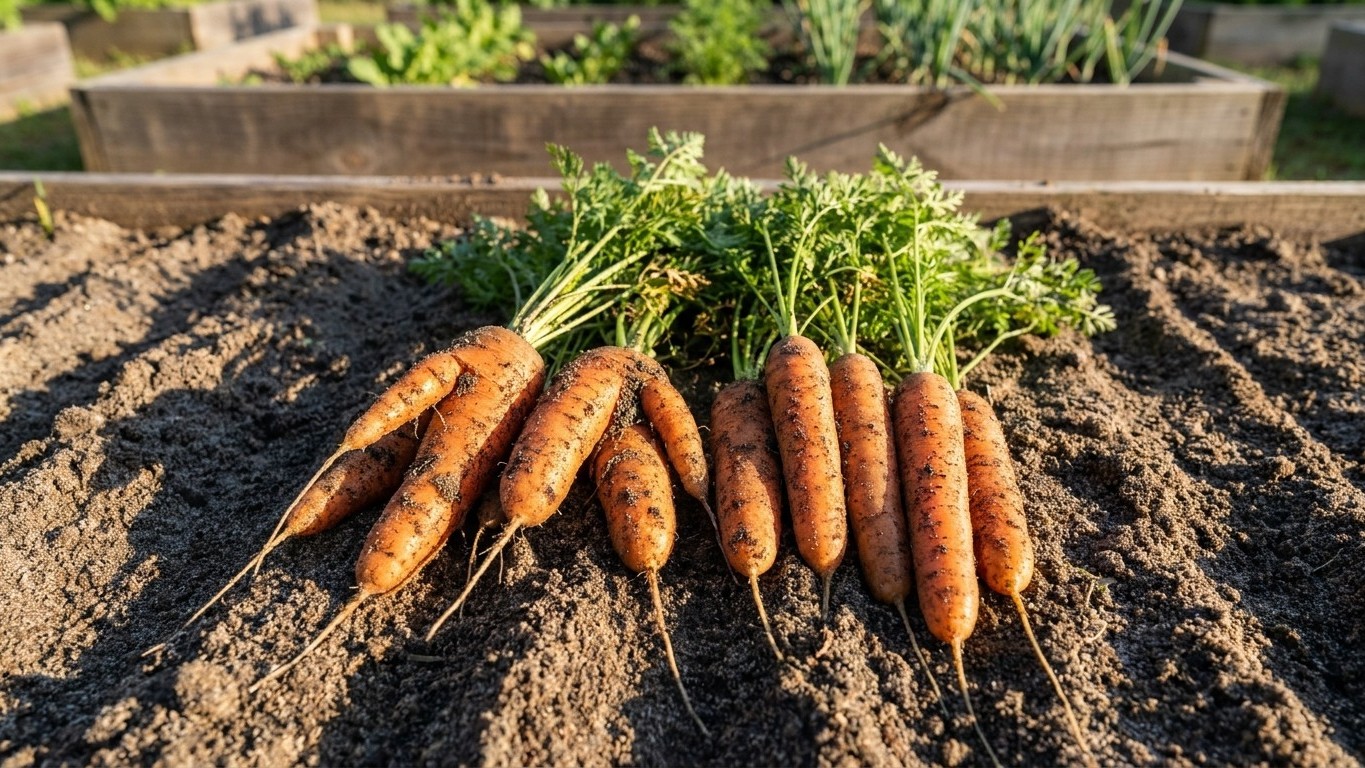

The honest answer for Minnesota is less about naming an insect and more about ruling out everything that isn’t one. The sourced data behind this page does not include a confirmed list of carrot pest species for the state, what it does include is the soil profile Minnesota carrots actually grow in, and the timing windows that decide whether a root problem is feeding damage or something the ground did on its own.
Which pests attack carrot in Minnesota
Start with what’s actually verified rather than what’s assumed. No entomology service is cited in the sourced facts behind this page with a documented list of insect species feeding on carrots in Minnesota gardens. That matters, because a lot of home-garden advice fills that gap with guesswork, naming insects that may or may not be present in a given county. This page won’t do that.
What’s documented instead is the ground itself. Minnesota’s official state soil, the Lester series, is a forest-derived Alfisol with a surface texture of 39 percent sand, 24 percent clay, and 37 percent silt, an organic matter content around 3.0 percent, and a surface pH near neutral at about 6.6. It’s classified as well drained, according to USDA NRCS Soil Data Access. That’s a loam leaning toward clay, not the deep, loose, sandy ground carrots actually want.
Utah State University Extension is explicit on this point: carrots need deep, sandy, well-drained soil rich in organic matter, and heavy or rocky ground makes the root fork. A clay share above roughly a fifth of the soil, which is close to what the Lester series carries, is exactly the kind of texture that produces forked, stubby, or misshapen roots that get mistaken for pest damage when the culprit was never an insect at all.
None of this means Minnesota gardens have no insect pressure at all. It means that before treating anything as a feeding pest, the soil deserves a look first, because the state’s representative soil texture is already tilted toward the kind of root distortion that looks like damage but isn’t. A garden built on river-bottom sand, a raised bed with amended mix, or a yard scraped down to subsoil by a builder will behave nothing like the Lester series average, and that’s precisely why a state-wide soil description can only set expectations, not confirm a diagnosis for one backyard bed.
When each one shows up, and what it does first
Without a confirmed insect calendar for this state, the timeline that actually holds up is the one built from planting to harvest, counted the way carrots are grown: sown directly in the ground, with no transplant date to anchor anything. Carrots are never moved as seedlings, so every day count on this page runs from the seeding date, not from a plant-out.
In the earliest weeks after seeding, the soil’s texture does most of the talking. A silt-and-clay-heavy bed like the Lester series profile can crust over after rain, slowing germination and producing patchy stands that get blamed on cutworms or wireworms when the real cause was a hard-crusted surface the seedling couldn’t push through.
As roots thicken through the middle of the season, forking becomes visible for the first time, and this is the stage where heavy or rocky soil shows its hand: a root that hits compacted clay or a stone splits and grows two tips instead of one. This isn’t sudden. It develops gradually as the taproot pushes downward, so a bed that looked fine at thinning can show forked roots weeks later at harvest.
Clemson Cooperative Extension puts harvest at about 65 to 75 days after planting, while the broader maturity window carried in Utah State University Extension guidance runs 70 to 100 days from seeding. That gap between the two is the window gardeners should be checking roots directly in the ground rather than guessing from the tops, since foliage can look healthy while the root underneath has already forked or cracked.
At the harvest window itself, the first sign of a problem is usually cosmetic before it’s structural, a split down the shoulder of the root or a fork visible right where it meets the soil line. Anything that looks like a tunnel, a chewed groove, or an entry hole at this stage is a different category of damage than forking, and it’s the point where a grower needs actual identification rather than a soil explanation, because the sourced data here doesn’t cover insect feeding signs specifically.
Telling the damage apart from everything else
Most of what gets called pest damage in a home carrot bed traces back to one of three non-insect causes, and separating them starts with what the root looks like, not with which bug was seen nearby.
| Symptom | Likely cause | What distinguishes it |
|---|---|---|
| Two or more root tips, splayed root | Heavy or rocky soil, per Utah State University Extension | Consistent across most roots in the bed, not isolated to a few plants |
| Root gone soft, limp, or wilted after storage | Storage temperature too warm | Sound at harvest, declines only after time in storage, not in the ground |
| Root shriveled or sprouting green growth | Tops left on during storage | Happens even at correct temperature if leaves weren’t trimmed first |
| Clean holes, tunnels, or chewed grooves in the root | Insect feeding, unconfirmed species for this state | Localized, irregular pattern, distinct from an even split |
The storage-related symptoms deserve their own note, because the numbers behind them are specific. Clemson Cooperative Extension recommends storing carrots at 33°F with high humidity, and that figure sits just above freezing, not at the temperature of a typical cellar or unheated garage shelf. Bunched carrots, meaning roots still carrying their tops, hold for about 10 to 14 days, while roots with the tops cut off first keep for months longer, because the leaves keep drawing moisture out of the root even after harvest.
A root with clean, isolated feeding marks and no forking pattern across the rest of the bed is the case that warrants an actual identification, not a soil explanation. That’s a job for a local diagnostic service, not a guess based on a photo search, since the sourced data behind this page doesn’t carry a confirmed species list to match the marks against.
What actually works here, and what is a waste of time
Given a state soil that leans toward clay, the highest-value move happens before seeding, not after a problem shows up. Utah State University Extension recommends working plenty of compost into heavy ground and double digging the bed, or building a raised bed filled with looser, sandier soil, so the root never meets the kind of resistance that produces forking in the first place. That’s a one-time investment that pays off for every season after, unlike a treatment applied once symptoms appear.
Watching the harvest window matters just as much as the soil prep. Pulling roots within the 65 to 75 day range Clemson Extension gives, rather than letting them sit in the ground past maturity, avoids the late-season splitting that comes from roots left too long in fluctuating soil moisture.
On storage, the fix is entirely mechanical: cut the tops off immediately at harvest, and get roots down to 33°F with high humidity as fast as possible. Skipping either step, leaving tops on, or storing at a warmer, more convenient temperature, is the single most common way a good harvest goes soft or sprouts within two weeks instead of lasting.
What’s a waste of time is applying any treatment, chemical or otherwise, to a root that’s forked rather than chewed. No product corrects a soil texture problem, and Utah State University Extension attributes forking to soil condition, not to a pest that a treatment would target. Guessing at a species and reaching for a product before confirming actual feeding damage wastes effort and money on a problem that soil prep, not a pesticide, would have prevented.
Where to check this for your own county
The Lester series data on this page describes Minnesota’s official representative soil, not the soil in any one garden. USDA NRCS built those figures from 251 sampled components of the series’ surface horizon, and a state spans hundreds of distinct soil series beyond it. River bottoms, hill country, and any yard a builder has scraped or filled will differ from that profile entirely, sometimes completely.
That gap is exactly what a soil test closes. Rather than assuming a garden’s clay content, sand share, or pH matches the state figures quoted here, a submitted sample gives an actual number for that bed, and settles whether forking risk is real or not.
For anything that looks like insect feeding rather than forking, a local extension office is the right next step, since no species list for Minnesota carrots is confirmed in the data behind this page. University of Minnesota Extension operates county offices that handle plant and pest identification directly, and a physical sample or a clear photo of the damage, not a description over the phone, is what gets an accurate answer.
The next move is straightforward: pull a soil sample from the actual carrot bed, and if a root shows feeding marks rather than a fork, bring it, not a description of it, to the county extension office nearest that garden.
Common questions
Does Minnesota soil naturally cause carrots to fork?
The state’s representative soil, the Lester series, carries 24 percent clay in its surface layer, which is on the heavier side of what Utah State University Extension says causes forking. Whether a specific garden matches that depends on its own soil test, not the state average.
How long can carrots be stored after harvest?
Clemson Cooperative Extension gives 10 to 14 days for bunched carrots stored with their tops on, and considerably longer once the tops are cut off, provided the roots are held at 33°F with high humidity.
When should carrots seeded in a Minnesota garden be harvested?
Clemson Cooperative Extension puts harvest at about 65 to 75 days after planting, counted from the seeding date, since carrots are sown directly and never transplanted.
What should be done if a harvested carrot shows holes or tunnels?
That’s a different symptom than forking, and the sourced data behind this page doesn’t include a confirmed list of insect species for Minnesota carrots. A physical sample or clear photo taken to the local University of Minnesota Extension county office is the way to get an actual identification.