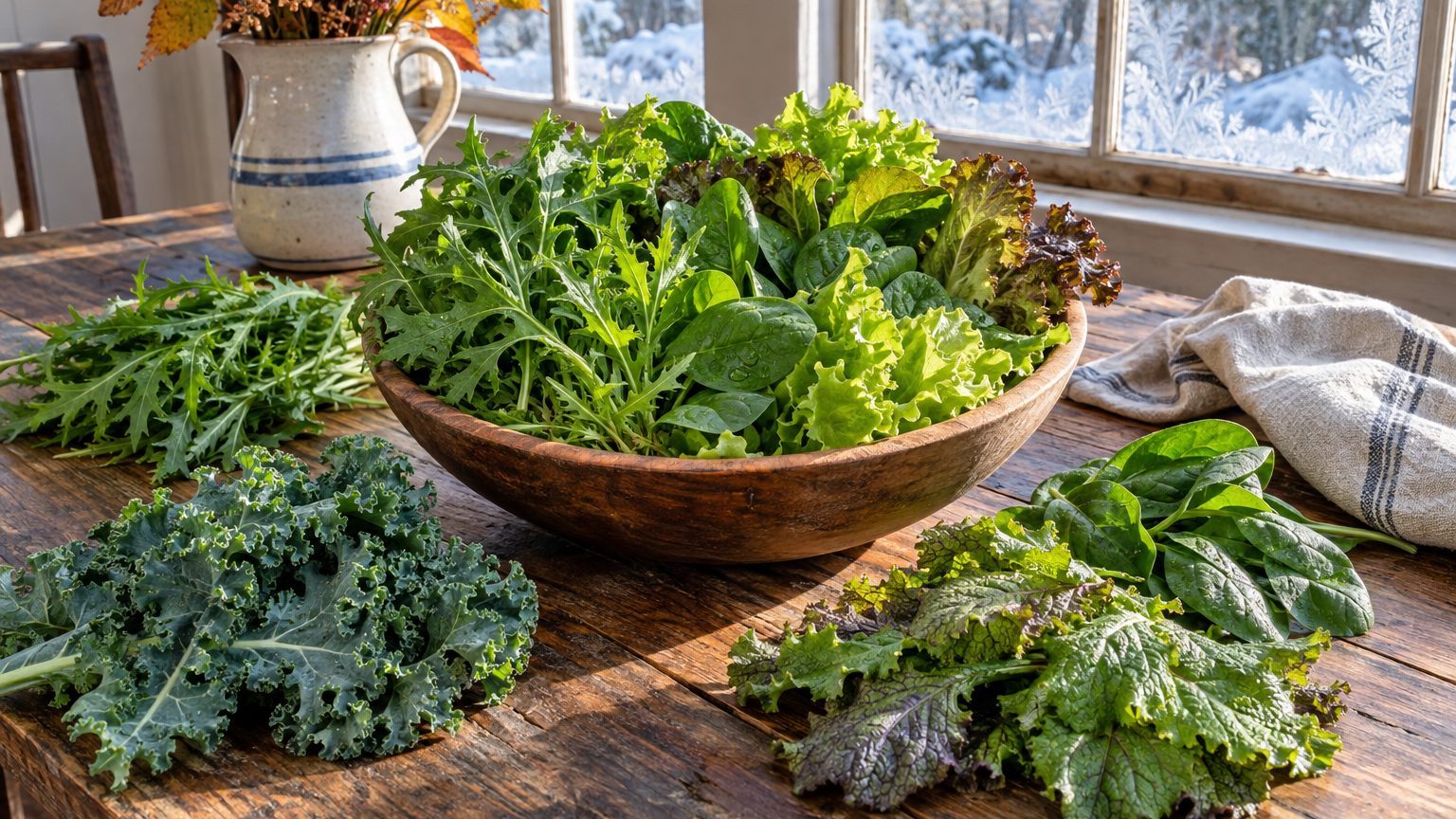

Spinach, mâche (corn salad), claytonia and the hardiest kales are the best winter salads for Minnesota. Tender lettuces and arugula come second, and only under cover. The Twin Cities’ average coldest-month nighttime low is 8.8°F, so open-ground greens survive only if they are tough or protected. Here is how the choice breaks down by type, and what shifts as you head north.
The short answer for Minnesota
Build the bed around cold-hardy types and treat everything else as a bonus. The 8.8°F figure (NOAA 1991-2020 Climate Normals, Minneapolis reference station) is the mean daily minimum of the coldest month. Half-ish of January’s nights are colder than that, so a plant has to tolerate a hard, sustained cold snap or sit under a cover that softens it.
The frost dates set the clock. At the Twin Cities station, the first fall frost falls between October 11 and October 23, and the last spring frost between April 17 and April 30. Both ranges come from NOAA’s 1991-2020 normals and describe the 30-70% band of 32°F freeze probabilities. They are a probability of a freeze, not a calendar guarantee, so a frost can still arrive before or after the window. With today’s date being October 5, the fall window is about a week from opening.
Hardy types to build around
Spinach is the anchor. Sown in fall, it can sit through winter as small plants and take off the moment spring light returns. Mâche and claytonia (also called miner’s lettuce) are the other two that handle the cold with little fuss, and both taste mild enough for a salad bowl rather than a cooking pot. Hardy kale, picked as baby leaf, rounds out the group. Mustards and tatsoi are quick and cold-tolerant, but they do best with some cover once the nights turn truly hard.
Tender types that need cover
Lettuce, especially loose-leaf and small butterhead types, will perform in a cold frame or an unheated low tunnel. Arugula is fast and forgiving in the cool shoulder weeks but gives out sooner than spinach when the cold deepens. Neither belongs in an uncovered bed in January.
| Type | Open ground in winter | Under a cold frame or low tunnel | Best role in Minnesota |
|---|---|---|---|
| Spinach | Good as fall-sown overwinterer | Very good | Backbone crop, earliest spring harvest |
| Mâche | Good | Very good | Reliable mild salad green |
| Claytonia | Good | Very good | Low-growing, tough, easy to cut |
| Hardy kale (baby leaf) | Fair to good | Very good | Heartier salad base |
| Mustards and tatsoi | Fair | Good | Fast fall harvests with a peppery edge |
| Loose-leaf lettuce | Poor | Fair to good | Fall and early spring only |
| Arugula | Poor | Fair | Quick fall and spring cuts |
The ratings are general cold-tolerance rankings, not trial results from a Minnesota county. For sowing dates that work backward from these frost windows, see When to Sow Winter Salads in Minnesota. The wider picture lives on Winter Salads for Minnesota Gardens.
What will not work here
Start with the clock. The first fall frost can arrive as early as October 11, and growth slows well before that as days shorten. A salad green that needs a long stretch to reach harvest size, sown in late September, ends up as seedlings facing winter. Anything that was not already established when the cold set in simply stalls. In a place with a window this narrow, slow is a liability.
Open-bed lettuce is the classic failure. Gardeners carry summer habits into fall and leave heads uncovered, then find them collapsed after the first deep freeze. With a coldest-month mean minimum of 8.8°F at the Twin Cities reference station, there is simply no margin for a tender leaf with nothing over it. The same goes for arugula left bare in December, and for thin-skinned seedlings of almost anything.
Using a Twin Cities date in the north is the quieter mistake. NOAA’s frost figures come from a Twin Cities station, which is the mild south of the state. Northern Minnesota runs two to three weeks tighter at both ends. That means the first fall frost arrives two to three weeks sooner there, and spring thaw is two to three weeks later. A gardener near the Canadian border who sows by the metro calendar may be planting after the window has already closed.
A cold frame also has limits. It buffers the nights, and on a sunny day it can overheat the plants inside. If nobody vents it, tender greens cook, while hardy ones tolerate it better. A closed frame with no ventilation turns a January sun break into a problem. The reverse is a missing cover, where the mean minimum does its work without interruption.
Finally, expecting steady winter growth is a mistake. In this climate, fall-sown spinach, mâche and claytonia mostly hold their size through the deepest cold and resume growth when days lengthen again. Plan harvests for the shoulder weeks, the late fall before hard freezes and the early spring after the last frost window of April 17 to April 30, not for a salad bar in January. Gardeners who expect constant output often conclude the crop failed, when the plants were simply waiting.
What changes across Minnesota
Minnesota does not have one answer. The USDA Plant Hardiness Zone Map (2023, based on 1991-2020 normals) places the state in zones 3a through 5a. The system is built on one variable, the average annual extreme minimum temperature. That is a different measure from the 8.8°F mean daily minimum used above, which describes a typical cold night rather than the worst one of the year.
A spread that wide means a single dated recommendation cannot cover the state. The dates on this page are tied to the Twin Cities, the reference city, and other parts of Minnesota differ from them. Readers in the far north should shift everything earlier in fall and later in spring, using the two-to-three-week gap as a starting offset. Fall sowing moves up, cover goes on sooner, and spring harvest starts later.
Hardiness matters most in the northern part of the state, where the coldest nights go well past what the metro sees. There, hardy types (spinach, mâche, claytonia) go from “works in open ground with a little mulch” to “wants a frame or low tunnel,” and tender types are best left to spring and fall only. In the milder south, the same hardy crops can often get by with lighter cover, and a few extra weeks of useful growth open up on either side of winter.
Local conditions add their own twist. A bed against a south-facing wall, a spot sheltered from wind, or a low pocket where cold air settles can each move the result by a full zone’s worth of difference. To see where your own address sits, check the USDA Plant Hardiness Zone Map and look up your location there. This page can’t tell you which zone you are in, and it won’t guess.
Where to check this for your own county
The best next stop is University of Minnesota Extension, the state’s land-grant extension service. It is where county-level gardening guidance gets written, and it covers a state that stretches from the metro to the Iron Range to the prairie edge.
Two things are worth looking for there. The first is a local planting calendar: dates built for your part of the state rather than for the Twin Cities. The second is a list of varieties trialled in your county. A variety that did well in a university trial a few counties over is a stronger bet than one that merely sounds hardy on a seed packet. Extension staff and master gardener programs can often tell you which cultivars have been tried and how they came through a hard winter.
A county recommendation beats a state one. This page is the state one. It rests on one reference station’s frost probabilities and one reference city’s winter lows, which is useful for deciding what type of salad green to grow and roughly when the clock starts. It does not replace a calendar built on your county’s own records.
One gap is worth stating. The sources behind this page do not include a Minnesota-specific winter salad calendar, so none is quoted here. Extension publications elsewhere are often written for a single crop or a single species, and you should only use one that matches what you are actually growing and where.
Checking this against your own garden
Your own observations outrank every date above. Three of them are enough, and none needs equipment beyond your hands.
- Soil warmth by feel. Push your hand into the bed in the morning. If it feels cool but not cold, and the soil crumbles instead of clumping or stiffening, spinach and mâche are good to sow. If it still feels warm like summer soil, germination for cool-season greens can be patchy. A bed that cools sooner than a neighbor’s tells you your site runs colder.
- First true leaves. After sprouting, seedlings show a pair of seed leaves, then true leaves that look like the adult plant. Seedlings with true leaves before the first hard freeze are the ones that sit through winter. If yours are still bare, they are behind, and a frame is worth adding.
- Frost on the lawn versus inside the frame. Check the grass on the first frosty mornings, then lift the lid. If grass is white and the plants inside are not, the frame is working. If both are frosted, add a second layer.
Keep a few notes from year to year. Over two or three seasons they will tell you more about your yard than any statewide table can.
Common questions
What is the single best winter salad green for Minnesota?
Spinach, for most gardeners. It tolerates the cold, handles fall sowing, and gives the earliest spring harvest. Mâche and claytonia are close behind and suit anyone who wants something milder in the bowl.
Can I grow lettuce through a Minnesota winter?
Not in an open bed. With a coldest-month mean minimum of 8.8°F in the Twin Cities, lettuce needs a cold frame or low tunnel, and even then it is mainly a fall and early spring crop.
Do the frost dates here apply to northern Minnesota?
No. The dates (first fall frost October 11 to October 23, last spring frost April 17 to April 30) come from a Twin Cities station. Northern Minnesota runs two to three weeks tighter at both ends.
Which hardiness zone is Minnesota in?
The state spans USDA zones 3a to 5a, so there is no single answer. Look up your own location on the USDA Plant Hardiness Zone Map rather than relying on a statewide figure.