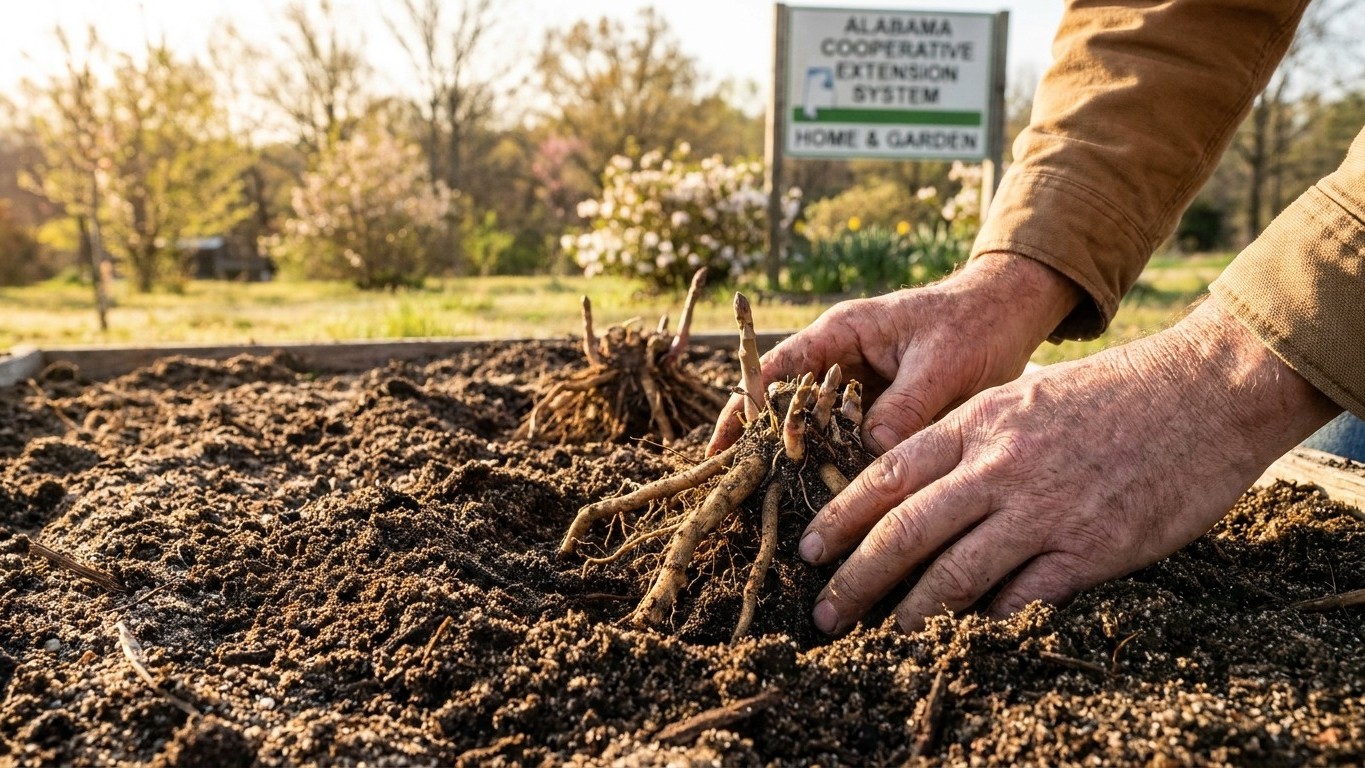

Set asparagus crowns into 8-inch furrows in early spring, timed around Mississippi’s average last frost window of March 6 to March 22. That’s the planting window. Everything else, from the soil under the furrow to the water that falls on it, decides whether the bed you dig this spring is still feeding you in a decade.
The short answer
Start with what you’re actually committing to: a bed that, once it starts producing, keeps producing for 10 to 15 years. There’s no redo button on that decision. If the spot drains poorly, you’ll be fighting it for a decade and a half, not just one bad season.
Mississippi’s official state soil, the Natchez series, gives a useful baseline. It’s a young soil, classified as an Inceptisol, meaning it hasn’t developed the strong layered structure older soils show. The surface runs 82 percent silt, 13 percent clay, and just 5 percent sand, with organic matter around 1.8 percent and a surface pH near 6.2. The USDA lists it as well drained. That’s good news on paper: the one soil requirement asparagus actually demands, according to Utah State University Extension, is drainage. Beyond that, most soils will do.
But the Natchez series describes a mapped average across the state, not the dirt behind your house. River-bottom ground, hill-country clay, and anything a builder has scraped or filled in can behave nothing like it. A soil test on your own plot, not the state soil profile, is what tells you whether water sits or moves through. If it sits, raised rows or a mounded bed with added organic matter get you the drainage the crop needs without moving the whole garden.
The clock on this commitment is long even after planting goes right. There’s no harvest at all in year one or two. Year three brings a first cutting window of about 4 weeks. That stretches to roughly 6 weeks the following year, then to about 8 weeks in the years after that. The signal to stop cutting each season isn’t a date on the calendar; it’s the spears themselves. Once most of them come up thinner than a pencil, the plant needs to stop feeding you and start feeding itself for next year.
Will the summer here water it for you?
- What the bed asks for. In its first two years, an Asparagus Bed wants 1 to 2 inches of water every other week. Once established, that eases to 1 to 2 inches every three weeks, a noticeably lighter demand.
- What a Mississippi summer delivers. Normal rainfall across June, July, and August runs about 14.1 inches, with June the driest of the three at 4.43 inches, July at 5.02, and August at 4.69. Spread evenly, that’s a bit over an inch a week, roughly in the range a young bed needs.
- Why the average is misleading. Summer rain in this part of the country tends to arrive in thunderstorms rather than steady soaking rain. A downpour that drops an inch in twenty minutes runs off a lot faster than it soaks in, especially once heat pushes evaporation up on the days in between. The monthly total looks sufficient; the week-to-week reality often isn’t.
- The practical adjustment. During the first two summers, plan to supplement with a hose or drip line whenever ten days or so pass without a soaking rain, rather than trusting the monthly average to even itself out. Once the bed matures and its water need drops to every three weeks, normal summer rainfall generally covers it, and supplemental watering becomes the exception rather than the routine.
- The one number that actually matters. Station normals describe a reference airport, not your backyard. A rain gauge on your own property, checked through a couple of dry spells, tells you more about your bed’s real water needs than any regional average ever will.
When to put the crowns in
Crowns go into the ground in early spring, set into furrows dug about 8 inches deep. For Mississippi, that window sits around the average last spring frost date, which the National Centers for Environmental Information places between March 6 and March 22 for the reference weather station. That’s a mean, not a promise, so treat it as a starting point rather than a hard date. Suburban and rural gardens away from the airport station commonly see their own last frost run one to two weeks later, sometimes more at higher elevation, so a check with your own county’s frost history is worth the five minutes it takes.
Once the crowns are in the furrow, resist the urge to fill it in all at once. The furrow gets backfilled gradually across the season, adding roughly 2 inches of soil every other month as the emerging spears grow, rather than burying the crown under a full 8 inches on planting day. That staged fill lets the young shoots push through without being smothered too early.
Seed is the alternative route to crowns, and it’s the one growers reach for when they want to raise their own plants rather than buy year-old crowns. It asks for more patience up front, since a seed-started planting adds time before it reaches the crown stage crowns already start at, but the source material doesn’t publish a specific seed-to-crown timeline for this climate, so it’s better to say plainly that detail isn’t available here than to guess at it.
On variety, Utah State University Extension names four, distinguished only by their reproductive type, without ranking them for flavor, yield, or regional suitability:
| Variety | Type |
|---|---|
| Jersey Giant | All-male |
| Jersey Knight | All-male |
| UC 157 F1 | Male/female |
| Purple Passion | Male/female |
No nursery source or performance claim beyond that sex classification is published, so pick based on what’s available locally rather than a claim about which one does better in Mississippi ground.
Common questions
Can asparagus grow in Mississippi clay soil? It can, but only if that clay drains. The one soil requirement the extension source gives is drainage, not a specific texture. Heavy clay that holds standing water after rain needs a raised bed or added organic matter before crowns go in, since a poorly drained spot will work against the plant for the entire 10 to 15 year life of the bed.
How soon can I expect to harvest after planting crowns? Not for two full years. Year three brings the first cutting, and even then it’s a short window of about 4 weeks. The bed needs that patience to build the root reserves that carry it through over a decade of future harvests.
Do I need to worry about a specific soil pH before planting? The extension source used for planting depth and watering doesn’t publish a pH requirement, so no specific target number is given here. The Natchez series, Mississippi’s state soil, runs a surface pH near 6.2, but that’s a statewide reference figure, not a stand-in for a test of your own bed.
What happens if I plant crowns before the last frost? Since the March 6 to March 22 window is an average drawn from one reference weather station, planting a little on the early side isn’t automatically a problem, but a hard late freeze can still damage tender young growth. Watching your local forecast in the weeks after planting matters more than hitting an exact calendar date.