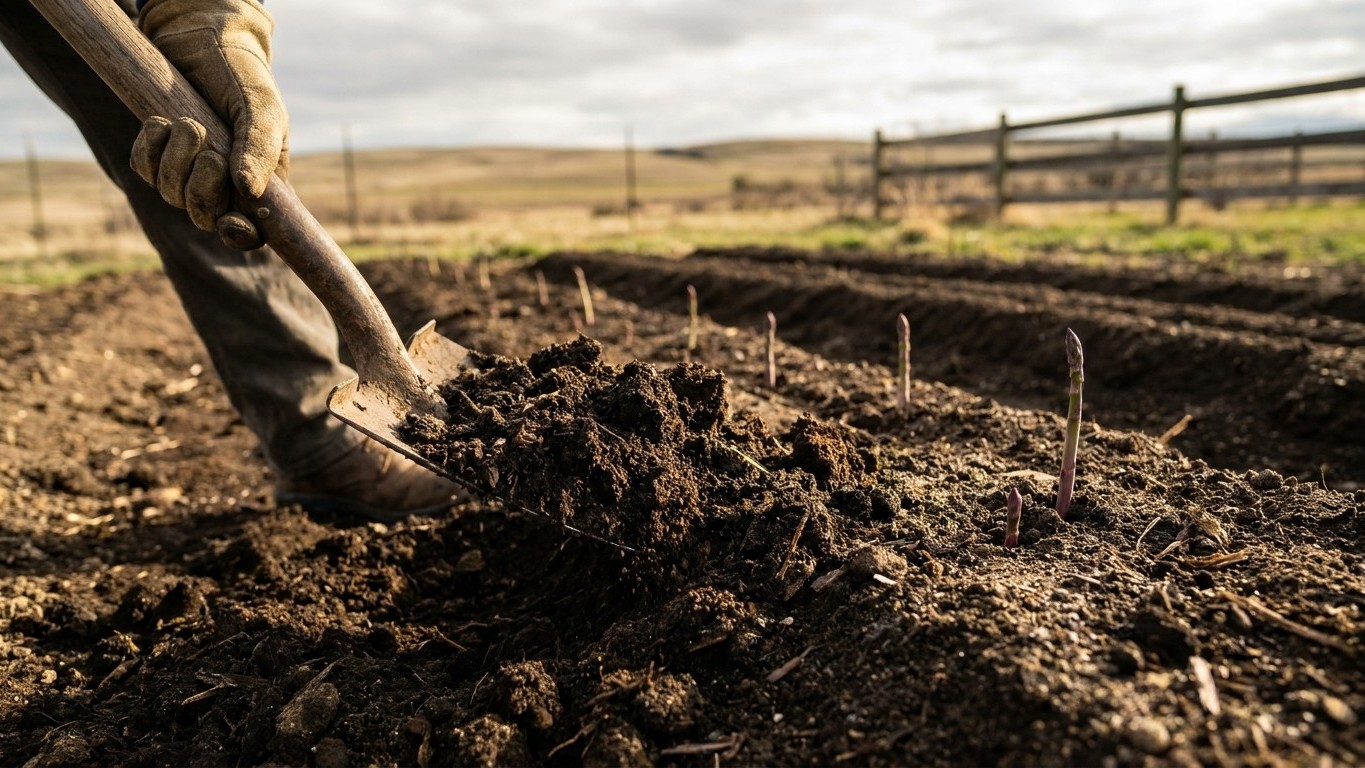

An asparagus bed in Mississippi can produce for 10 to 15 years, which means the spot you pick today is a decision you’ll live with for a decade and a half—raising the question, Will Mississippi Soil Hold an Asparagus Bed for Fifteen Years? The state’s representative soil, the Natchez series, drains well and sits at a mildly acid pH, which is a reasonable starting point. But asparagus asks for one thing above all else: soil that drains. Whether your patch of ground does that is a question only your own dirt can answer.
The short answer
Asparagus doesn’t care much about fertility, pH, or what grew there before. It cares whether water moves through the root zone or sits in it. Utah State University Extension puts it plainly: most soils will grow asparagus, provided they are well drained. That single condition is the reason this crop gets its own long-term planning, unlike a tomato bed you can rework every spring.
What the state soil tells you
Mississippi’s official state soil, the Natchez series, is classified as an Inceptisol, a young soil that hasn’t had time to build strong layered horizons. USDA soil survey data puts its surface texture at 5 percent sand, 13 percent clay, and 82 percent silt, a loam-to-silt profile with organic matter around 1.8 percent and a surface pH near 6.2, slightly acid. Critically, it’s mapped as well drained. If your yard sits on ground close to that description, drainage is likely already working in your favor.
That said, the state soil is a map-level average, not a report card on your backyard. Mississippi spans river bottoms, hill country, and plenty of lots where a builder scraped the topsoil and dropped in fill dirt. None of those resemble the Natchez series component that USDA surveyed. A state soil tells you what the region tends to do; it doesn’t tell you what your own forty feet of garden bed will do after a hard rain.
If your ground doesn’t drain
The fix, when a spot holds water, isn’t to abandon asparagus. It’s to stop fighting the native grade and build up instead. A raised bed or mounded row lifts the crowns above standing water without changing anything about the surrounding yard. Given that this bed won’t be touched again for a decade or more, and won’t even be harvested until year three, it’s worth spending an afternoon watching how a low spot in your yard behaves during a heavy rain—and getting clear on When to Plant Asparagus Crowns in Mississippi—before you commit the crowns to the ground.
Will the summer here water it for you?
Newly planted asparagus wants 1 to 2 inches of water every other week for its first two seasons, then settles into needing that same amount roughly every three weeks once established, per Utah State University Extension. Mississippi’s summer rainfall, drawn from NOAA’s 1991-2020 climate normals at the reference station, averages about 14.1 inches across June, July, and August. Broken down, that’s June at 4.43 inches, July at 5.02 inches, and August at 4.69 inches, out of a 57.4-inch annual total.
What the numbers mean for your hose
- June, the driest summer month: at 4.43 inches for the month, that averages out to roughly an inch a week, close to what a young bed needs, but summer rain rarely falls evenly. A single thunderstorm can dump most of a week’s total in an hour and run straight off, especially on compacted ground.
- July and August, slightly wetter: 5.02 and 4.69 inches respectively still land in the right neighborhood on paper, but these are also the hottest months, when temperatures pushing into the 90s pull moisture out of the topsoil faster than a passing storm replaces it.
- The soil filter: the same inch of rain behaves differently depending on what it lands on. A silty, well-drained soil like the state’s Natchez series lets water move through and needs a rain gauge check every week or two. A heavier clay soil holds moisture longer but can also stay soggy after a storm, which matters more for asparagus than dry spells do.
- The honest answer: Mississippi’s summer rainfall gets a young bed most of the way there on an average year, but it won’t reliably deliver water on the schedule asparagus actually needs, evenly spaced rather than dumped all at once. A rain gauge staked next to the bed, checked weekly, is the only way to know whether you need to supplement.
When to put the crowns in
Crowns go into the ground in early spring, set into furrows about 8 inches deep, according to Utah State University Extension. In Mississippi, that window lines up with the 32°F freeze probability data from NOAA’s 1991-2020 climate normals, which puts the last spring frost at the reference station somewhere around March 6 to March 22. That’s a mean date built from thirty years of records, not a guarantee for any single spring, and gardens outside town, especially at higher elevation or away from the moderating effect of pavement and buildings, often see their last frost run one to two weeks later than an airport-based reading.
Frost date and furrow depth
Once the ground is workable and the worst of the frost risk has passed, crowns get laid in the bottom of the furrow and covered with a couple of inches of soil, not the full depth all at once. As the season goes on, more soil gets pulled back in gradually, about 2 inches every other month, until the furrow is level with the surrounding bed by fall. That gradual backfill protects the emerging shoots while still letting the crown settle at proper depth over the year.
Utah State University Extension names four varieties without ranking them on flavor or yield, only on sex, since asparagus plants come as either male, female, or a mix, and that trait affects how much energy goes into spears versus seed production:
| Variety | Type |
|---|---|
| Jersey Giant | All-male |
| Jersey Knight | All-male |
| UC 157 F1 | Male and female |
| Purple Passion | Male and female |
Starting from seed instead
Crowns are the faster route since they’re already a year or more into growing, but starting from seed is an option for gardeners who want to raise their own transplants rather than buy dormant roots. The tradeoff is time: seed-started plants need to grow to a comparable size before they can go into the permanent bed, which pushes the whole schedule back before you even reach the three-year wait to first harvest. For most home gardeners, crowns remain the more direct path from the early-spring planting window to an eventual harvest.
Checking this against your own county
Everything above is built on statewide and reference-station data: a soil series mapped across dozens of components, and frost dates from one weather station representing thirty years of averages. Neither one is a substitute for what’s actually happening in your own county. Mississippi State University Extension, the state’s land-grant extension service, keeps county-level guidance on planting windows, local soil conditions, and variety performance that a statewide figure can’t capture. Their office network and online resources are listed at extension.msstate.edu, and a call to your county office is the fastest way to turn a regional average into a plan for your specific yard.
Common questions
Can I harvest asparagus the first year it’s planted?
No. Utah State University Extension is clear that harvest doesn’t begin until year three, regardless of how vigorous the first-year growth looks. Cutting spears earlier robs the crown of the energy it needs to establish itself for the following decade of production.
How long can I harvest once the bed matures?
The harvest window itself expands gradually: about four weeks in year three, then six weeks, then eight weeks in later years, according to Utah State University Extension. Within any given season, the signal to stop cutting isn’t a date on the calendar, it’s the spears themselves. Once most of what’s coming up is thinner than a pencil, harvest stops for that year and the plant is left to grow its ferny top growth to recharge the crown.
Does Mississippi’s climate affect how many hours of winter chill asparagus needs?
That figure isn’t published in the sources behind this guide. Utah State University Extension’s planting guidance is silent on any winter chilling requirement, and no chilling hours figure should be inferred from Mississippi’s hardiness zone. If that number matters to your planning, it’s worth asking your county extension office directly rather than relying on a general guideline.
What if my soil test comes back more acidic or more clay-heavy than the state soil?
That’s expected in plenty of Mississippi yards, since the Natchez series represents just one mapped soil, not every lot in the state. The published guidance for asparagus doesn’t specify a target pH, only that the ground needs to drain. If a soil test shows heavy clay or poor drainage, building a raised bed addresses the one condition asparagus actually requires, regardless of what the pH reading says.