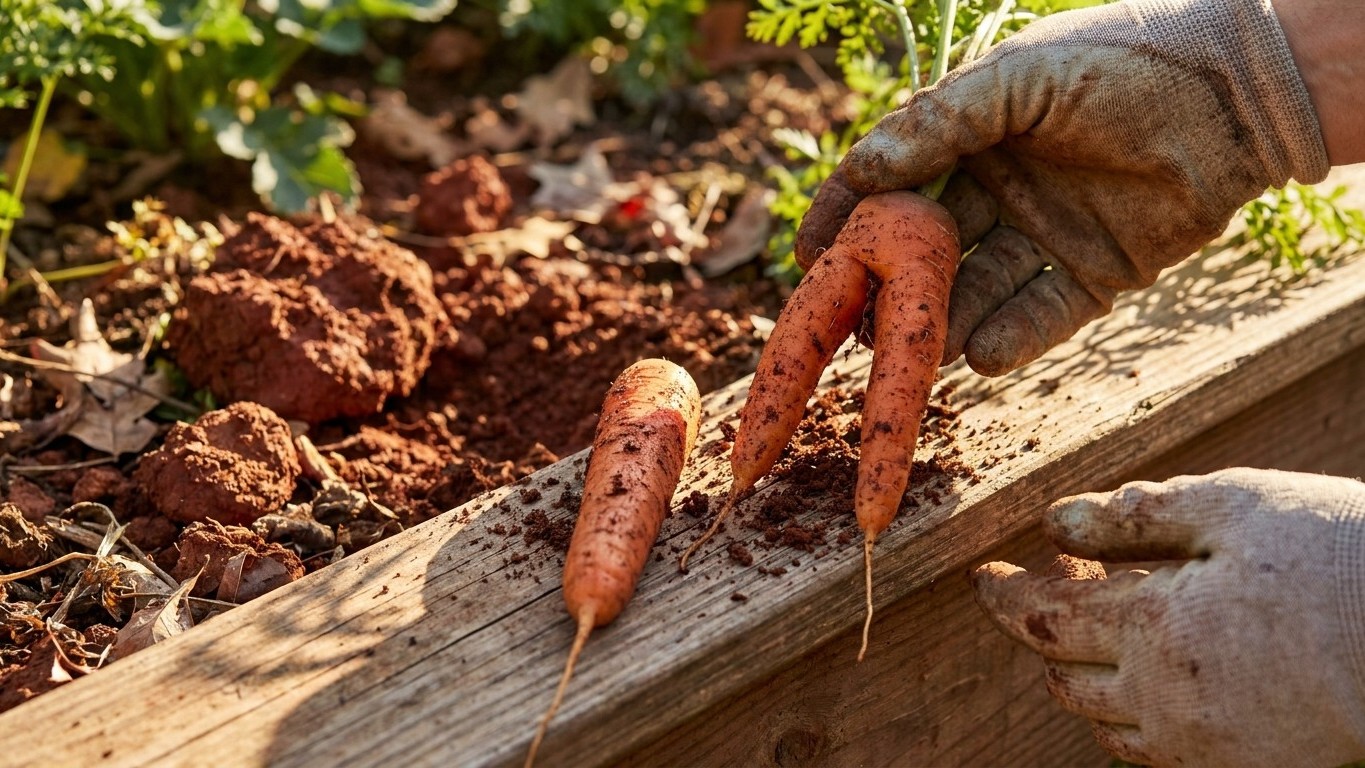

The Natchez series, Mississippi’s official state soil, is a well-drained silt loam with very little clay and almost no sand. That combination points toward a lower forking risk than the state’s reputation for heavy ground might suggest, but low organic matter still means a carrot planted straight into unimproved dirt will struggle before it forks. Compost and loosening the bed fix both problems.
The short answer
Mississippi’s state soil is the Natchez series, an Inceptisol, a young soil that hasn’t had time to build the strong layered structure older soils develop. The surface layer runs about 5 percent sand, 13 percent clay, and a striking 82 percent silt, with organic matter around 1.8 percent and a surface pH near 6.2, slightly on the acid side. It drains well. Those numbers come from the USDA’s Soil Survey Geographic Database, which tracks the representative values recorded for the major components mapped under this series.
What that means for a carrot root
Carrots want deep, loose, well-drained ground with plenty of organic matter, according to Utah State University Extension. A root pushing through compacted clay or catching on rock hits resistance, splits its path, and grows two legs instead of one, a straight taproot. Natchez soil’s clay number is low enough that raw compaction shouldn’t be the main enemy here the way it is in true clay-heavy ground. The bigger weak spot is the organic matter figure. At roughly 1.8 percent, this soil is thinner in decayed plant material than carrots prefer, and thin, silty ground can still crust and pack down hard after a heavy rain, which is exactly the kind of resistance a young root can’t push through cleanly.
The fix is the same one Extension recommends for any dense or compaction-prone bed: work in generous compost before seeding, and double dig the row, turning and loosening the soil a full spade’s depth or more so the root has an open path straight down. A raised bed filled with a loose, sandy-loam mix sidesteps the issue completely and is often the simplest route for a gardener who doesn’t want to rework native ground every season.
Why this number isn’t your number
Here’s the catch with any state soil. Mississippi contains hundreds of distinct soil series, mapped county by county, and the Natchez series describes one representative slice of that patchwork, not the ground under any particular garden. A yard sitting on old river-bottom silt, hill-country clay, or fill dirt trucked in during construction can behave nothing like the numbers above. Treat the Natchez profile as a regional starting point, a rough sense of what the area’s ground tends to do, hold water, run slightly acid, resist a taproot, and then confirm the reality in your own bed before you plan the row.
The test that settles it in your own garden
State-level data can’t tell you what’s six inches under your own tomato bed. The only way to know if your soil will fork a carrot is to dig into it, and the process takes about fifteen minutes with tools most households already own.
Four checks, one shovel
- Dig a test hole a foot deep. Use a shovel or a soil probe in the spot you plan to seed. Carrots need that depth of loose ground to grow straight, so this is the first pass-fail check.
- Look at what comes out. Note any layer of hardpan, a compacted band that resists the shovel, and count how many rocks or roots turn up in the pile. Either one forces a root to detour, which is how a fork starts.
- Feel the texture between your fingers. Squeeze a moist handful into a ball. Sandy soil won’t hold together at all. Silty soil forms a ball that crumbles at a light touch. Clay-heavy soil holds a ribbon shape and feels sticky. The stickier and more rock-like the sample, the more compost and loosening the bed will need.
- Watch how water drains. Fill the test hole with water and time how long it takes to soak in. Water that sits for hours signals poor drainage, a setup for split or misshapen roots later when rain follows a dry spell. Water that vanishes in minutes signals sandy, fast-draining ground that will need more frequent watering to avoid the opposite problem.
None of these four checks needs a lab. A gardener who runs through them once, before the first seed goes in the ground, has a far better answer than any state average can provide, because it’s an answer about the specific six inches the carrot will actually grow through.
What goes wrong here
The combination of a silty, low-organic-matter soil and a warm, humid climate creates a specific set of failure points for carrots grown in Mississippi gardens, most of them tied directly back to structure and water.
- Forking in heavy or compacted ground. Even in silt-dominant soil, a crust can form after rain and pack the surface hard enough to deflect a young root. Work compost into the bed and double dig it before seeding so the taproot has a clear, loose path straight down.
- Poor germination during a hot spell. Carrot seed is slow to sprout under the best conditions, and a run of hot, dry days can crust the surface and stop germination before it starts. Keep the seedbed consistently moist with light, frequent watering until the seedlings show, rather than one heavy soak followed by days of dry crust.
- Splitting from uneven watering. Roots that grow through an inconsistent cycle of dry stretch and sudden soaking swell irregularly and crack open. A steady watering schedule, rather than reactive watering only when the bed looks dry, keeps the root growing at an even pace.
- Stunted roots from shallow beds. Carrots are sown in place, with no transplant step to correct a bad start, so the bed has to be right from the seed on down. A bed that isn’t loosened a full foot deep before seeding will produce short, blunt roots even without visible rocks or clay to blame.
Common questions
Does Mississippi’s state soil mean my carrots will fork?
Not necessarily. The Natchez series is low in clay and well drained, which works in a carrot’s favor, but its low organic matter and tendency to crust after rain can still resist a young root. Your own soil test matters more than the state average.
How deep should I loosen the bed before seeding?
Carrots need at least a foot of loose, rock-free soil to grow a straight root. Double digging to that depth, working in compost as you go, gives the root room to grow down instead of around an obstacle.
Can I fix forking by switching carrot varieties?
Utah State University Extension ties forking to soil conditions, heavy or rocky ground, rather than to variety choice. A different seed packet won’t solve what a loosened, compost-rich bed will.
Why did my carrots split instead of fork?
Splitting usually points to uneven watering rather than compacted soil. A root that swells fast after a dry stretch gets soaked can crack along its length. A steady watering rhythm through the growing season heads this off.