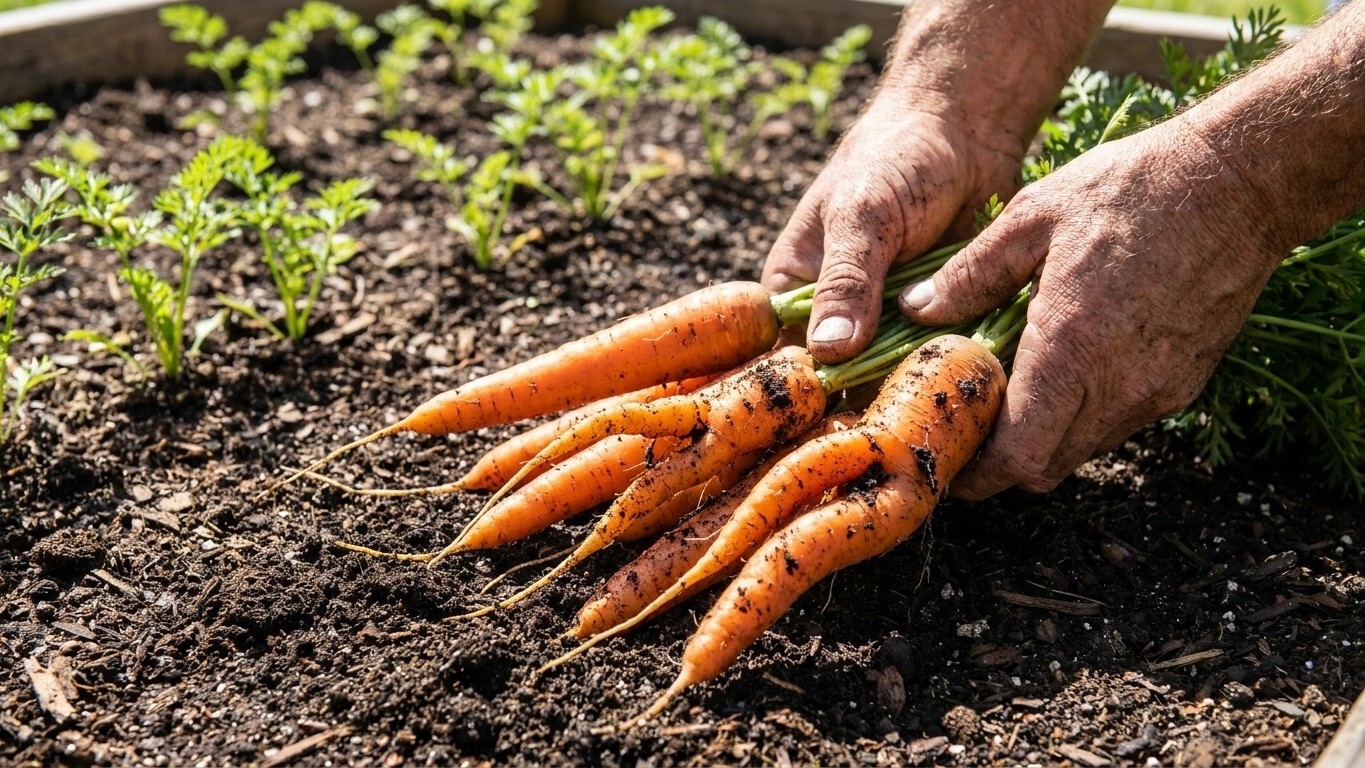

Mississippi gardeners sow carrots straight into the ground, never as transplants, and they count back 70 to 100 days from their local last-frost date to pick a planting window. That span comes from Utah State University Extension and it starts the day seed touches soil, not the day a seedling goes in. The bigger variable is what’s under that seed: the state’s official soil is a silty, well-drained young soil quite different from the heavy clay that ruins a carrot’s shape.
The short answer
Mississippi’s official state soil, named by state law in 2003, is the Natchez series, an Inceptisol. That’s soil-science shorthand for a young soil, one that hasn’t had time to build the strong, distinct layers older soils show. According to USDA NRCS Soil Survey Geographic Database records for the surface horizon of the series’ major mapped components, the Natchez runs about 5 percent sand, 13 percent clay and 82 percent silt, a texture that lands it in silt loam territory. Surface pH sits around 6.2, slightly acid. Organic matter measures about 1.8 percent, and the drainage class is well drained.
Set that against what a carrot actually wants. Utah State University Extension is direct about it: carrots want deep, sandy, well-drained soil rich in organic matter, and heavy or rocky soil makes the root fork, splitting into two or three legs instead of growing as one clean taproot. The Natchez series clears the first hurdle easily. At only 13 percent clay, it’s nowhere near the dense, sticky ground that typically forks a carrot, and “well drained” is exactly the drainage class the crop is looking for. A carrot growing in true Natchez silt loam shouldn’t fight the kind of physical resistance that splits roots.
Where it comes up short is organic matter. At 1.8 percent, this soil is lean by the standard the extension guidance sets, and a carrot pushing through low-organic, silt-heavy ground can still meet a surface crust after a hard rain, the kind of crust that slows or distorts germination even when the deeper soil is fine. The fix isn’t a different variety. It’s the same fix Utah State University Extension gives for heavy ground generally: work in plenty of compost before sowing, and loosen the bed deeper than you think you need to, whether that means double digging or simply building a raised bed filled with a lighter mix.
None of that is a verdict on your yard. Mississippi spans hundreds of soil series, from Delta bottomland clays to sandy hill-country ground to whatever mix of fill and topsoil a builder left behind a subdivision lot. The Natchez series represents the state on paper. It doesn’t represent every garden in it. Treat this as the starting point for how the region’s ground tends to behave, not a diagnosis of the dirt under your own carrots.
The test that settles it in your own garden
The only way to know what you’re actually working with is to look at it yourself, in your own bed, before you sow a single seed.
- Dig a hole at least a foot deep where you plan to plant. Carrots need loose ground well below where the visible root will sit, so check depth before you check anything else.
- Look at what comes out of the hole. Note how far down the soil stays loose and diggable, and whether you hit rocks, gravel, construction debris or a hard compacted layer partway down. Any of those will deflect or fork a growing root the same way heavy clay does.
- Feel the texture between your fingers. Wet a small handful and squeeze it. Soil that forms a slick, sticky ribbon is clay-heavy. Soil that falls apart and feels grainy is sandier. Soil that holds a loose shape but crumbles easily is closer to the loam carrots prefer.
- Watch how water moves through it. Fill the hole with water and time how long it takes to drain. Standing water after an hour or more points to poor drainage, the kind that invites rot and disease around a developing root. Water that vanishes almost immediately suggests sandy soil that may need more frequent watering to avoid the splitting that comes from uneven moisture.
- Repeat the test in more than one spot. Soil can change character within a few feet, especially near a driveway, a foundation, or a spot that’s been graded or filled at some point. One good hole doesn’t guarantee the whole bed behaves the same way.
No lab result substitutes for this walk-around. A state-level figure like the Natchez series’ 13 percent clay tells you nothing about the specific eight square feet you’re about to plant. Your own hands, a shovel and a bit of patience are what settle the question.
What goes wrong here
- Forking in heavy or rocky ground. Wherever the local soil runs heavier in clay than the state’s Natchez series, or wherever buried rock and debris sit in the root zone, carrots split into two or three legs instead of growing as a single taproot. Utah State University Extension’s remedy is straightforward: work in generous compost and double dig the bed, loosening soil well below where the root will reach, or build a raised bed filled with a lighter mix from the start.
- Poor germination in a hot spell. Carrot seed is slow to sprout under the best conditions, and a stretch of hot, drying weather right after sowing can crust the soil surface and stall germination further, especially in silt-heavy ground that tends to seal over after rain. Keeping the seedbed consistently moist, with light watering rather than one heavy soak, gives seed a better shot at breaking through before the surface hardens.
- Splitting from uneven watering. A carrot root that goes dry for a stretch and then gets a heavy soak tends to grow fast and crack under the sudden pressure, or split lengthwise as it matures. Steady, even moisture through the growing season, rather than feast-or-famine watering, is the fix, and it matters more in soil that drains quickly and dries out between waterings.
Common questions
Do I need to test my soil’s pH before sowing carrots in Mississippi?
The state soil’s surface pH runs around 6.2, slightly acid, but that figure describes the Natchez series specifically, not your yard. A home soil test is the only way to know your own bed’s pH, and it’s worth doing before you invest a season’s worth of seed and water in a spot you haven’t checked.
Can I fix heavy clay soil instead of building a raised bed?
Yes. Utah State University Extension’s guidance for heavy soil is to work in plenty of compost and double dig the area, loosening it well beyond the depth a shovel normally reaches. A raised bed is often faster and more reliable, but it isn’t the only option if you’re willing to put in the labor on the ground you already have.
Does the 70 to 100 day window start when I transplant seedlings?
No. Carrots are sown directly in place; there’s no transplanting step with this crop. The 70 to 100 day span runs from the day seed goes into the soil to the day roots are ready to pull, according to Utah State University Extension.
Why does organic matter matter more than the clay percentage here?
Because the Natchez series’ clay content, at 13 percent, is already well below what typically causes forking, so that hurdle is mostly cleared. Its organic matter, at about 1.8 percent, sits below what Utah State University Extension recommends for carrots, and low organic matter contributes to surface crusting that can slow germination even in soil that isn’t heavy or rocky.