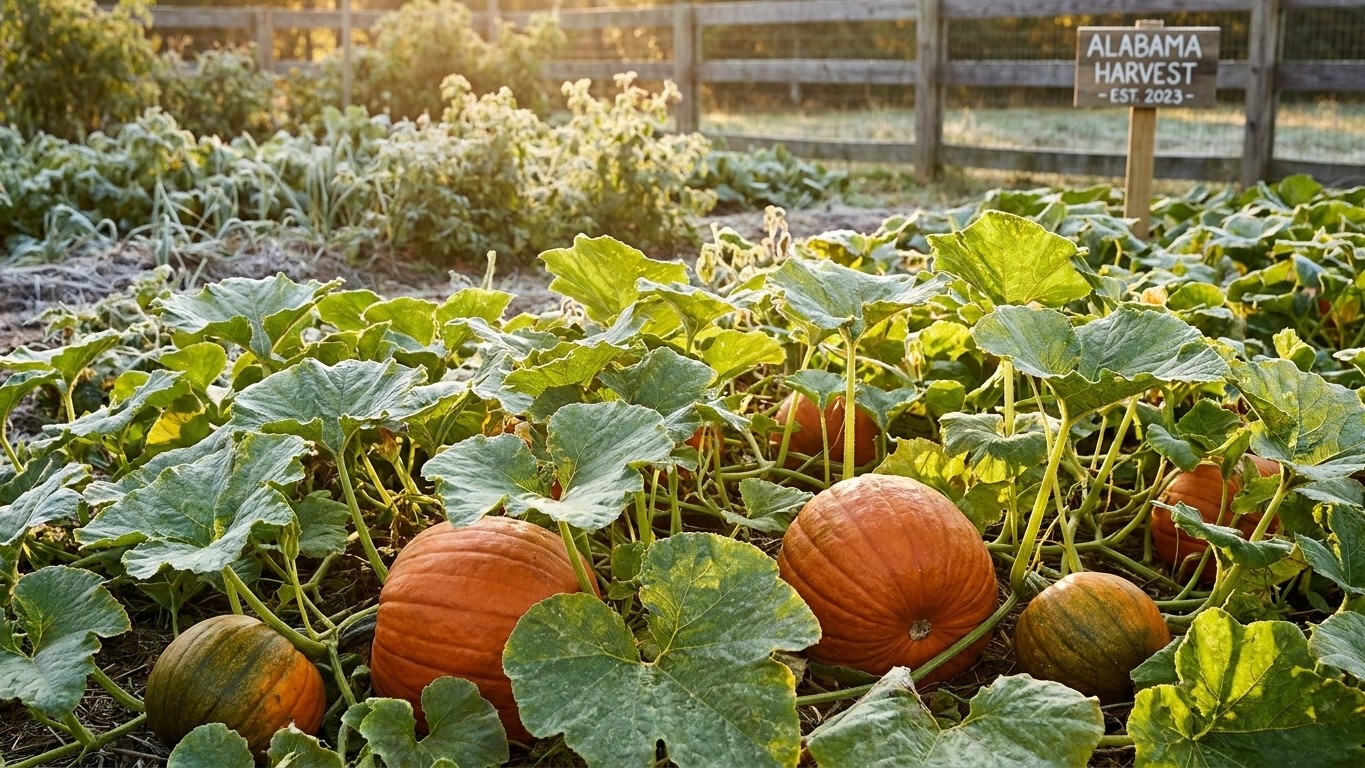

Yes, most years, but only if flowers open by early October at the latest. Mississippi’s first fall frost lands anywhere from November 7 to November 22, and a pumpkin needs 45 to 55 days after its flower opens to turn from green to fully colored. That leaves a narrow flowering window, roughly mid-September through the first week of October, depending on where in the state you garden and how early frost shows up that particular year.
The short answer
Start with the frost date, not the calendar page. NOAA’s 1991-2020 climate normals put Mississippi’s first fall frost somewhere between November 7 and November 22, a fifteen-day spread that already tells you this isn’t a single fixed deadline. Count backward from each end of that window using the 45 to 55 day maturation clock that Utah State University Extension attaches to pumpkins, and you get a range of “last safe flowering dates” rather than one tidy answer.
Work the math both directions. Subtract 55 days from the earliest frost date, November 7, and you land on September 13. Subtract 45 days from the latest frost date, November 22, and you land on October 8. That’s the full spread: a flower that opens as early as September 13 is safe under almost any scenario, while one that opens as late as October 8 only ripens if frost holds off until the tail end of its window and the fruit matures on the faster end of the 45 to 55 day range.
Gardeners in the hillier northern counties, where frost tends to arrive on the earlier side of that window, should treat mid-to-late September as their real cutoff for flowering. Gardeners closer to the Gulf Coast, where frost typically holds off longer, have more room to push toward early October. Either way, the count runs from the day the flower opens, not from the day the seed goes into the ground and not from when the vine first starts running. A pumpkin patch can look lush and healthy in late September with plenty of green fruit on the vine, and still not deliver a single ripe pumpkin if those flowers opened too late to beat the clock.
One more wrinkle worth building into the plan: the November 7 to November 22 window comes from a single reference weather station. Home gardens, especially in low-lying or rural spots away from pavement and buildings, often see their first fall frost one to two weeks earlier than the station reports. If your property tends to frost early, or you’re not sure, it pays to treat September as the real cutoff rather than banking on the later end of October.
When to sow here
Sowing date depends on soil temperature, not the last frost date on a calendar. Here’s the sequence that actually determines when pumpkin seed can safely go into a Mississippi garden bed.
- Mark the last spring frost window for your area. At the reference weather station used for Mississippi’s climate normals, that falls between March 6 and March 22. Your own yard may run later, sometimes by a week or two, especially in low spots or shaded corners.
- Wait for soil, not air. Pumpkin seed needs soil at 65 F before it goes in the ground, and that threshold typically arrives well after the last frost date, sometimes several weeks later, since soil warms more slowly than the air above it.
- If the wait feels too long, lay row covers over the bed. They trap enough extra heat to buy roughly two weeks, letting you sow into soil that would otherwise still be too cold for germination.
- Once seed is in the ground, give the vine time to establish, spread, and set its first flowers before the ripening clock even starts. This vegetative stretch isn’t part of the 45 to 55 day maturation window; it happens before that window opens.
- When flowering begins, count 45 to 55 days forward and check that date against the fall frost window from the previous section. If the math is tight, that’s the signal to move next year’s sowing date earlier rather than hoping the season runs long.
Skipping straight from “last frost passed” to “seed in the ground” is the single most common timing mistake with pumpkins in this state. Air can warm into the 70s for a week while the soil a few inches down is still sitting in the 50s, and pumpkin seed sitting in cold, damp soil rots more often than it germinates.
What goes wrong here
- A late flower that never colors. This happens when sowing gets pushed too far into spring, or a cool stretch delays the vine’s first female flowers past that mid-September to early-October cutoff. The fruit sets, grows to size, and stays green because the 45 to 55 day clock simply runs out before frost. Remedy: track sowing date against soil temperature rather than the calendar, and use row covers to get seed in the ground as soon as that soil hits 65 F, buying back the two weeks that make the difference.
- A fruit caught by frost before it finishes ripening. Even a well-timed flower can lose the race if frost arrives on the early end of the November window. Remedy: harvest with the stem attached before frost hits, following Utah State University Extension’s guidance, and move the fruit somewhere it will not freeze. The source doesn’t publish a specific storage temperature or keeping time beyond that, so “somewhere it will not freeze” is the standard to hold to rather than guessing at a number.
- A vine that dies back before the skin has hardened. Insect pressure, particularly from squash bugs and cucumber beetles, can take down foliage well before frost does, leaving fruit exposed to sun scald with a rind that never toughens properly. This site covers both pests in state-specific detail elsewhere; if vines are collapsing mid-season, check the squash bug and cucumber beetle pages for Mississippi before assuming frost is the culprit.
Common questions
My pumpkin flowers didn’t open until mid-October. Is that too late in Mississippi?
Very likely, yes. Counting 45 days forward from October 15 lands on November 29, past even the latest end of the state’s first fall frost window (November 7 to November 22). A flower opening that late needs frost to hold off well beyond normal, which isn’t something to plan around. The fix is next season: track soil temperature in spring and sow as soon as it hits 65 F rather than waiting for warm air alone.
Can I still use a pumpkin that frost caught while it was still green?
A green, immature pumpkin that’s been through a hard frost generally isn’t going to finish ripening off the vine the way a mature one might. Utah State University Extension’s guidance centers on harvesting with the stem attached before frost and keeping fruit somewhere it won’t freeze, which points toward getting fruit off the vine ahead of the cold rather than relying on frost-damaged fruit to come around afterward.
Does Mississippi’s growing season allow for a second pumpkin planting aimed at Halloween?
It depends entirely on whether flowering can happen early enough to clear the 45 to 55 day window before the first fall frost, which lands between November 7 and November 22 here. A second sowing only works if the resulting flowers open by roughly early October at the latest; anything later runs into the same math problem as a single late planting.
How do I know when my soil has actually reached 65 F, rather than guessing from air temperature?
The only reliable way is to measure the soil itself, a few inches down, rather than going by how warm the air feels. Air temperature can climb into comfortable ranges well before the ground underneath has caught up, which is exactly the gap that catches gardeners who sow right after the last frost date instead of waiting for the soil to hit that 65 F mark.