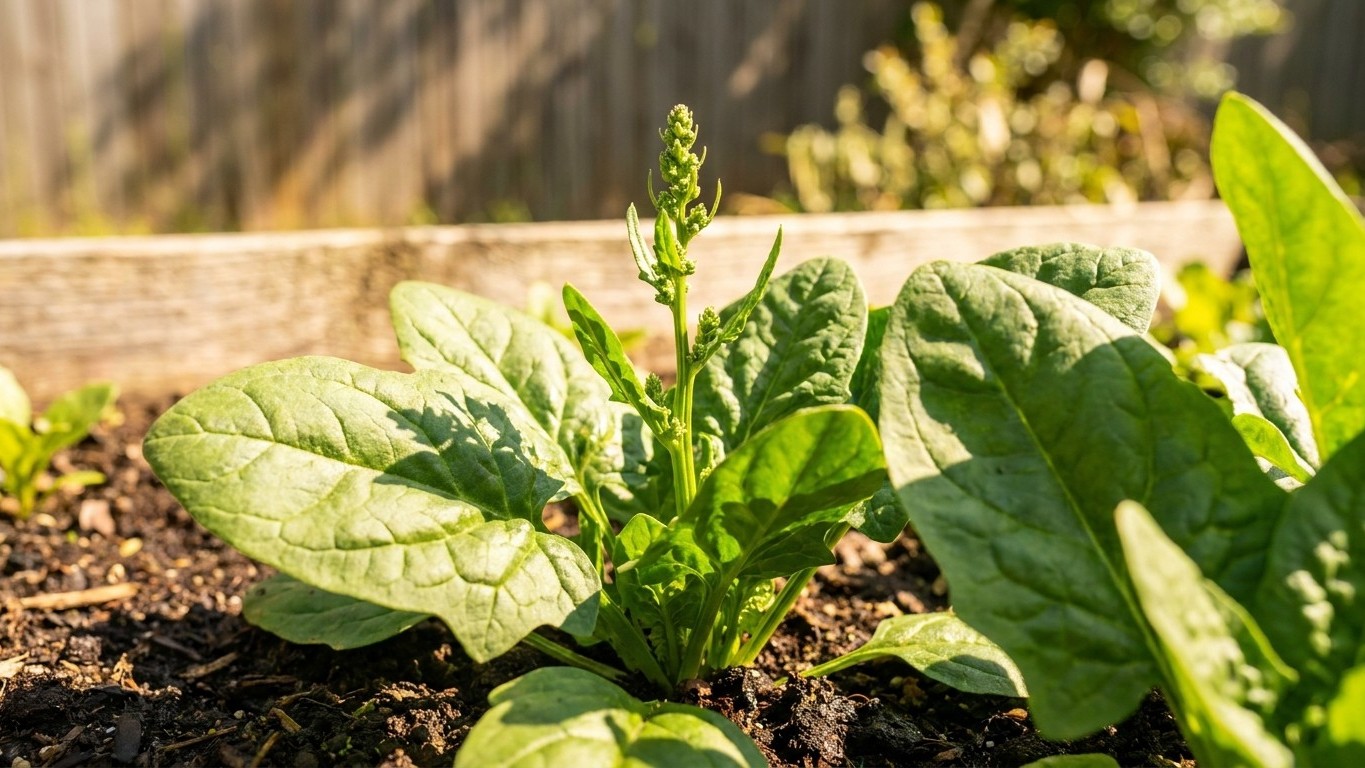

Yes. Spinach bolts early almost everywhere in Mississippi, and the reason has less to do with heat than most gardeners assume. Long daylight hours by themselves push the plant into flower, and the state’s heat load finishes the job for anything that survives that trigger. That leaves two short growing pushes each year, one in late winter and early spring, one in fall once the ground finally cools, rather than one long season.
The short answer
On the longest day of the year, the reference city for Mississippi’s climate normals sees 14 hours and 7 minutes of daylight. That number matters more than the thermometer. Spinach flowers, or bolts, in response to long days combined with warm temperatures, and once daylight stretches out that far, the plant is already on a clock that has nothing to do with how hot or cool the season actually feels. A run of mild days in May does not buy a Mississippi gardener extra weeks, because the day-length trigger fires on its own schedule every year, mild or not.
Heat piles a second constraint on top of the first. Spinach grows best where temperatures stay below 75 degrees Fahrenheit, and that same 75-degree line marks where leaves start turning bitter even if the plant hasn’t bolted yet. The reference station near Jackson averages 71.1 days a year at or above 90 degrees. That is not a measure of average summer warmth so much as a measure of how much heat load the growing season carries, and it tells you plainly that once spring passes, the air stays well above spinach’s comfort zone for most of the summer.
So which is it, day length or heat? Here, it’s both, and they arrive close together. Long days push the plant toward flowering right around the same weeks that daytime highs climb past the growth ceiling. A gardener in a cooler, shorter-summer state might get a slightly longer run before the heat catches up. In Mississippi, the two pressures overlap almost from the start, which is exactly why the spinach season splits into two narrow windows instead of one long stretch. There’s no summer spinach crop to plan for here, only a spring rush and a fall rush, each bounded on both ends.
This is worth sitting with for a moment, because it changes how you should think about timing. Waiting for “better” weather doesn’t help once daylight has already crossed the point that triggers bolting. The practical response is to sow early enough that the plant reaches usable leaf size before the day-length and heat pressures converge, then switch to counting backward from the fall frost for the second chance.
How long the spring window really is
- Start from the last spring frost. At the reference station, the last spring freeze typically falls somewhere between March 6 and March 22. Gardens outside town, especially rural and suburban plots away from the airport station, often see frost linger one to two weeks later than that, and longer still at higher elevation, so treat this as a starting estimate rather than a guarantee for your own yard.
- Sow two to three weeks ahead of that date. Spinach seed goes in the ground before the last frost, not after it, which puts a realistic sowing window somewhere in mid-February through the first days of March for most of the state, shifting later the farther north or the higher up you garden.
- Count the usable growing weeks that follow. From that sowing date, the plant has a limited run before the 75-degree ceiling and the lengthening days start working against it. In the Deep South, spring temperatures climb quickly once the calendar turns toward late March and April, so the stretch of cool, short-enough days that favor leafy growth is genuinely narrow.
- Expect the window to close from both directions at once. Day length keeps increasing regardless of temperature, and warm afternoons arrive early in a Gulf South spring. The two pressures close in on each other rather than one waiting for the other, which is why gardeners here often describe spring spinach as a sprint rather than a season.
- Plan for a short, useful harvest rather than a long one. The practical takeaway is to sow as soon as soil can be worked after the last hard freeze risk passes, harvest promptly once leaves reach usable size, and not count on stretching the crop into late spring the way a cooler-summer state might.
The autumn crop, and when the soil lets you sow
Fall offers a second chance, but it opens later than most gardeners expect, and it’s blocked by heat on one side and frost on the other. Getting the timing right means working through two separate obstacles rather than one.
Soil still too warm to germinate
Spinach seed germination drops off once soil temperature climbs above 80 degrees Fahrenheit, according to Utah State University Extension. That’s the obstacle that catches people off guard in a hot-summer state like Mississippi, because it isn’t about air temperature or the calendar date at all. It’s about how long the ground itself stays hot. With an average of 71.1 days a year reaching 90 degrees or more in the air, the soil beneath a Mississippi garden holds onto summer heat well past the point when the weather starts to feel like fall. Exactly when soil crosses back below that 80-degree line isn’t published in the source data here, but the heat-load figures make clear that the safe sowing point likely lands later in the season than gardeners in milder climates would expect, closer to the back end of the fall window than the front.
The frost that ends the season
At the reference station, the first fall freeze arrives somewhere between November 7 and November 22, again with the caveat that rural and suburban gardens often see frost show up one to two weeks earlier than an airport reporting station does. Utah State University Extension recommends sowing a fall spinach crop 50 to 75 days before the date you want to harvest, and no maturity figure beyond that range is published for the crop. Counting back from a harvest target near the earlier end of that frost window, say early November, lands a sowing date somewhere in late August to mid-September. Counting back from a harvest closer to late November pushes sowing into September and even early October.
Put the two obstacles together and the realistic fall sowing window in Mississippi sits later than the frost math alone suggests, because the soil-heat limit tends to hold the door shut into September regardless of what the frost calendar says. Gardeners who wait until soil has genuinely cooled, rather than sowing on a fixed date, tend to get better germination and a crop that has enough time to size up before frost ends it.
Four spinach varieties commonly discussed for home gardens, Bloomsdale, Melody, Teton, and Olympia, are named in Utah State University Extension’s guidance, but no bolt-resistance data, days-to-maturity figures, or performance comparisons among them are published in that source. Choosing among them means relying on seed packet information and local experience rather than any single authoritative dataset.
Common questions
Can shade cloth let me grow spinach through a Mississippi summer?
Shade cloth can lower leaf temperature somewhat, but it does nothing about day length, and day length alone is enough to push spinach into flower. It may extend the spring harvest by a few days but it won’t create a summer crop here.
Which spinach variety bolts slowest in Mississippi’s climate?
Bloomsdale, Melody, Teton, and Olympia are the varieties named by Utah State University Extension’s guidance, but that source publishes no bolt-resistance ranking or comparative data among them. Local trial and error, or advice from a county extension office, fills that gap.
Is it better to sow fall spinach early or wait?
Waiting is usually the safer call. Sowing while soil is still above 80 degrees leads to poor, patchy germination, so it pays to check soil temperature directly rather than sow on a fixed calendar date.
Does a raised bed change the timing?
Raised beds warm and cool faster than ground-level soil, which can push spring sowing a few days earlier and fall sowing a few days later than the timelines above, though no specific figures for that effect are published here.