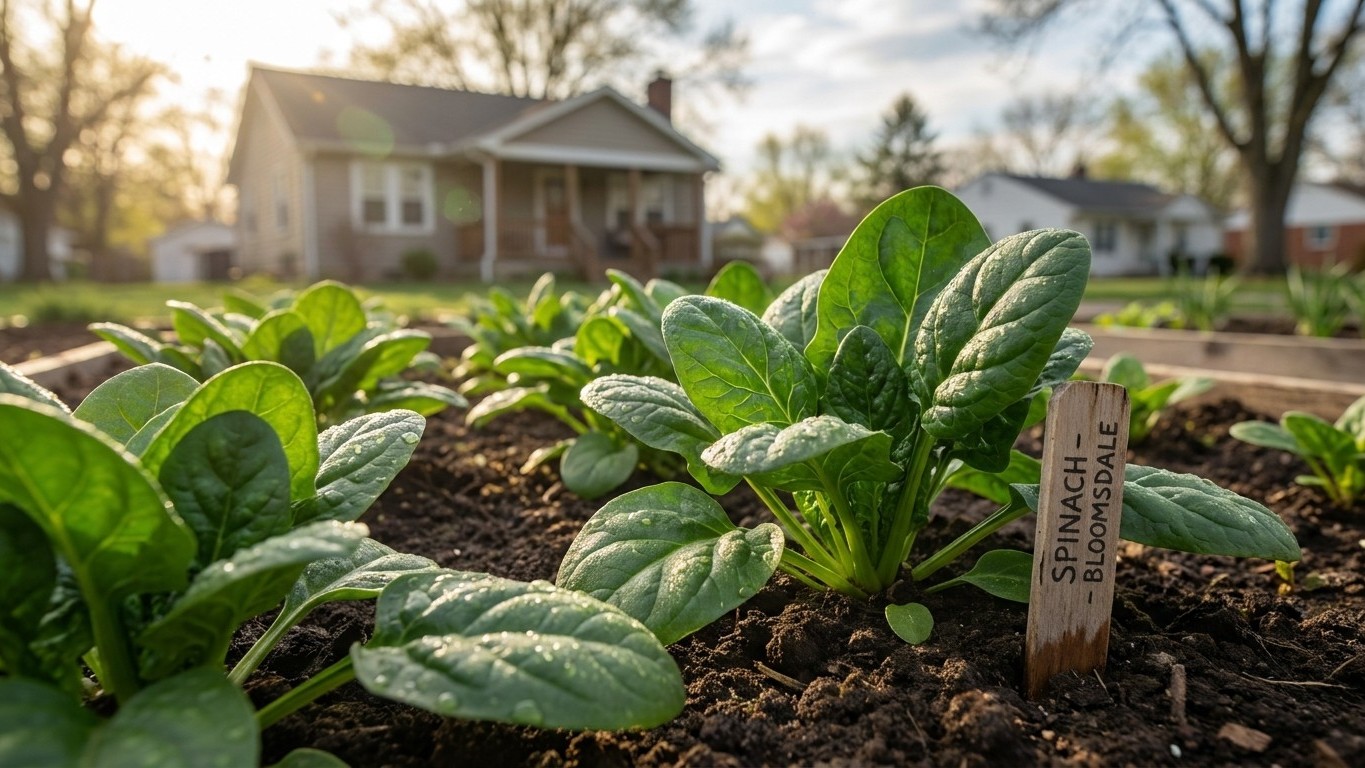

In Jackson, the sun stays up 14 hours and 7 minutes on the longest day of the year. Spinach doesn’t wait for the calendar to say “summer” to react to that. Long days push it toward flowering, and heat finishes the job, so the honest answer for a Mississippi garden is that spinach bolts fast, usually within weeks of the day length and temperature crossing their limits together, and the crop only really works in the short cool brackets before and after that happens.
The short answer
Fourteen hours and seven minutes of daylight at the summer solstice is the number that matters most here, and it works against spinach rather than for it. Long days trigger flowering in this crop. That’s the opposite of what happens with a long-day onion, where extended daylight builds the bulb. For spinach, the lengthening days of late spring are a signal to stop making leaves and start making seed, and there’s nothing a gardener can do to talk the plant out of it once the days stretch that far.
A cooler-than-average Mississippi summer doesn’t change any of this. The day length keeps climbing on its own schedule no matter what the thermometer says, so a mild June doesn’t buy an extra week of usable leaves. If day length were the only issue, spinach would still struggle here. It isn’t the only issue.
Heat piles on top of the day-length problem and makes things worse. Mississippi’s reference station in Jackson averages 71.1 days a year at 90 degrees Fahrenheit or above, a heat load that arrives early and lingers late. Spinach grows best where temperatures stay under 75 degrees Fahrenheit, and above that line the plant both slows down and turns bitter. So the limit in Mississippi is genuinely both: long days pull the plant toward bolting, and heat pushes it there faster and makes what little harvest remains taste worse.
That combination is why spinach in this state is treated as a bracket crop, something squeezed into the cool edges of the calendar rather than grown through the middle of it. Spring gives a short run before the days lengthen and the heat builds, which raises the question of Will Spinach Bolt Early in Mississippi? Fall gives a longer, gentler run once both start easing back down, which is why knowing When to Sow Autumn Spinach in Mississippi matters as much as timing the spring crop. Summer itself is functionally off the table, not because the plant can’t survive the season, but because it won’t stay in leaf-producing mode once daylight and heat cross their thresholds at the same time.
Four spinach varieties commonly show up in seed racks and garden references: Bloomsdale, Melody, Teton, and Olympia. No days-to-maturity figures or heat tolerance data for any of these four are published in the sources behind this article, so none should be assumed. What is established is the mechanism: day length triggers bolting, heat accelerates it, and Mississippi’s climate supplies both in generous amounts for most of the year.
How long the spring window really is
- Start with the last frost. At the Jackson reference station, the last spring freeze typically falls between March 6 and March 22. That’s the anchor date for everything that follows.
- Count back for sowing. Spinach seed goes in the ground two to three weeks before that last frost date, which puts a realistic sowing window somewhere between mid-February and early March, depending on how far into that March 6 to March 22 range a given year lands.
- Track how fast the ceiling arrives. Once temperatures start climbing past the 75 degree Fahrenheit growth ceiling, the plant’s productive window closes, and Mississippi’s climate, with 71.1 days a year reaching 90 degrees at the reference station, tends to warm up quickly once the frost season ends. There isn’t a published date marking exactly when that 75 degree line gets crossed each spring, so this has to be read as a trend rather than a fixed day.
- Add the day-length pressure. While that heat builds, daylight is also lengthening toward the 14 hour, 7 minute peak, which independently pushes the plant toward bolting. The two pressures usually land close together in Mississippi springs, which shortens the harvest window from both directions at once.
- Total it up. Between a mid-February to early March sowing and a spring that warms fast enough to average more than 70 days above 90 degrees over the year, Mississippi gardeners are typically working with somewhere around six to eight weeks of usable spring spinach growth before bolting takes over, and less in a year where warmth arrives on the early side of normal.
The autumn crop, and when the soil lets you sow
Fall is the better season for spinach in Mississippi, mainly because both pressures, day length and heat, are heading downward instead of up. But two separate obstacles still shape the timing, and they don’t line up with each other automatically.
Soil still too warm to germinate
Spinach seed germination drops off once soil temperature climbs above 80 degrees Fahrenheit. In a state that logs an average of 71.1 days a year at 90 degrees air temperature, soil often holds onto that heat well past the point when the air itself starts to feel like fall. Sowing too early in late summer, even if the day count works out on paper, can simply mean seed that won’t sprout because the ground underneath it hasn’t cooled down yet. Waiting for soil to actually drop below that 80 degree mark matters more than sticking to a fixed date on the calendar.
The frost that ends the season
The other boundary is the first fall frost, which at the Jackson reference station arrives somewhere between November 7 and November 22. Utah State University Extension advises sowing a fall spinach crop 50 to 75 days before the date you want to harvest. Counting back from a harvest target in early to mid-November puts a reasonable sowing window somewhere in the stretch from late August through early October, with the earlier end of that range only workable once soil temperatures have actually cooled past the 80 degree threshold. In practice, that means Mississippi gardeners are usually looking at mid-September through early October as the more reliable sowing stretch, once the ground has caught up with the calendar.
Checking this against your own county
Every figure above comes from a single reference station, and frost dates in particular shift by county, by elevation, and by how close a garden sits to open water or pavement. A rural garden away from Jackson can see its last spring frost run later and its first fall frost arrive earlier than the airport-station dates given here, sometimes by one to two weeks.
Before locking in a sowing date, it’s worth checking those local patterns against county-level guidance. The Mississippi State University Extension Service tracks planting recommendations and local conditions county by county, and its county offices are the most direct way to confirm how the statewide numbers above translate to a specific garden.
Common questions
Can spinach be grown through a Mississippi summer with shade cloth?
Shade cloth can lower leaf temperature somewhat, but it doesn’t shorten the day. Since long days trigger bolting independently of heat, shading alone won’t stop the plant from flowering once daylight passes its threshold for the season.
Is fall or spring the more reliable season for spinach in Mississippi?
Fall generally works better, since both day length and temperature are moving downward through the sowing and growing period rather than climbing toward the bolting threshold, as they do in spring.
Does bolted spinach mean the harvest is over?
Once a spinach plant sends up a flower stalk, leaf quality drops fast and the remaining leaves tend toward the bitterness associated with the 75 degree Fahrenheit ceiling. At that point, most gardeners treat the crop as finished rather than trying to extend it.
Do Bloomsdale, Melody, Teton, or Olympia handle Mississippi conditions differently?
These four varieties are commonly available, but no published data compares their days-to-maturity or heat response, so no variety-specific claim about Mississippi performance can be made here.