
Mississippi gardeners can start summer squash outdoors once soil temperatures stay reliably warm, generally from mid-to-late March in the southern half of the state to early April farther north. But the real story isn’t the calendar date, it’s what happens underground, in the air, and in the sky above your garden all summer long, and that’s where this state’s particular mix of heat and rain changes the usual advice.
When the soil is warm enough in Mississippi
At the reference station used by NOAA for Mississippi’s climate normals, the last spring frost falls somewhere between March 6 and March 22 (30-70% probability band, NOAA NCEI 1991-2020 Climate Normals). That’s a wide window, and it’s worth sitting with for a second: it means in some years the risk clears by the first week of March, and in others it lingers past the equinox. Suburban and rural gardens away from the airport station typically see frost linger later in spring, sometimes by one to two weeks, more if you’re at higher elevation or in a low-lying frost pocket. Check your own county’s extension office before you trust a date on a page like this one.
Here’s the part that trips people up: frost date is a proxy, not the actual trigger. Summer squash doesn’t care about frost risk directly, it cares about soil temperature. Squash seed sown into cold, wet soil will often rot before it germinates, or sit stalled for weeks while weeds around it take off. Soil warms up after the frost risk fades, not the moment it does, because soil holds cold longer than air does. A sunny week can clear the air of frost danger while six inches down the dirt is still cool enough to slow germination to a crawl.
That’s also why a frost date is a probability, not a promise. Nothing in these NOAA figures guarantees a frost-free string of nights after March 22. It’s a statistical band built from three decades of data, useful for planning, useless as a guarantee for any single spring.
What this means for planting
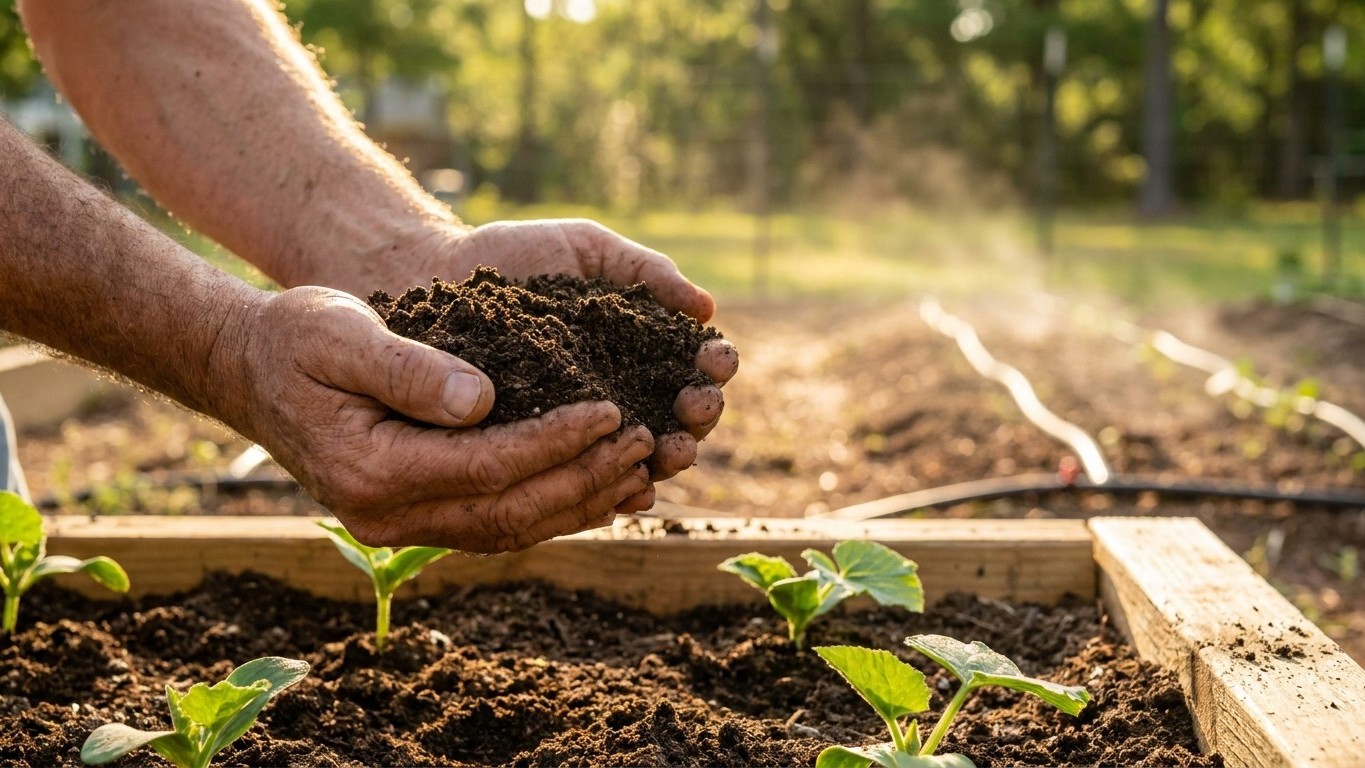
Rather than circling a date on the calendar, most Mississippi gardeners do better watching the soil itself: is it crumbly and workable, has it had a run of warm days, does a handful feel more like potting mix than mud? Direct-seeding works well once that threshold is crossed. Transplanting can buy a couple of extra weeks at the front end, but summer squash resents root disturbance more than most vegetables, so any transplants need to go in young, with minimal root check, and get real gentle handling around the stem.
Mississippi sits mostly in USDA Hardiness Zones 7b to 9a, a range built entirely from average annual extreme minimum winter temperature (USDA Plant Hardiness Zone Map, 2023, based on 1991-2020 normals). That figure tells you almost nothing about summer squash timing directly, since it’s a winter cold metric, but it does explain why the frost window itself sits where it does across such a long, warm state. Zone alone won’t tell you when to plant. The frost data and your own soil will.
How long the season lasts here
Run the numbers from the same reference station: last spring frost in the March 6 to March 22 window, first fall frost between November 7 and November 22 (both NOAA NCEI 1991-2020 Climate Normals). Counting from the latest spring date to the earliest fall date gives a conservative frost-free window of roughly 230 days. Counting from the earliest spring date to the latest fall date stretches that to around 261 days. Either way you land on, that’s a long season by national standards, and it’s the single biggest advantage Mississippi gardeners have over squash growers farther north.
What does a window that long actually allow? It allows you to treat your first sowing as a starting point rather than your only shot. Summer squash plants typically decline in vigor and productivity after six to eight weeks of heavy bearing, especially once squash vine borer or powdery mildew starts working on older plants. In a short-season territory, that decline just means the garden winds down for the year. In Mississippi’s long window, it means there’s real calendar room left to pull tired plants and put in a fresh round, often catching a second harvest before the fall frost risk actually arrives.
A season this long also changes the transplanting math. In a tight window, a week saved by starting seed indoors matters enormously, worth the risk of root disturbance. Here, with well over 200 frost-free days on the table, direct-seeding loses little by comparison, and it sidesteps the transplant shock squash is prone to. Where transplants still earn their keep is in getting that second or third succession sowing going while the first planting is still producing, letting you start the replacements in cell trays off to the side rather than losing garden space early.
For the mechanics of staggering plantings, timing the gap between sowings, and reading when a stand of squash is past its productive peak, the succession sowing guide on this site walks through the decision points in more detail than fits here.
Heat and water in Mississippi
This is where Mississippi’s climate stops being a convenience and starts requiring management. At the Jackson reference station, the year averages 71.1 days at or above 90°F (NOAA NCEI Climate Normals, 1991-2020). That’s not an average summer temperature, it’s a count of how many days actually cross that threshold, and it matters because squash pollen loses viability fast once temperatures push into the high 90s. Flowers can open, look perfectly normal, and still fail to set fruit, because the pollen itself didn’t survive the afternoon heat. A gardener who sees plenty of blossoms but few squash forming in July or August is usually watching heat stress play out, not a pest or disease problem.
Squash leaves compound the issue. They’re enormous relative to the plant’s root system, and a shallow, spreading root plate simply can’t pull water fast enough to keep pace with what those broad leaves lose to evaporation on a 95-degree afternoon. The plant wilts by midday even when soil moisture looks adequate, a defensive response rather than a drought emergency, but it’s a sign the whole system is working near its limit.
Rainfall during the growing season doesn’t fully offset that heat load. Summer rainfall across June, July and August averages about 14.1 inches at the reference station (NOAA NCEI Monthly Climate Normals, 1991-2020), broken down as 4.43 inches in June, 5.02 in July, and 4.69 in August, June being the driest of the three. On paper that sounds like reasonable moisture. In practice, Mississippi’s summer rain tends to arrive as thunderstorms rather than steady soaking rain, meaning a good share of it runs off rather than infiltrating, especially on clay soils where water can pool and shed rather than sink in, or on sandy soils where it drains through before roots get much benefit. Combined with 71 days a year pushing past 90°F and driving evaporation hard, this is a territory where irrigation and afternoon shade cloth aren’t optional extras, they’re what decides whether a planting makes it through late July intact.
A soil moisture check with your own hand, or better, a simple rain gauge on the property, tells you more than any regional average. Local slope, tree cover, and soil texture change how far that 14.1-inch summer average actually reaches your root zone.
Which summer squash suit Mississippi
None of this points to a single named variety, and that’s deliberate, not an omission. Reasoning from the facts above: Mississippi’s long frost-free window, well over 200 days, doesn’t force gardeners toward the earliest-maturing types the way a short-season northern state would. There’s room here to choose based on other priorities instead.
Heat load is one of those priorities. With 71.1 days a year above 90°F, types that hold up under sustained heat, and that respond well to being grown with good airflow and light afternoon shade at the hottest point of the day, tend to fare better through Mississippi’s July and August stretch than types bred mainly for cooler, shorter growing regions.
Humidity is the other. Summer rainfall arriving mostly as thunderstorms, combined with the state’s warmth, creates the kind of damp, still air that powdery mildew and other fungal pressures thrive in. Disease resistance, particularly to powdery mildew, becomes less of a nice-to-have and more of a first filter when choosing what to plant.
What this page won’t do is hand over a cultivar name. Seed catalogs change their offerings yearly, and a variety trialled and recommended in one Mississippi county doesn’t necessarily perform the same two hundred miles away on different soil. The Mississippi State University Extension Service publishes locally trialled variety recommendations that this page simply can’t replicate responsibly. That’s not a dodge, it’s the honest answer: a variety name invented or borrowed from a national seed catalog is worth less than a five-minute call to your county extension office, which knows what’s actually held up against this state’s heat, humidity, and thunderstorm patterns.