
Near Billings, the last spring freeze lands anywhere from April 29 to May 10, and the first fall freeze arrives October 1 to October 14 — a window most orchard advice treats as a fixed date instead of the 30 to 70 percent gamble it actually is. A tree still in bloom on April 29 hasn’t dodged anything yet. What decides your year isn’t the calendar so much as elevation above the Yellowstone valley, which cultivar you planted, and whether site and rootstock were settled before bloom became the thing at risk.
The short answer for Montana
Near Billings, NOAA’s 1991-2020 climate normals put the last spring freeze at April 29 to May 10 and the first fall freeze at October 1 to October 14. Everything an apple tree does between those two windows, from bud break to picking, has to fit inside that stretch, and the coldest month there runs a mean daily minimum of 17.8°F, also NOAA NCEI’s 1991-2020 figure, which is mild enough for the hardiest orchard cultivars but says nothing at all about a late frost catching an open blossom.
The NOAA window itself is a probability band, not a hard line. It marks the days when a 32°F freeze has a 30 to 70 percent chance of happening at the reference station in Billings. In practice that means a tree in full bloom on April 29 is still gambling, and a tree still at pink on May 10 has already dodged more risk than one already past petal fall.
That answer depends on three things: how much elevation sits between your orchard and the Yellowstone River valley where Billings sits, which cultivar is in the ground, and whether the basics in Growing Apples in Montana, mainly site selection and rootstock choice, are already settled before bloom timing becomes the thing that decides the year. Cultivars bred for northern winters and short seasons, ‘Haralson’, ‘Wealthy’, ‘Norland’, ‘Zestar!’ and ‘Honeycrisp’ among them, carry USDA zone 3 or colder ratings on the nursery tag, and a full ranking of those against Montana’s climate is worth reading in The Best Apple Varieties for Montana before you plant.
Working through it

Apple timing in Montana runs off the tree’s stage, not the date on the wall, because a warm March can push a stage two weeks ahead of an average year and a cold April can hold it back just as far.
Dormancy through bloom
Dormant pruning happens before any bud swells, while the tree can still take a hard freeze without injury. This is the season to judge cold hardiness against Billings’ mean coldest-month minimum of 17.8°F: a cultivar rated for that kind of winter specifically, not just for “cold climates” in general, is the one worth having in the ground. As buds swell and show a sliver of green at green tip, the wood is still frost-tolerant well into the twenties, and this is when a dormant oil or copper spray goes on if scab has been a problem. At pink, the blossom shows color but stays closed, and frost tolerance drops hard from here forward.
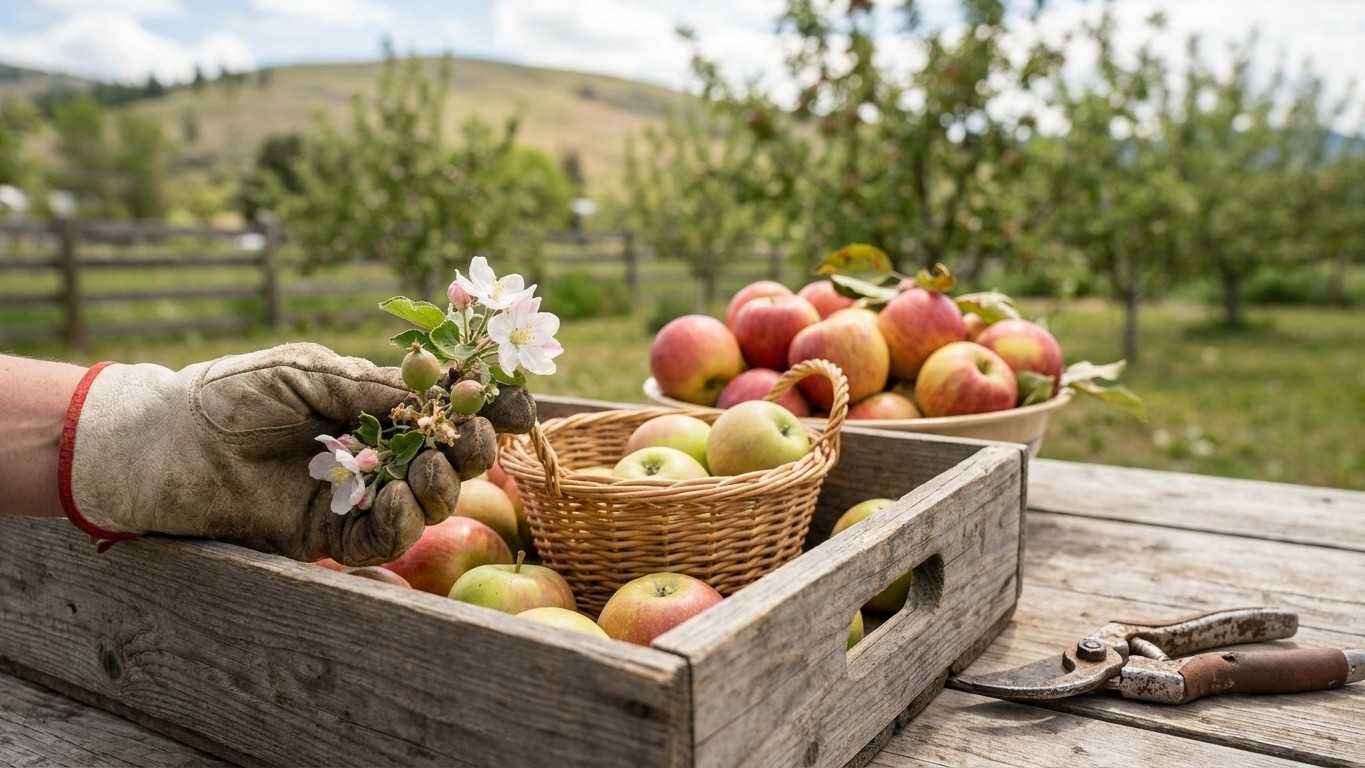
Bloom is the stage that decides the crop, more than any other. An open blossom is the most frost-sensitive tissue the tree carries all year, and losing it to a freeze inside or after NOAA’s April 29 to May 10 window means no fruit on that spur for the season, whatever the weather does afterward. Most years in the Billings area, full bloom lands after that window closes, but a warm spurt in April can pull it earlier and put it right back inside the risk band, which is the whole reason to watch the blossom instead of the calendar page.
Petal fall through harvest
Once petals drop, the young fruit toughens and frost tolerance climbs back up fast. Thinning to one fruit per cluster happens here, while the tree still has a full season to size up what is left. Fruit set follows, and from that point the countdown to harvest is set by the cultivar’s own ripening season, early for ‘Norland’ and ‘Zestar!’, mid for ‘Wealthy’ and ‘State Fair’, late for ‘Haralson’ and ‘Honeycrisp’, crossed against how many weeks of frost-free season are actually available that year. Late-season cultivars need to finish before the first fall freeze at October 1 to October 14, NOAA’s Billings figure again, and in a year running behind schedule, that is the stage worth checking against the forecast rather than fruit color alone.
| Stage | Frost risk | What to do |
|---|---|---|
| Dormancy | Very low | Prune, settle on cultivar and rootstock |
| Green tip | Low | Dormant oil or copper spray if scab has a history |
| Pink | Rising fast | Watch forecasts closely, hold off late fertilizer |
| Bloom | Highest | Avoid sprays that harm pollinators, protect from forecast frost |
| Petal fall | Dropping | Thin fruit to one per cluster |
| Fruit set | Low | Water and feed on schedule, stop nitrogen by midsummer |
| Harvest | Rising again | Pick late cultivars before the first fall freeze window |
What changes across Montana
The NOAA figures above are measured at Billings, one of the state’s milder valleys along the Yellowstone River, and the rest of Montana does not share that frost window.
Where the season runs shorter
Elevation is the biggest single factor. Mountain valleys elsewhere in the state, the kind that ring the Bitterroot, the Big Hole and the high benches around Bozeman and Livingston, sit high enough and trap cold air well enough that a frost can arrive in any month, which is why an orchard in one of those valleys should treat the Billings dates as an outside boundary, not a working schedule, and plan on a narrower bloom-to-harvest window than the one above.
Where a large body of water helps
Flathead Lake, in the northwest part of the state, moderates the air around its shoreline enough that orchards there have historically grown tree fruit that would struggle a short distance away at higher, drier ground. That moderating effect works the same way large lakes do anywhere: it slows both the spring warm-up and the fall cool-down, softening the swings that damage blossom and fruit.
Where the plains push back
East of the mountains, toward Miles City and the open plains, the climate runs more continental: hotter summer days, colder winter nights, and faster swings between the two. Growers in that part of the state are working with wider margins in both directions, and the cultivar list that performs well in a moderated valley is not automatically the right one on the open plains.
The mistakes this climate punishes
Some errors do not show up until the one year the weather does not cooperate, and by then the tree has already told you what it needed.
Blooming into the frost window
An early-blooming cultivar planted where local frost risk actually runs into NOAA’s April 29 to May 10 band, which by the definition of a 30 to 70 percent probability happens in a meaningful share of years, loses its blossoms and its crop for the season. This shows up as a tree that flowered heavily and then set almost no fruit, which growers often blame on poor pollination when the real cause was a night nobody watched.
Feeding too late
Nitrogen applied after midsummer pushes soft new growth right when the tree should be hardening wood for winter. That soft growth is the tissue that dies first when the first fall freeze arrives, October 1 to October 14 at Billings by NOAA’s normals, and earlier than that at higher elevation. The fix is stopping nitrogen well before that window opens, not after the first cold snap makes the mistake obvious.
Matching hardiness, not chill
Montana’s winters are long enough that chill is rarely the limiting factor the way it is in a mild-winter state. The filter that actually matters here is cold hardiness: a cultivar rated for a milder zone than the winter it is planted into declines over several winters instead of failing outright in the first one, which makes the mistake easy to miss until the tree is too far gone to replace easily.
- Early bloom in a frost-prone site: shows as heavy flowering, poor fruit set
- Late nitrogen: shows as winter dieback on the newest wood
- Zone mismatch: shows as slow decline over several winters, not a single kill
- Ignoring elevation: shows as a crop lost to a frost the valley floor never saw
Checking this against your county
Every figure above comes from one reference station near Billings, and Montana’s climate changes enough across the state that a county line, a river bench or a thousand feet of elevation can shift both frost dates by weeks. Montana State University Extension keeps county-level guidance and can point to weather station data closer to your own valley before you commit to a planting date or a spray schedule.
Call the county extension office before ordering trees for spring, not after, since a cultivar suited to Billings is not automatically suited to a colder valley an hour away.
Common questions
Can apples even survive a Montana winter without any protection?
Established, correctly hardy cultivars survive Montana winters without wrapping or mulching in most valleys, since they’re bred for winters colder than Billings’ mean coldest-month minimum of 17.8°F. Young trees in their first one or two winters benefit from trunk protection and mulch regardless of cultivar, since the graft union and young bark are more vulnerable than mature wood.
My tree bloomed before the last frost date passed. Is the crop already lost?
Not necessarily. NOAA’s April 29 to May 10 window at Billings is a probability band, not a guarantee of frost, so a tree in bloom inside that window may still come through a mild night undamaged. Check the blossoms the morning after any freeze: browned or blackened centers mean that flower is done, while blossoms still showing white or pink are likely fine.
How do I tell if a frost actually killed my blossoms?
Cut a few open blossoms open and look at the center. A live flower shows a pale green or cream-colored core, while a frost-killed one turns brown or black at the base within a day of the freeze. Petals that look fine on the outside can still hide a dead center, so check inside the flower rather than judging by petal color alone.
Do I need two different apple trees for pollination in Montana?
Most apple cultivars need a different cultivar blooming nearby to set fruit reliably, since they don’t pollinate themselves well. A neighbor’s tree or a crabapple within bee range often covers this, but if you’re planting in an isolated spot, plan on at least two compatible cultivars with overlapping bloom times rather than assuming one tree will produce on its own.