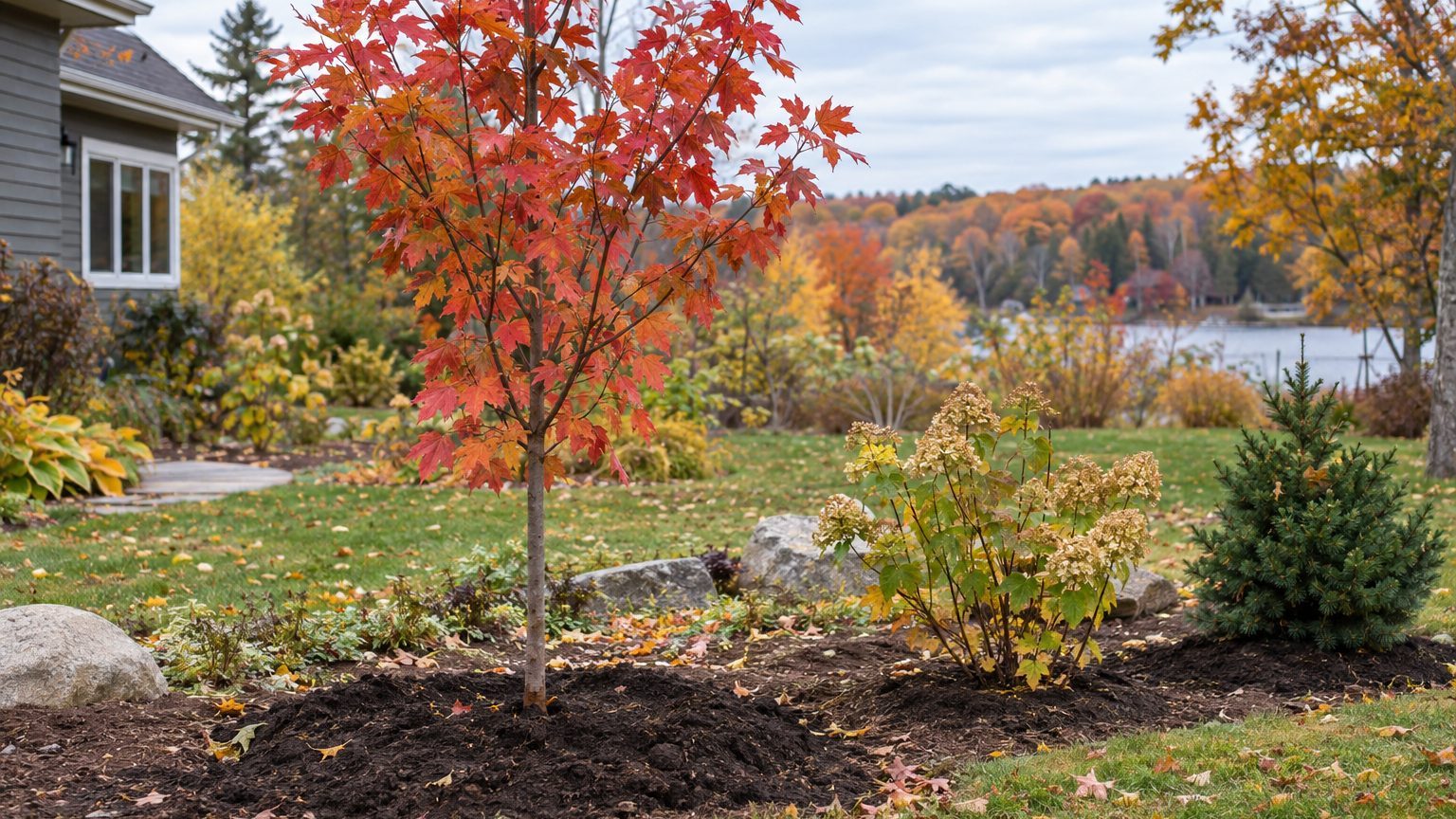

In Missouri, the safe cutoff for planting trees and shrubs in fall is six weeks before the first fall frost. At the Kansas City airport station, that works out to September 6 to September 17. Plants that go in later often survive, but every week past that window shortens the time roots have to grow before the soil shuts down. Southern Missouri gets extra time. The colder north gets less.
The deadline in Missouri
Roots don’t follow the thermometer the way leaves do. They keep growing as long as the soil is workable and above freezing, which can be weeks after the first cold night in the air. That gap is the whole reason fall planting works: the top of the plant goes quiet while the roots keep moving into new ground.
The gap has a limit, though. Cornell Cooperative Extension states the rule this way: “Fall is an excellent time for transplanting, provided you get them to their new home at least 6 weeks before the ground freezes, allowing them time to establish roots before winter dormancy.” The count runs back from the moment the ground freezes, not from the first frost. Soil holds summer heat longer than air does, so the ground freezes later than the first 32°F night.
Now the Missouri numbers. NOAA’s 1991-2020 Climate Normals for the Kansas City International Airport station put the first fall 32°F freeze between October 18 and October 29 (that is the band where the odds of a first freeze run from 30 to 70 percent). Count six weeks back from that range and you land on September 6 to September 17. That is the date to write down as your safe target for trees and shrubs.
| Measure | Kansas City area (MCI station) | Source |
|---|---|---|
| First fall frost (32°F) | October 18 to October 29 | NOAA NCEI 1991-2020 Climate Normals |
| Conservative planting deadline | September 6 to September 17 | Cornell rule counted back from the frost range |
| Coldest-month mean daily minimum | 19.5°F | NOAA NCEI 1991-2020 Climate Normals |
Treat that window as a conservative target, not a wall. Because the ground freezes after the first frost, the true limit usually falls later than the dates above. Counting from the frost simply builds in a cushion. A tree planted in early October is behind schedule, not doomed, and a tree planted in mid-November into workable soil has a real chance if you care for it well. What you lose with each week is margin.
Missouri does freeze. The coldest month at Kansas City has a mean daily minimum of 19.5°F, according to NOAA, so this is not a place where fall planting runs into winter without consequence. The deadline is real here.
Keep in mind that one city stands in for a big state. The USDA Plant Hardiness Zone Map (2023 edition) spans 5b to 7b across Missouri, and the dates above belong to Kansas City. The station sits well north of the city center, and the state’s colder northern reaches see their first frost earlier, so they hit the deadline sooner. Southern Missouri is milder and gets more time. For your own county, check First and Last Frost Dates in Missouri and shift the window accordingly. Gardeners comparing notes with the Mid-Atlantic can see how the same logic plays out in How Late Can You Plant Trees and Shrubs in Fall in Maryland?
What to plant late, and what to wait on
Not every plant handles a late start equally. The safest candidates are container-grown and balled-and-burlapped trees and shrubs that are fully hardy in your zone. They arrive with a decent root mass, they’re dormant or close to it, and they don’t ask much of the soil except moisture. Hardy deciduous trees are the easiest of all, since bare branches lose almost no water once the leaves drop.
The risky group is smaller but worth knowing by name. Plants sold as borderline for your area are the first. The 19.5°F coldest-month minimum at Kansas City tells you how cold a typical winter night gets, and a plant that barely tolerates that range needs a full season of established roots to cope with a bad winter. Putting it in late stacks two risks on one plant. Evergreens are the second. Pines, spruces, hollies and other evergreens keep their foliage all winter and keep losing water through it, while cold soil makes it hard for young roots to send more upward. A deciduous tree solves that problem by shedding its leaves. An evergreen can’t.
| Plant type | Late-fall outlook | What decides it |
|---|---|---|
| Hardy deciduous trees, container or balled | Good | Bare branches lose little water |
| Hardy deciduous shrubs, container | Good | Smaller root ball settles in faster |
| Evergreens, needled or broadleaf | Riskier | Foliage keeps losing water in cold soil |
| Borderline-hardy plants | Wait | Little root growth before the first hard winter |
Here’s the decision worth writing down: plant fully hardy container or balled deciduous trees and shrubs through fall, and hold evergreens and borderline-hardy plants until spring if you’ve missed the September window. Spring planting gives those plants a whole growing season before their first winter, and nurseries usually keep stock available then anyway.
One habit improves any late planting. Before a container plant goes in the ground, slide it out and look at the roots. Circling roots need to be loosened or cut so they grow outward into your soil instead of continuing in the shape of the pot. A plant with a tight root mass in cold soil may never break out of its container shape, and that habit costs it later, during a hot summer or a windstorm. General technique for setting the plant at the right depth and backfilling sits in Planting and Caring for Trees, Shrubs and Perennials.
Timing matters most for the plants in the middle. A hardy, healthy shrub from a nursery and a tree that has been sitting in a pot in a parking lot since July are not the same purchase, even if the tags match. Pick plants with firm, moist root balls and healthy buds, and skip any with roots poking hard out of the drainage holes or dry, brittle stems.
Watering and mulch until the ground freezes
Newly planted trees and shrubs need water the way an infant needs feeding: on a schedule you can’t skip, even in October. Roots in dry soil stop growing, and roots that stop growing don’t anchor the plant or reach for moisture later. The job is to water deeply, until the soil freezes, whenever rain doesn’t do it for you.
A slow, deep soak beats a quick sprinkle. Water that sits on the surface evaporates or runs off, while water that soaks down pulls roots deeper. To check whether a plant needs a drink, push a trowel or screwdriver into the soil beside the root ball and look at what comes out. Damp and cool means wait. Dry and crumbly means water. Some Missouri falls run dry from September into November, and a tree that looked fine in October can go into winter stressed if nobody checked it. Keep watering until the soil is too frozen to take water, not until the leaves turn color.
Mulch at the right depth
Mulch does two things for a fall planting: it holds moisture and it evens out soil temperature. The NC State Extension Gardener Handbook (chapter 11, Woody Ornamentals) gives the depth in plain terms: “A 2-inch to 3-inch layer of mulch suppresses most annual weed seeds and makes it easy to hand-pull any that do germinate.” On trees specifically it adds: “Provide a 3-inch layer of mulch to reduce water loss and maintain uniform soil moisture and temperature around roots.”
Two sentences, two different jobs, and the same order of depth. The point is to stay in that range. More does not help, and deep mulch is how a neat ring turns into a volcano, with a cone of chips piled against the trunk. That cone traps moisture against the bark, invites rot and gives small animals a sheltered place to chew. Spread mulch in a wide, flat ring and pull it back from the trunk so the flare, where the trunk widens toward the roots, stays visible. The shape of that ring is spelled out in Mulching Without Killing the Plant.
Underneath all of this sits one idea about what the first winter is for. A newly planted tree is not trying to grow taller. It is trying to rebuild the root system it lost when it was dug or containerized, and cool, moist soil is good for that job. Top growth waits for spring. So the 2-inch to 3-inch mulch layer, applied in a ring after a deep watering is the decision that pays off, because it protects the one thing the plant is actually building this season.
What goes wrong
The most common failure is simple: planting too late for this climate. When the soil cools and then freezes before roots have spread, the plant enters winter anchored by little more than its original root ball. Trees and shrubs put in well after the September 6 to September 17 window are not automatically lost, but they have less margin for a hard winter, a dry spell or a cold snap in January, and the reduced margin is where they die.
Winter burn is the second problem, and it belongs mostly to evergreens. Leaves and needles lose moisture on sunny, windy winter days, and frozen soil keeps roots from replacing it. The foliage browns, usually from the tips or on the side facing the wind. An evergreen with a full season of roots behind it handles this. One planted in late fall often can’t. A deep watering right before the ground freezes helps, and so does putting the plant where winter wind won’t hit it directly.
Heaving is the third. Missouri soil freezes and thaws repeatedly through winter, and that cycle can push a shallow, unanchored root ball up and out of the ground a little at a time. The plant looks fine until the roots dry out in exposed air. A proper ring of mulch evens out those temperature swings, and it is worth checking newly planted trees after each thaw, pressing the soil back down if the root ball has lifted.
The last one is quiet: drying out. A dry fall gives a new plant no natural help, and because nothing looks wrong until spring, the damage goes unnoticed. If you miss the safe window, plant only while the soil is still workable, and keep watering until the ground freezes. If the ground has already frozen, wait for spring.
Common questions
Can I plant trees in Missouri in November?
Sometimes, yes. The safe target is September 6 to September 17 at Kansas City, but the ground freezes after the first frost, so November planting is possible whenever the soil is still workable. Stick with hardy deciduous trees and shrubs, water them deeply, and mulch. Skip evergreens and borderline-hardy plants and wait for spring. Once the soil is frozen too hard to dig, planting is over for the year.
Does the deadline change across Missouri?
It does. The dates here come from the Kansas City International Airport station, where the first fall 32°F freeze falls between October 18 and October 29 in NOAA’s 1991-2020 normals. Northern Missouri is colder, gets its first frost earlier and reaches the deadline sooner. Southern Missouri is milder, so the window runs later there. The USDA Plant Hardiness Zone Map (2023) shows the state spanning 5b to 7b, a good reminder that one date can’t cover every county.
Should I fertilize a tree I plant in fall?
Fertilizer is not what a new tree needs in its first fall. Nitrogen encourages leafy top growth, which is the wrong signal going into winter, when the plant should be spending its energy on roots. Water and mulch do more for a fall planting than anything from a bag. If a soil test shows a specific deficiency, deal with it in spring.
How do I know when to stop watering?
Stop when the soil is frozen too hard to push a trowel or screwdriver into it, because water can’t soak in at that point. Until then, keep checking beside the root ball and water when the soil is dry. Cornell’s rule counts six weeks back from when the ground freezes, and at Kansas City the coldest-month mean daily minimum is 19.5°F, per NOAA, so that freeze does arrive every winter. The Missouri guides cover more of the local calendar.