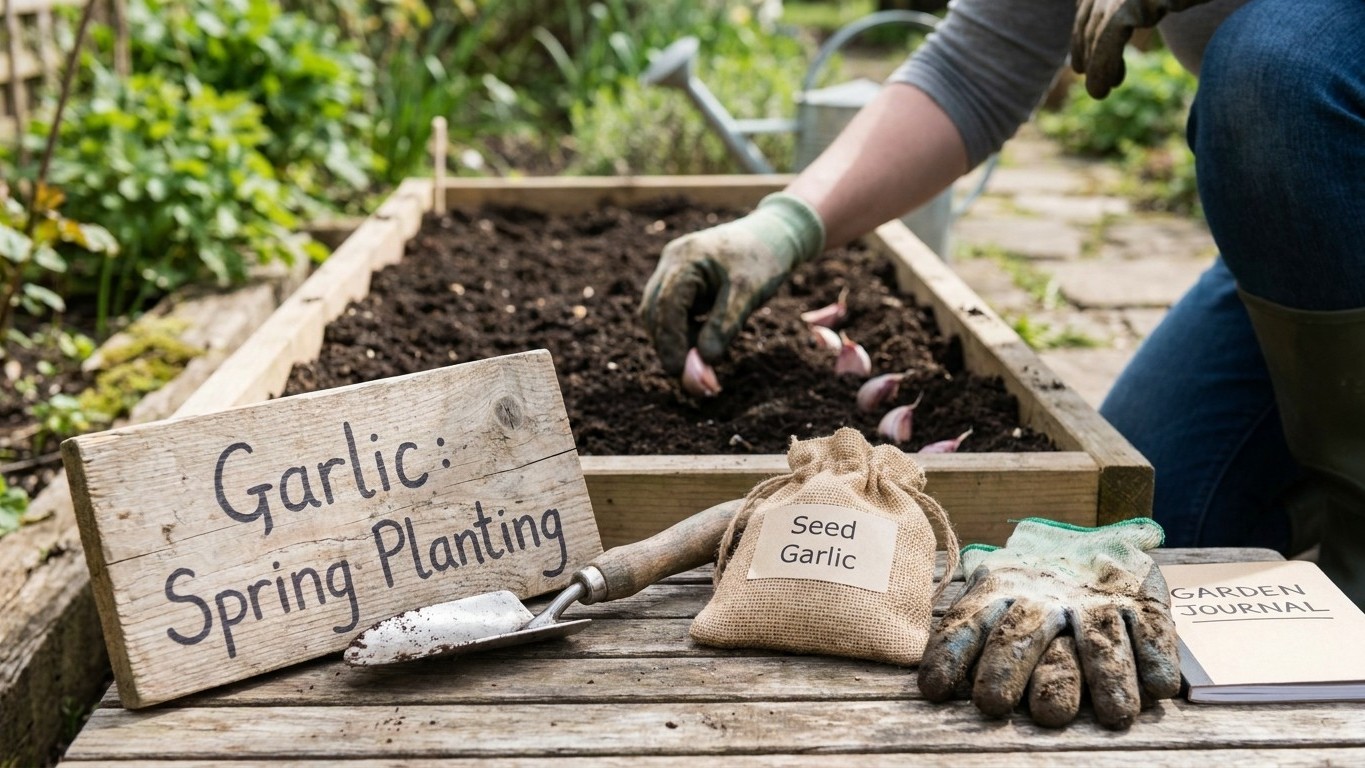

Garlic planted in spring will not size up the way a fall-planted bulb does, because it misses most or all of the cold spell that tells a clove to split into cloves at all. You will still get a harvest, just a smaller one, often a single round bulb instead of a divided head. If spring planting is your only option this year, get cloves into the ground the moment soil can be worked, and reach for a softneck variety like ‘California Early’ or ‘Inchelium Red’ rather than a hardneck, since softnecks tolerate a shorter chill.
Why this matters for garlic

Garlic is one of the few crops where the planting decision and the harvest are separated by most of a year. Get the timing wrong in autumn or spring, and the result does not show up as a wilted seedling next week. It shows up in midsummer as a bulb the size of a shallot, or as a single unsplit clove with no wrapper layers at all. By the time you see it, the season is already over and there is nothing left to adjust.
The mechanism behind this is vernalization, the cold period a garlic clove needs to trigger cell division inside the bulb. Skip enough of that cold, and the plant grows leaves and a stem but never divides the bulb into cloves. This is the single biggest reason spring planting under-delivers, and it is worth understanding before you decide whether to plant at all this season. For the full mechanics of how cold hours translate into clove count, see Why Garlic Needs Cold: The Weeks That Decide Whether You Get Cloves.
None of this means spring planting is worthless. It means you are trading bulb size and clove count for the chance to still harvest something in a year you missed the fall window. That trade-off should be made on purpose, not discovered in July.
When to do it
There is no single calendar date that works everywhere, and garlic sources genuinely disagree on how to phrase the window. Some describe spring planting as happening as soon as the ground can be worked, meaning the soil is no longer frozen or waterlogged, regardless of what the calendar says. Others tie it to the last expected hard freeze in a given area, planting a few weeks ahead of that so the clove gets whatever residual cold is left in the soil before active growth starts.
Why the disagreement exists
The disagreement comes down to how much natural chilling a region still delivers in early spring. In places where nights stay cold well into the season, a clove planted early can pick up several more weeks of vernalizing temperatures before it starts pushing leaves. In places where spring warms quickly, that window closes fast, and planting even a week late can mean the difference between a bulb that divides and one that does not. Your state extension service or land-grant university publishes local frost and soil-temperature data that will tell you where your own window falls, and that is the number to check rather than a national average.
Whatever the local date turns out to be, treat it as an outer limit, not a target. Earlier is almost always better for spring-planted garlic, because every extra week of cool soil before growth kicks in is a week of vernalization you would otherwise be missing entirely.
How to do it
Start with the clove, not the ground. Break bulbs apart just before planting, not weeks ahead, since exposed cloves dry out and lose vigor. Plant only the largest, firmest cloves and discard anything soft, discolored, or visibly shrunken. Buying dedicated seed garlic rather than planting supermarket bulbs matters here more than usual, since supermarket garlic is often treated to suppress sprouting and is rarely matched to your climate. See Seed Garlic: Why Supermarket Bulbs Disappoint, and What to Buy for how to source cloves that will actually grow.
Plant each clove pointed end up, root end down, at a depth commonly recommended by garlic growers of roughly one to two inches of soil above the tip. Space cloves four to six inches apart within a row, and leave enough room between rows for a hoe or hand fork to pass without disturbing neighboring plants, typically twelve inches or more. Firm the soil gently over each clove so there is no air pocket beneath it, which slows rooting.
Cover and feed
Mulch immediately after planting. A two to three inch layer of straw or shredded leaves keeps soil temperature more even, suppresses early weeds, and holds moisture while roots establish, which happens faster than top growth. Garlic is a heavy nitrogen feeder later in the season, but at spring planting the priority is getting roots down, not pushing leaf growth, so hold off on a nitrogen-heavy feed until plants are a few inches tall.
Choose your variety with the shortened season in mind. Softneck types generally need less cold to divide than hardnecks, which is why varieties such as ‘California Early’, ‘California Late’, and ‘Nootka Rose’ are more forgiving of a spring start than hardneck types like ‘Music’ or ‘German Extra Hardy’. Days-to-maturity figures printed on seed catalogs are counted from a fall planting with a full winter chill, so treat those numbers as a rough guide rather than a promise when you are planting in spring instead. If you are still deciding whether this crop fits your rotation and space at all, Growing Garlic covers the full-season basics.
What goes wrong
The most common failure is planting cloves that were never meant for the ground at all. Grocery store garlic is frequently a variety bred for storage and shipping rather than regional performance, and some is treated with a sprout inhibitor. The tell shows up early: cloves that sit in the soil for weeks without any green shoot, when everything else in the bed is up. By the time you notice, replanting for the season is usually no longer realistic.
A second failure is planting too shallow or skipping mulch, both of which leave the clove exposed to temperature swings that interrupt whatever vernalization is still happening. This one is harder to catch early, because the plant often looks fine through spring. The tell arrives at harvest, when you dig a bulb and find it never split into cloves at all, just one solid round mass under the wrapper.
Timing mistakes that hide until summer
Planting too late is the failure gardeners repeat most, because a few warm days in early spring feel like permission to wait. Garlic does not reward that patience. Every week of delay is a week of missed chilling, and the effect compounds silently through the growing season with no visible warning sign until harvest, when bulbs come in noticeably smaller than a neighbor’s fall-planted crop from the same variety.
Overcrowding is the last common error, usually from planting cloves closer than recommended spacing to fit more into a small bed. Garlic does not compete well below ground, and tight spacing produces uniformly undersized bulbs across the whole row rather than a few good ones and a few bad ones. The fix is prevention, not correction. Once cloves are in the ground and growing, thinning does more root damage than it solves.
How this changes across the country
Growers in long, cold-winter regions such as the northern Midwest, the interior Northeast, and the Rocky Mountain states generally have the least reason to Plant Garlic in spring at all, since their fall planting window delivers a long, reliable chill and produces a far better crop. For these growers, spring planting is mainly a fallback for a missed fall window, not a first choice.
- Cold-winter states: fall planting is strongly preferred, spring is a backup plan only.
- Mild-winter states along the Gulf Coast and in parts of the Southwest: naturally shorter, less reliable chill even from fall planting, so softneck varieties matter more year-round.
- Maritime and Pacific Northwest climates: milder winters still deliver enough chill for hardnecks in most years, but spring-planted garlic there sees a shorter cool window before warm weather sets in.
In warmer, short-winter states such as those along the Gulf Coast, the gap between fall and spring planting outcomes narrows, because even fall-planted garlic in those regions gets a shorter, milder chill than a northern grower’s crop. Growers there already lean on softneck varieties for this reason, and spring planting does not represent as steep a drop-off as it does further north. Checking your local university extension’s garlic planting guidance is the most reliable way to know exactly how much that gap matters where you garden, since chill hours and frost timing vary widely even within a single state.
Common questions
Can I still get a full-size bulb from spring-planted garlic?
Rarely. Most spring-planted garlic produces a smaller bulb than the same variety planted in fall, because it misses much of the cold period that triggers clove division. Some plants may not divide at all and instead form a single round bulb.
Is it worth planting garlic in spring if I missed the fall window?
It depends on what you want from the crop. If you are growing for fresh eating or for a future seed source rather than long storage, a spring planting still gives you something to work with, just not a crop you should count on for winter storage.
Do I need to refrigerate cloves before planting them in spring?
Some growers pre-chill cloves in a refrigerator for several weeks before spring planting to make up for the missing field cold. This is a reasonable workaround if your spring soil temperatures are already climbing fast, but it does not fully replace weeks of natural cold in the ground.
Which garlic type is better for a spring planting, softneck or hardneck?
Softneck varieties generally need less cold exposure to divide properly, which makes them more forgiving of a compressed spring chill than hardneck types. That is why varieties like ‘California Early’ or ‘Inchelium Red’ tend to outperform hardnecks in a spring-only planting.