
In Missouri, pumpkin seeds go into the ground once the soil reaches a steady 65°F, typically from mid-May into early June depending on how far north or south of the state you’re gardening. That timing isn’t arbitrary: it’s the only window that lets vines flower early enough for fruit to mature and harden before Missouri’s first fall frost, which arrives statewide between October 18 and October 29. Everything else, from choosing a sowing date to watching the vines through late summer, hinges on hitting that flowering deadline.
The short answer
Missouri’s first fall frost lands somewhere between October 18 and October 29, depending on where in the state you’re gardening (source: NOAA NCEI 1991-2020 Climate Normals). That range comes from a weather station well north of Kansas City itself, so gardeners closer to downtown KC typically see frost arrive about five days earlier, and gardeners in southern Missouri, from the Ozarks down toward the Arkansas line, get a milder autumn still, pushing the date later.
Pumpkins need 45 to 55 days after flowering to reach full maturity, according to Utah State University Extension. That figure is the whole reason a Missouri pumpkin calendar exists at all: not the day you drop a seed in the ground, but the day the first female flower opens and gets pollinated. Count backward from frost, and you get the real deadline for that flower.
Take the earlier end of the frost window, October 18. Subtract 55 days and you land on August 24; subtract only 45 days and you land on September 3. Take the later end of the frost window, October 29: 55 days back is September 4, 45 days back is September 14. Line those numbers up and Missouri’s last safe flowering window runs from roughly the last week of August through the middle of September, tighter in the north, looser toward the Ozarks and the Bootheel.
That’s an unforgiving margin. A flower that opens even a week past that window is racing a fruit that won’t finish coloring, sizing, or hardening its skin before a killing frost ends the season outright. And because a pumpkin plant doesn’t flower the day it’s sown, it needs weeks of vine growth first. That means the sowing date has to sit well ahead of the late-August-to-mid-September flowering deadline, not pressed right up against it.
That’s the mechanism behind every planting calendar you’ll see for the state: not a fixed date on a page, but a frost window worked backward through the flowering clock that Utah State University Extension has documented for pumpkins generally. Get the flowering date right, and the harvest mostly takes care of itself.
When to sow here
Sowing in Missouri isn’t really about the last frost date, at least not directly. It’s about soil temperature, and soil warms up on its own schedule, lagging well behind the air above it.
- Let the last frost window pass first. Missouri’s last spring frost falls between April 6 and April 20 (NOAA NCEI 1991-2020 Climate Normals). Treat that as the earliest the air is reliably safe, not as permission to sow pumpkin seed.
- Wait for the soil, not the air, to hit 65°F. Utah State University Extension names 65°F soil as the sowing threshold for pumpkins. Bare Missouri ground commonly takes real additional time past that April frost window before it holds steady at 65°F, since soil temperature trails air temperature by weeks rather than days.
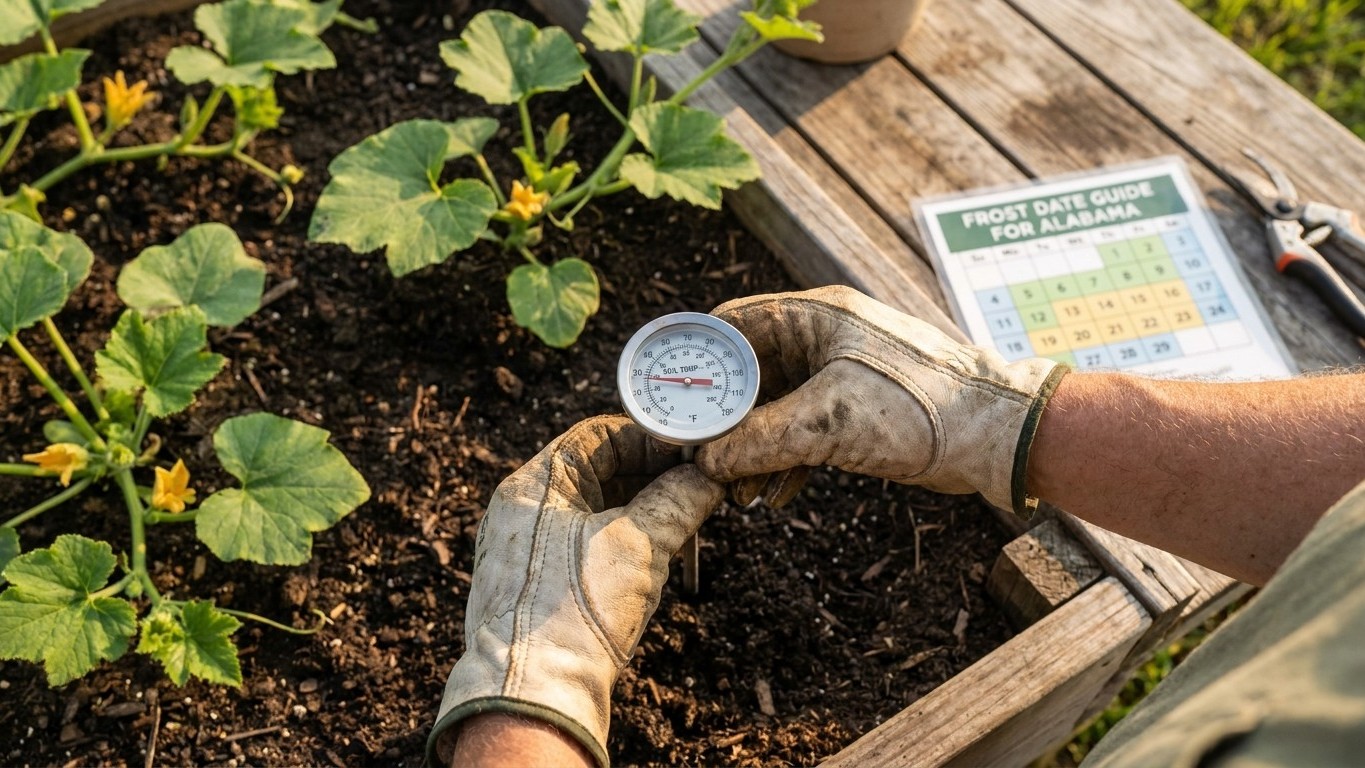
- Check with a soil thermometer, not a calendar page. Push it two to four inches down, mid-morning, on several consecutive days. One warm afternoon doesn’t count; you’re looking for a reading that holds.
- Use row covers or plastic mulch to buy time. Warming a bed ahead of sowing with clear or black plastic, or shielding young seedlings under row cover, can move effective sowing up by about two weeks compared with bare, uncovered soil.
- Aim to have seed in the ground by mid-May through early June. That places sowing far enough ahead of the late-August-to-mid-September flowering deadline described above, leaving room for the weeks of vine growth a pumpkin plant needs before it ever opens a flower.
Miss that window on the late side, sliding into July, and you’re no longer sowing for a full-size, hard-shelled pumpkin. You’re gambling on a frost that may well arrive before the fruit finishes.
What goes wrong here
- A late flower that never colors up. When sowing slips into July, the plant may not open its last productive flower until well past Missouri’s late-August-to-mid-September deadline. The fruit sets but stays green at best, soft and pale at worst, because it never gets the 45 to 55 days of warm weather after flowering that Utah State University Extension says pumpkins require. The fix sits upstream: sow by early June, and treat any flower opening after mid-September as unlikely to finish before frost.
- A fruit caught by frost before it hardens. Missouri’s first fall frost, October 18 to October 29 depending on location, can hit a vine that still has one or two pumpkins sizing up. Extension guidance on this point is simple: harvest with the stem attached before frost reaches the fruit, then move it somewhere it will not freeze. No published storage temperature or timeline comes with that instruction, just the directive to keep it out of freezing conditions until it’s used.
- A vine that dies back before the skin hardens. Foliage loss, whether from an early cold snap or from pests feeding through the leaves, can strip a plant of the photosynthesis it needs to finish hardening a pumpkin’s rind. Squash bugs and cucumber beetles are common culprits in Missouri gardens; rather than re-cover that ground here, see this site’s pages on squash bugs in Missouri and cucumber beetles in Missouri for identification and control. Protecting foliage through the final weeks before frost is often what separates a hardened, storable pumpkin from a soft one.
Common questions
Can I start pumpkin seeds indoors to get ahead of Missouri’s short window?
Pumpkins generally transplant poorly because of a sensitive taproot, which is why most Missouri gardeners direct-sow once the soil reaches 65°F rather than starting seed indoors and moving seedlings later.
What happens if I sow pumpkins too late in Missouri?
A late sowing pushes flowering past the late-August-to-mid-September deadline worked out above, which leaves fruit without the full 45 to 55 days after flowering it needs to size up and harden before the first fall frost.
How do I know if my soil has actually reached 65°F?
Use a soil thermometer pushed two to four inches deep, checked mid-morning across several consecutive days. A single warm afternoon isn’t a reliable reading; you need the temperature to hold.
How long will a Missouri pumpkin store after harvest?
Utah State University Extension doesn’t publish a specific storage temperature or keeping time for pumpkins, only that they should be kept somewhere they will not freeze. Any specific storage-duration claim you see elsewhere isn’t backed by that source.