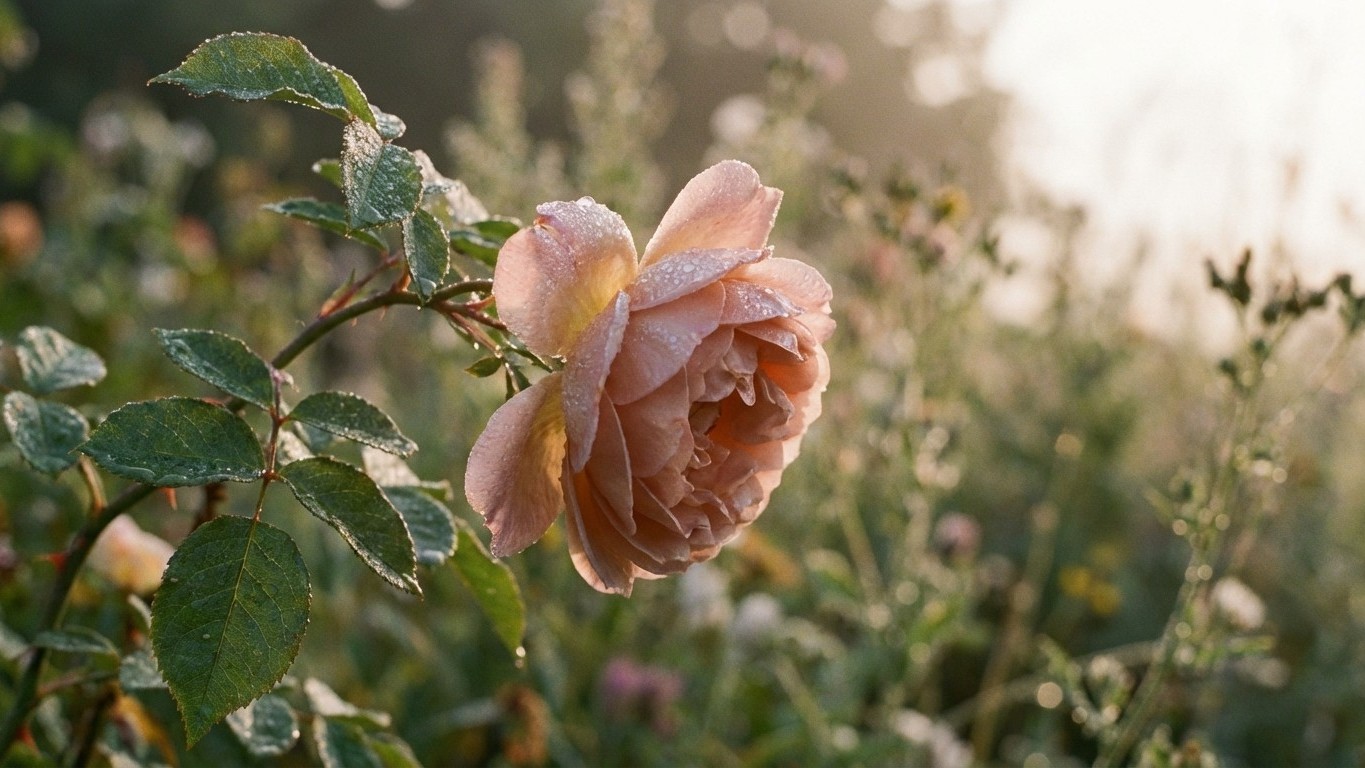

Bare-root roses go in the ground in late March or early April. Container roses follow after the last spring frost, which falls between April 6 and April 20 at Kansas City International Airport. Choose disease-resistant shrub roses, mulch them well, and expect Japanese beetles by late June. Those habits separate a bed that handles Missouri’s humid, hot summers from one that spends August covered in black spot. For the species-wide basics, see How to Grow Roses: The Complete Guide.
When to plant Roses in Missouri

The frost dates here come from the NOAA NCEI 1991-2020 Climate Normals for the Kansas City International Airport station (MCI), using the 30-70% band of 32°F freeze probabilities. Last spring frost: April 6 to April 20. First fall frost: October 18 to October 29. One caution matters. MCI sits well north of the city, and the downtown station runs about five days earlier in spring. Southern Missouri is milder still, while northern counties and higher ground run later. A single airport is not the whole state, so shift these dates by a week or more depending on where your bed sits.
Bare-root and container roses
Most roses reach home gardeners as dormant bare-root plants in late winter or as potted plants in spring. Bare-root roses go in as soon as the soil is workable, meaning neither frozen nor soggy. In the Kansas City area that is typically late March, a couple of weeks ahead of the frost window. Soak the roots in a bucket of water for 12 to 24 hours first. Dormant canes shrug off frost. Once leaves unfurl, cover the plant on any night when frost is forecast.
Container roses already in leaf are safer after April 20, the late end of the range. Planting up to two weeks earlier works if you are willing to throw a bedsheet or a bucket over them on cold nights. Fall planting is the other good window. Count back six weeks from October 18, the early end of the first-frost range, and you land around the first week of September. That gives roots time to settle before the ground cools.
Starting roses from seed
Starting from seed is a long game, and most gardeners skip it. Hybrid teas and other named, grafted roses do not come true from seed, so you would get a different rose than the one you admired. Species roses and some shrub roses are the realistic candidates. Their seeds need cold, moist stratification before they germinate, commonly two to three months in the refrigerator.
Here is the count-back, using the safe April 20 transplant date. Seedlings need a week to ten days of hardening off, so they head outside around April 10. Roughly eight weeks of growth under lights puts the move out of the fridge near mid-February. Eight to twelve weeks of stratification before that means starting the seeds in the refrigerator between late November and late December. These are rules of thumb, not NOAA figures. For hardening off, give seedlings an hour of shade and wind at first, then add a little more time each day, and bring them in on any frost night.
Soil and site preparation
Roses want at least six hours of direct sun, and morning sun counts double. It dries the dew off leaves early, which cuts down on the fungal disease that dogs roses in humid summers. Afternoon shade in July does no harm, especially to dark red varieties that scorch. Avoid spots hemmed in by walls or dense shrubs, where air sits still and leaves stay wet.
Drainage decides more rose deaths than cold does. Dig a hole about 12 inches deep, fill it with water, and let it drain. Then fill it again. If water still stands after several hours, you have a heavy-soil problem, and a raised bed or a mounded planting spot will solve it far better than digging a deeper hole. A hole dug into clay and filled with loose amendments becomes a bathtub that holds water around the roots. Roses do best at a pH slightly on the acid side of neutral, and a soil test through your county extension office tells you whether lime or sulfur is warranted. Without a test, skip both.
Timing the prep matters more than the day of planting. Four to six weeks ahead, strip the sod and work 2 to 3 inches of finished compost into the top 8 to 12 inches of soil. Fresh manure is a bad idea this close to planting because it can burn roots. For a March planting, that means doing the bed in February whenever the ground thaws. Order bare-root plants by January so you are not picking from leftovers.
Space plants for airflow. Compact shrub roses need about 3 to 4 feet between them, hybrid teas roughly 2 to 3 feet, and climbers 6 to 8 feet from the next plant or structure. Crowding looks generous in May and turns into a mildew nursery by July. On planting day, dig a hole wide enough to spread the roots without bending them, set the plant so the bud union sits at or just below the soil line (Missouri winters can kill tops of grafted roses, and a slightly buried union is better protected), backfill, and water slowly and deeply.
Varieties that suit Missouri
Four traits matter here. The first is disease resistance, since black spot thrives in humid Missouri summers and an unsprayed susceptible variety may drop half its leaves by August. The second is cold hardiness. Winter dieback is common on tender hybrid teas, especially in the northern part of the state. Own-root roses (grown on their own roots rather than grafted) regrow true from the base if the top is killed, while a grafted rose that dies back may return as the rootstock. The third is heat tolerance. Many roses pause blooming or produce washed-out flowers in July and August. The fourth is habit: once-blooming roses flower in one big flush, while repeat bloomers cycle back every several weeks until frost.
| Variety | Type | Good for | Keep in mind |
|---|---|---|---|
| Knock Out series | Shrub, repeat bloom | Low-maintenance beds, strong black spot resistance | Resistance is not immunity, and rose rosette can still take plants |
| Drift series | Compact groundcover | Front edges, slopes, containers | Small plants, modest scent |
| Carefree Beauty | Shrub, repeat bloom | Fragrance with good hardiness | Bred as a tough landscape rose, not a cut-flower rose |
| Iceberg | Floribunda, repeat bloom | Continuous white flowers, cutting | Can pick up black spot in wet summers |
| Double Delight | Hybrid tea | Fragrance, cut flowers | Needs a more attentive disease-control routine |
| New Dawn | Climber, repeat bloom | Fences, arbors, pillars | Vigorous, needs space and annual tying |
| William Baffin | Hardy climber | Cold exposure in the north of the state | Large and thorny |
This list reflects widely sold varieties and their known traits, not an endorsement from any agency or extension office. Plant tags can only tell you so much, so read them for words like “disease resistant” and “own-root.” If you garden across state lines, regional guides adjust the list for climate: see Growing Roses in Illinois: Planting Dates, Varieties and Local Pests, Growing Roses in Maryland: Planting Dates, Varieties and Local Pests and Growing Roses in Washington: Planting Dates, Varieties and Local Pests for how different climates change the picks.
What to plant alongside
Good neighbors do three jobs: keep the soil covered, draw pollinators and predators, and fill the bare “legs” of leggy rose canes. Catmint (Nepeta) is the classic. It tolerates Missouri heat, blooms through much of the summer, and hides bare stems. Sweet alyssum as a ground cover has real support behind it, because its tiny flowers attract hoverflies, whose larvae eat aphids. Low perennial geraniums and salvia also work well as long as they leave a gap around the canes.
Be skeptical of some popular claims. Garlic and chives are often said to deter aphids and fungal disease when tucked around rose bases. The evidence is thin. They are harmless, they do no damage to the roses, and they may confuse a few pests, but they will not replace spraying or good airflow. Marigolds are credited with repelling Japanese beetles, and there is no good evidence that they do. Some marigold varieties suppress certain root nematodes in the soil, which is a different benefit from the one the folklore promises.
What competes? Large tree roots and aggressive shrubs steal water and nutrients, and turf grass creeping up to the canes does the same. Plants that grow tall and dense enough to shade roses or block air movement turn a sunny bed into a damp one. Keep new roses out of the exact spot where an old rose recently died, because replant problems are real in rose beds. Dig out the old soil and replace it with fresh soil from elsewhere, or choose a different site. Keep roses away from lawns treated with broadleaf herbicides, whose drift can twist and distort rose foliage.
Watering, feeding and support
Water deeply rather than often. Roses generally want about an inch of water per week, from rain plus irrigation, and in a Missouri July that can mean two long soakings rather than a daily sprinkle. Deep watering pushes roots down where the soil stays cooler. Water at the base in the morning, because wet leaves overnight invite black spot. A soaker hose or a slow drip at the plant’s base does the job without wetting foliage.
Mulch holds in that moisture. Spread 2 to 3 inches of shredded bark or compost, keeping it a few inches off the canes, and refresh it each spring. Mulch also blocks soil splash, which carries fungal spores up to the lowest leaves. For feeding, start when new growth appears in spring, feed again after the first big flush of bloom, and stop around the first week of September. The first-frost range starts October 18, and fertilizing later pushes tender growth that frost will burn. Too much nitrogen gives lush leaves and few flowers.
Most shrub and hybrid tea roses need no staking, though a newly planted tall rose may want a stake for its first season. Climbers are different. Tie main canes to the support as close to horizontal as you can manage, since horizontal canes trigger more flowering shoots along their length. Prune in late winter or early spring, once the worst cold has passed and buds begin to swell, which in much of Missouri means around late March. Cut out dead, damaged and crossing canes, then trim live canes back to an outward-facing bud. Roses on grafted rootstocks may send up suckers from below the bud union. These have different leaves, often with more leaflets, than the grafted variety. Trace the sucker to its source and pull or cut it off at the base, since a stub only regrows.
Common problems

Roses do not get blossom end rot or fruit cracking, so most of the usual failures are fungal, cultural or viral. Black spot is the one most gardeners meet first. Round black spots with fringed edges show up on the upper leaves, then the leaf yellows and falls. It spreads in wet, humid weather, so give the plant sun and airflow, water at the base, rake up fallen leaves, and use a labeled fungicide on susceptible varieties starting at first leaf-out. Powdery mildew looks like a white dusty coating on young leaves and buds, and it favors cool nights and warm days with poor air circulation.
Rose rosette disease deserves a hard look any time a plant behaves strangely. The signs are a witches’-broom of tight, deformed shoots, unusually red and thick canes, and an excess of thorns. It has no cure. Remove and bag the whole plant, roots included, so it does not spread to neighbors. Do not compost it. Poor blooming is usually less dramatic: too little sun, too much nitrogen, or pruning at the wrong time. Flower buds that ball up and refuse to open after rain are a weather problem, not a disease. Leaf curl and distortion often trace to herbicide drift from a nearby lawn, not to an insect.
Wilting canes on an otherwise healthy rose may signal drought, root rot from poor drainage, or a cane borer, and the cure depends on which. Check soil moisture first, then cut a wilted cane open to look for tunneling. Winter dieback is common in the north of the state, so cut back to green, healthy wood in spring. For anything you cannot identify, a photo and a cane sample taken to your county extension office will get a better answer than a guess.
Pests that actually show up in Missouri
The University of Missouri Extension and MU IPM list of home-garden pests covers many plants, so not every name on it hits roses. Of those listed, three do real damage to roses: Japanese beetle, spider mites and bagworms. Pest pressure peaks from June through August.
Japanese beetles (Popillia japonica) announce themselves as skeletonized leaves, lacy and brown-edged, with metallic copper-and-green beetles clustered on open blooms. In mid-Missouri they emerge mid to late June, peak the second week of July, and decline by early August. The control that works on a home bed is hand-picking: knock them into a jar of soapy water in the early morning, when they are sluggish. Traps tend to draw more beetles into your yard than they catch.
Spider mites start as a pale stippling on leaves, then turn them bronzed and dry, with fine webbing on the undersides in bad cases. Populations increase under hot, dry conditions, so July and August are the danger months, especially for roses in a dry spell. Hose the undersides of the leaves with a strong spray of water every few days, and keep plants watered so they are not stressed.
Bagworms (small silk-and-debris bags hanging from branches) are easiest to miss until the damage is done: ragged chewed foliage and little cone-shaped bags up to a couple of inches long. They must be controlled in June, because by July the larvae are almost too big to treat. Pick off and destroy the bags by hand, or spray young larvae in June with Bt (Bacillus thuringiensis var. kurstaki).
The rest of the list is mostly vegetable and turf trouble: squash vine borer, squash bug, hornworms and hunting billbug. Cucumber beetles may nibble some blooms and brown marmorated stink bugs feed on a wide range of plants, but neither is a main rose pest in this list. Pressure varies across the state, so your county office can identify anything unfamiliar.
Cutting Flowers and Preparing Roses for Winter
Cut flowers for the vase when the buds show color and the outer petals have just begun to loosen. For most hybrid teas and floribundas that is the tight-bud-to-half-open stage. Cut in the early morning, make the cut just above a leaf with five leaflets, and plunge the stems into water right away. A rose cut at the bud stage will finish opening indoors. Store cut roses in the refrigerator or a cool room, with fresh water and a fresh cut every couple of days.
Pinching spent flowers keeps repeat bloomers going through summer, but ease off in the last weeks of the season. If you let hips form, the plant begins to slow down and harden off for winter. With the first fall frost expected between October 18 and October 29 at Kansas City International, start winding down by early September: stop fertilizing, and avoid any heavy pruning, which can trigger tender new growth.
Once the soil starts to cool toward freezing, usually in November, mound 10 to 12 inches of soil or compost around the base of grafted roses to protect the bud union. Skip the heavy cutting until late winter, when you can see which canes survived. Rake and discard fallen leaves from around black-spot-prone plants so the spores do not overwinter in the bed.
Local help
County dates, soil tests and pest identification vary across the state, so the best next step is your county office of University of Missouri Extension. They can run a soil test, identify a mystery pest from a sample, and tell you how your local frost dates differ from the Kansas City figures above. For more state-specific guidance, browse our Missouri guides.
Common questions
When is the best time to plant roses in Missouri?
Bare-root roses go in from late March to early April, as soon as the soil is workable. Container roses are safest after the last spring frost, which runs April 6 to April 20 at Kansas City International. Fall planting works too, ideally by early September so roots establish before the first frost, expected October 18 to October 29 at the same station. Northern and higher parts of the state run later, and southern areas run earlier.
Which roses are easiest for beginners in Missouri?
Disease-resistant shrub roses such as the Knock Out and Drift series are the common starting point. They repeat-bloom, tolerate summer heat and need little spraying. They are not immune, so watch for rose rosette and keep the bed mulched and uncrowded.
How often should I water roses in Missouri summers?
Aim for about an inch of water per week, delivered in deep soakings at the base of the plant in the morning. In a hot, dry July that may mean watering twice a week. Mulch of 2 to 3 inches reduces how often you need to water.
What is eating my rose leaves and flowers in July?
Lacy, skeletonized leaves and chewed blooms with metallic copper-and-green beetles on them point to Japanese beetles. In mid-Missouri they peak around the second week of July and decline by early August. Hand-pick them into soapy water in the morning. Stippled, bronzed leaves with fine webbing suggest spider mites instead.
When should I stop fertilizing and prepare roses for winter?
Stop feeding around the first week of September, well ahead of the October 18 to October 29 first-frost range at Kansas City International. After the soil begins to cool, mound soil or compost 10 to 12 inches high around grafted roses. Save heavy pruning for late winter, when you can see which canes survived.