
Plant potted roses after the last spring freeze window, which at Billings runs April 29 to May 10, and put bare-root plants in as soon as the soil can be worked. Pick varieties bred for hard winters, and give them a sunny, well-drained spot with wind protection. The pests that matter most on roses here are grasshoppers and thrips, with the brown marmorated stink bug a third to watch. The details below follow the calendar from spring to the first fall frost.
When to plant Roses in Montana
NOAA’s 1991-2020 Climate Normals for Billings put the last spring freeze at April 29 to May 10. That is the band where the probability of a 32°F freeze falls between 30 and 70 percent (NOAA NCEI data for Billings). Inside that band, a freeze on any given day is closer to a coin flip than a safe bet. The first fall freeze lands October 1 to October 14, by the same measure.
Billings is one of the milder valleys, so treat these dates as a reference point, not a statewide rule. Northern Montana and higher-elevation valleys run later in spring and earlier in fall, and mountain valleys can frost in any month. If you garden above the valley floor, add a week or two of margin and watch your own thermometer. This page doesn’t publish dates for those places, so a local extension office is the source to ask.
Three ways to start, three calendars
Most roses come from a nursery in one of two forms. Bare-root plants arrive dormant in early spring and go into the ground as soon as the soil is workable, which in much of Montana means April. Keep them in a cool garage, not a heated house, and soak them in a bucket of water for several hours before planting. Potted roses are already leafed out, so they wait until after the freeze band. Planting on the late end, May 10, costs you a week and protects soft new growth.
Rose seed is the slow path. Seed from many hardy shrub roses needs weeks of cold, moist stratification (a stretch in the refrigerator in damp sand or paper towel) before it will sprout, and seedlings from hybrid parents rarely resemble the parent plant. If you try it, anchor on May 10 as the planting-out date. Seedlings need about 7 to 10 days of hardening off, so start carrying them outside April 30 to May 3. Allow roughly 8 weeks for stratification and germination, which puts the start near March 15. Gardeners who want a named variety should buy plants instead.
Hardening off a nursery rose
A potted rose from a greenhouse or big-box store has never felt wind or direct sun. Over 7 to 10 days, move it outdoors for a few hours in shade, then lengthen the time and add morning sun, and leave it out overnight only once nights stay well above freezing. Montana wind burns tender leaves faster than most newcomers expect.
Fall planting is a gamble. With the first fall freeze arriving October 1 to 14 in Billings, a rose planted in September has only a few weeks to root before the ground stiffens. Spring gives it the whole season.
Soil and site preparation
Roses want at least six hours of direct sun, and morning sun matters most because it dries dew off the leaves early and cuts down on fungal disease. A spot against a south or east wall gives extra warmth in spring and cuts the wind. Open prairie sites need a windbreak such as a fence, a shrub row or a building, because constant wind desiccates canes in winter and shreds summer blooms.
Drainage decides more rose deaths than cold does, and winter wet is worse than winter cold. Test it: dig a hole about a foot deep, fill it with water, let it drain, then fill it again. If the second filling is still standing after several hours, move the planting site or build a raised bed of at least 8 to 12 inches. Heavy clay is common in valley bottoms, and gravelly or sandy soil is common on benches and slopes. Both can grow roses, and both need organic matter. Clay needs it for structure, and sand needs it to hold moisture.
Work on the bed in the weeks before planting. As soon as the soil thaws and isn’t muddy (squeeze a handful, and if it forms a slick ball, wait), spread 2 to 3 inches of finished compost over the area and fork it into the top 12 inches. Skip heavy fertilizer in the planting hole, because fresh nitrogen close to new roots can burn them. A soil test through your extension office tells you the pH and nutrient levels. Many Montana soils run alkaline, and roses prefer slightly acidic to neutral ground, so guessing at amendments can waste money.
Spacing depends on the variety. Compact shrub roses sit about 3 feet apart, large shrubs and climbers 5 to 6 feet or more. Crowded plants hold humidity in their leaves, which invites mildew. Dig the hole roughly twice the width of the root mass, and set grafted roses with the bud union (the knobby swelling near the base) a couple of inches below the soil surface in cold climates. Own-root roses go in at the same depth they grew in the pot. Water thoroughly after planting, and add a few inches of mulch kept back from the canes.
Varieties that suit Montana
Winter hardiness is the first trait to check. The second is whether the plant grows on its own roots. Grafted roses have a hardy rootstock under a tender top. If a hard winter kills the canes, what regrows may be the rootstock, with small flowers that look nothing like the label. Own-root roses regrow from the base as the same variety, a real advantage where winter dieback happens.
Disease resistance is the third trait. Black spot and powdery mildew are less severe in dry climates, but irrigation and sprinklers bring them back. Repeat bloom matters because a once-blooming rose gives you only a few weeks of flowers, while a repeat bloomer keeps producing until frost. The groups below are widely sold and bred for cold. Your local garden center’s stock and your own microclimate finally decide.
| Variety | Type | Good for |
|---|---|---|
| Hansa | Rugosa shrub | Very hardy, fragrant double blooms, hips for fall, tolerant of tough sites and wind |
| Therese Bugnet | Hybrid rugosa | Tall informal hedge, repeat bloom, a good performer in cold climates |
| William Baffin | Explorer series climber | Fences and trellises, bred in Canada for cold winters, good disease resistance |
| John Cabot | Explorer series climber | Large arching canes, bright magenta flowers in a big early flush |
| Morden Blush | Parkland series shrub | Compact size for small beds, pale pink repeat blooms |
| Winnipeg Parks | Parkland series shrub | Low mounded habit, cherry-red flowers, suitable for borders and containers |
| Knock Out | Modern shrub | Easy repeat bloom and strong disease resistance, though it may die back to the snow line in hard winters |
The Explorer and Parkland series came out of Canadian breeding programs aimed at prairie winters. Hybrid teas are possible but need more effort: deep mounding in late fall and a tolerance for losing a plant every few years. If you want one anyway, tuck it near a south-facing wall. For a first Montana rose, a rugosa or an own-root Canadian shrub forgives more mistakes than anything else on the rack.
What to plant alongside
The companion-planting claims around roses range from solid to folklore. The best-supported idea is the least glamorous: give roses neighbors that bring beneficial insects. Sweet alyssum, catmint and other small-flowered plants feed hoverflies and parasitic wasps, which prey on aphids and other soft-bodied pests. Low bloomers around the base also shade the soil, hold moisture and keep weeds down.
Chives and garlic are often said to ward off aphids and black spot, but the evidence is thin, so don’t count on them as pest control. They are harmless neighbors if you like them. The same goes for marigolds: the nematode-suppressing effect is documented in some vegetable systems, but there is little to show it protects roses.
Lavender wants dry, lean soil, while roses want deep, regular watering and richer ground. If you want that pairing, keep lavender on the dry edge, a few feet away. Clematis is a better partner for climbing roses, since both appreciate cool roots and the vine adds a second bloom period on the same support.
Several plants should stay away. Black walnut roots release juglone, which stunts many ornamentals, so keep roses well beyond the drip line of any walnut. Large trees and shrubs steal water and nutrients and cast shade. Mildew-prone plants such as phlox or bee balm restrict airflow and spread the same fungus. Give each rose a few feet of elbow room from other roses too.
Watering, feeding and support
Water deeply and less often. A rose with a good root system needs about an inch of water a week during the growing season, more in hot, windy stretches, delivered in a slow soak at the base that reaches 12 inches down. Frequent light sprinkling keeps roots shallow and leaves wet. Water in the morning, and use a soaker hose or drip line in preference to an overhead sprinkler. If the top inch or two of soil is dry, water.
Mulch is the cheapest insurance you can buy. Two to 3 inches of shredded bark, wood chips or compost over the root zone slows evaporation, moderates soil temperature and suppresses weeds. Pull it a couple of inches back from the canes so the base stays dry.
Feed when growth starts. Once the first leaves open in spring, apply a balanced rose fertilizer or a layer of compost, and repeat after the first flush of bloom, following label rates. Stop feeding about six to eight weeks before the first fall frost. Using the Billings band of October 1 to 14, that means early to mid August. Late nitrogen pushes soft new growth that the first freeze will kill, and it keeps the plant from hardening for winter.
Support is minor for shrub roses and essential for climbers. Tie climbers to a trellis or fence with soft ties, fanning the canes out sideways, because horizontal canes produce more flowering side shoots than vertical ones.
Prune in spring, after the buds begin to swell and you can see which canes survived. Cut dead, black or brown wood back to healthy green tissue, which should show white or pale pith inside. Remove crossing and weak canes to open the center for airflow. Don’t prune hard in fall. If your rose is grafted, watch for suckers, which are shoots that come from below the graft with different leaves. Trace them back to their source and pull or cut them cleanly at the root, since snipping at the soil line only encourages more.
Common problems
Winter dieback tops the list. Canes turn black or brown and brittle in spring, and sometimes the plant dies to the ground. It doesn’t always mean the rose is lost. Wait until leaf-out, then cut to live green wood. If the plant is own-root, it will often regrow from the base. If it’s grafted and the new shoots look different from what you bought, the rootstock has taken over.
Black spot shows up as dark, fringed-edge circles on leaves, which then yellow and drop. Powdery mildew looks like white dust on new leaves and buds, often curling and distorting them. Both thrive when leaves stay wet and air doesn’t move. The fixes are cultural: water at the base, space plants properly, clear fallen leaves in autumn, and choose resistant varieties. A fungicide labeled for roses can slow either disease if started early, but it won’t repair damaged leaves.
Yellow leaves with green veins point to iron chlorosis, which is common in alkaline soil. A soil test confirms it, and chelated iron or soil acidifiers can help, though a stubborn case means the site is wrong for that variety.
Blooms that don’t come are usually a light or feeding problem. Too much shade, too much nitrogen or hard late pruning on a variety that blooms on old wood each cuts flowers. Blind shoots, which are stems with no flower bud at the tip, often result from cold damage or low light. Cut them back to a healthy five-leaflet leaf and the plant will try again.
Aphids, the clusters of soft green or pink insects on new growth and buds, turn up on roses nearly everywhere. A strong spray of water knocks them off, and repeating it for a few days usually does the job. Scorched, crispy leaf edges in summer usually mean drought stress or wind, not disease, so check soil moisture first.
Pests that actually show up in Montana
Montana State University Extension’s Urban IPM program publishes a short list of garden pest fact sheets: brown marmorated stink bug, grasshoppers, miller moths, social wasps and thrips. Anything outside these five is a question for MSU Extension, not a guess. Of the five, three do real damage to roses.
Grasshoppers
You first see ragged holes in leaves and chewed petals, then the insects themselves flicking away as you walk past. Grasshoppers overwinter as eggs, hatch from mid to late spring, and the adults live into late summer and early fall. The control that works best on a small planting is physical: lightweight insect netting over young or vulnerable plants during the worst feeding, along with weed control in and around the bed, since nymphs gather in weedy margins before moving to the garden.
Thrips
The first sign is flower damage: petals streaked or browned at the edges, and buds that stay closed or open deformed. Tap a bloom over white paper to spot the tiny slender insects. Thrips are a warm-season pest, so expect trouble once buds form. The control that works is sanitation. Clip off and bag damaged buds and spent flowers instead of dropping them in the bed, because thrips shelter and breed in them. For anything beyond that, ask extension which product suits your site.
Brown marmorated stink bug
Look for shield-shaped, mottled brown bugs on buds and stems, and small discolored spots where they have fed. Check with extension about whether they have reached your county before you worry. If you find them, hand-pick into a bucket of soapy water in the morning, when they are slow.
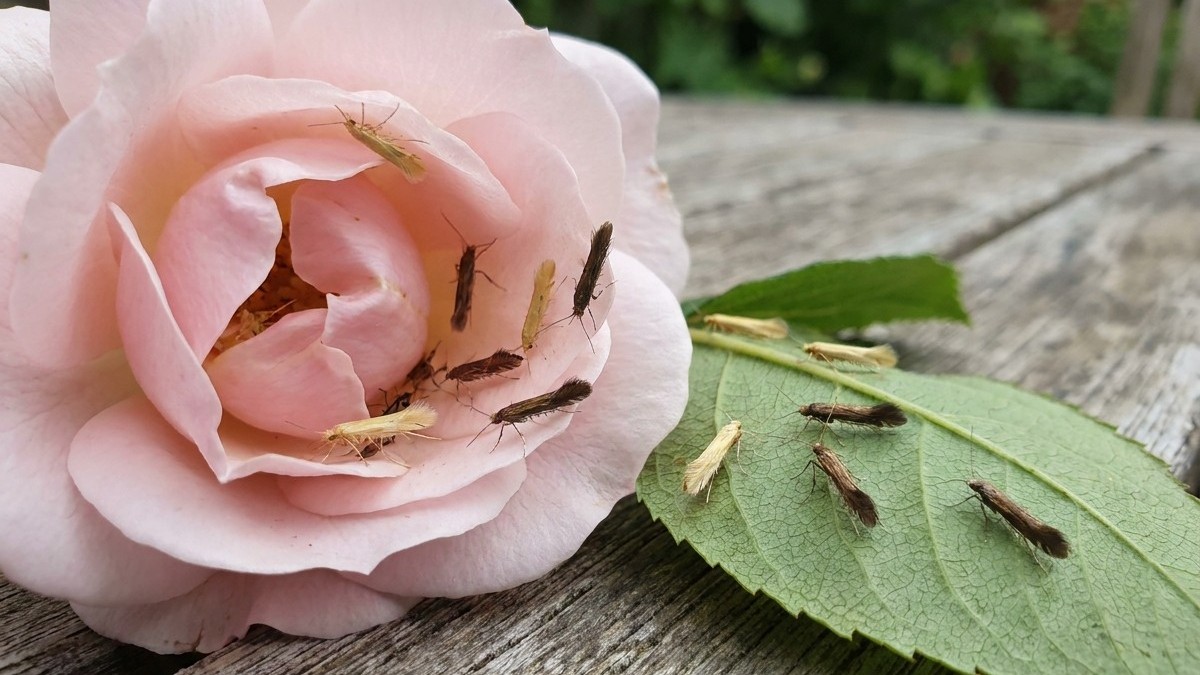
Miller moths and social wasps are mostly nuisances. Miller moths visit blooms for nectar, but the adults don’t harm the plant. Wasps can sting you during deadheading, though they also prey on caterpillars.
Harvest and end of season
Cut flowers for the vase in the morning, when stems are full of water. Choose buds that are just starting to open, make a slanted cut about a quarter inch above an outward-facing five-leaflet leaf, and plunge the stems into water right away. Recut the stems under water at home, strip leaves below the waterline, and keep the vase out of direct sun. A tight green bud cut too early tends to wilt instead of opening.
Rose hips are the other harvest, and rugosa types like Hansa produce the largest ones. Let them color to bright orange or red on the bush. Many gardeners wait until after the first frost, which softens them and sweetens the flavor. Cut off the tops and tails, split them, scrape out the seeds and fine hairs, and dry the shells for tea or cook them into jelly. Use only plants that haven’t been sprayed with products not labeled for edibles.
As fall approaches, ease off. Around early to mid August, stop fertilizing, and from late summer on, stop deadheading so the plant forms hips and slows toward dormancy. Keep watering until the ground freezes, since a dry rose goes into winter weaker. Leave pruning for spring.
Once the soil has begun to freeze, usually after several hard nights, mound 10 to 12 inches of soil or compost around the base of each grafted rose, and add straw or evergreen boughs over the top for climbers and tender types. Mounding too early traps warmth and invites rot, so wait for the cold. Pull the mound back gradually in April to reveal fresh growth. Rake up fallen leaves from the bed and throw them out, not into the compost, to cut black spot carryover.
Local help
For county-level planting dates, soil testing and identification of problems, contact Montana State University Extension, which runs county offices across the state. If you’re comparing regions, see our guides for Growing Roses in Oregon: Planting Dates, Varieties and Local Pests and Growing Roses in West Virginia: Planting Dates, Varieties and Local Pests, along with more Montana guides.
Common questions
When is it safe to plant roses outside in Montana?
For Billings, the last spring freeze falls April 29 to May 10, according to NOAA’s 1991-2020 normals. Potted roses are safest planted after May 10. Dormant bare-root plants can go in earlier, once the soil is workable. Colder and higher valleys run later.
Can I grow hybrid tea roses in Montana?
Yes, with extra work. They need a sheltered, sunny spot, deep mounding in late fall and some tolerance for losses after hard winters. Hardy shrub roses, such as rugosas and the Explorer and Parkland series, take much less effort.
Why did my rose die back to the ground over winter?
Cold, wind and fluctuating temperatures kill canes above the snow line. Wait until new leaves open, then cut to live green wood. Own-root roses often regrow true from the base. If new shoots look different from the plant you bought, they’re likely from the rootstock.
What pests should I watch for on roses?
MSU Extension’s garden pest list names brown marmorated stink bug, grasshoppers, miller moths, social wasps and thrips. Grasshoppers and thrips do the most damage to roses. For anything else, MSU Extension is the place to get an identification.
When should I stop fertilizing roses?
Stop about six to eight weeks before the first fall freeze. At Billings, where the freeze comes October 1 to 14, that means early to mid August. In colder valleys, count back from your own earlier fall date.
The How to Grow Roses: The Complete Guide covers the basics that apply in every state.