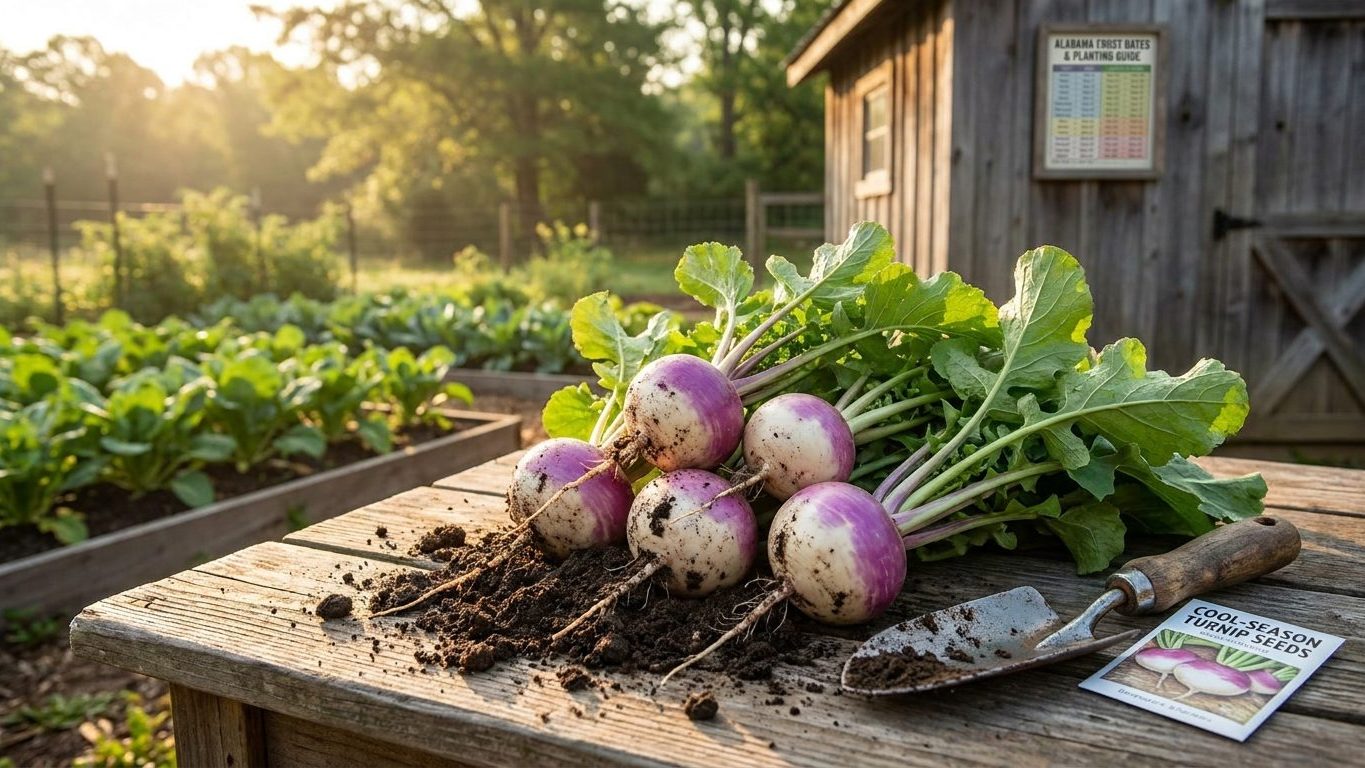

Missouri turnips split into two very different windows: a narrow spring sowing that finishes before summer heat arrives, and a more forgiving fall sowing timed off the state’s first frost. The fall window is the one most Missouri gardeners rely on, because turnip roots sweeten with cool weather and the plant tolerates the season’s early frosts without damage.
The short answer for Missouri
Turnips in Missouri get two shots: a spring sowing squeezed in before heat arrives, and a fall sowing that’s more reliable because it lines up with the crop’s biology. Turnip seed germinates in cool soil and the young plants shrug off a light frost, which is why gardeners sow well before the last spring freeze rather than after it. With Missouri’s last spring frost falling between April 6 and April 20 (the NOAA window where a 32°F freeze has a 30 to 70 percent chance of happening), spring turnips generally go in from mid-March through early April, then get pulled or eaten young before late-spring heat turns the roots woody and bitter.
The fall crop is the one worth planning around, because it counts backward from a fixed, later date instead of forward from an uncertain warm-up. Missouri’s first fall frost lands between October 18 and October 29. Standard turnip varieties need roughly 40 to 60 days from seed to a harvestable root, so working backward from that frost window gives a sowing range that covers both quick and slower varieties. The safest bet is to sow between August 19 and September 19, with the earlier end of that range favoring slower-maturing types and gardeners in the cooler northern half of the state.
That range isn’t a guess pulled from a seed packet. It comes directly from subtracting a turnip’s typical days-to-maturity from the actual NOAA frost probability band for this region, not from a national average or a neighboring state’s numbers. Rutabaga, the turnip’s slower cousin, needs closer to 90 to 100 days, which pushes its ideal sowing date to the front edge of that same window, in mid-to-late August, so the root has time to size up before the ground cools too fast in late October.
Anyone gardening in the Bootheel or far southern Missouri can lean toward the later dates in both windows, since frost arrives there noticeably after the Kansas City reference station used for these figures. Anyone north of the Missouri River, or at higher elevation, should lean earlier. The next section covers why missing these windows in either direction causes real crop failures, not just smaller roots.
What will not work here

Sowing rutabaga in spring is the most common mistake, and Missouri’s climate makes it a costly one. Rutabaga needs 90 to 100 days to bulk up a proper root, and if you sow it right after the last spring frost (April 6 to April 20), that maturity date lands smack in the middle of Missouri’s hot early summer. The roots that do form under that stress are typically woody, cracked, and sharply bitter, because rutabaga sizes up cleanly only in cool, steady soil temperatures, not in a state where June afternoons regularly climb well past comfortable growing conditions. Rutabaga belongs almost entirely to the fall calendar here; treat the spring window as turnip-only.
Germination failures in late-summer heat
The fall sowing window opens in mid-to-late August, which in Missouri is also peak heat and peak dryness for topsoil. Turnip and rutabaga seed need steady surface moisture to germinate within about a week; a single missed watering during an August dry spell can bake the top inch of soil hard enough that seedlings never break through, or emerge unevenly across the row. Gardeners who treat this sowing like a spring planting, checking the bed every few days instead of daily, routinely lose a large share of the stand before it’s even up.
Crowding and humidity late in summer
Missouri’s humid continental summers also punish tight spacing. Turnip greens sown close together in August and September hold moisture between the leaves longer after a humid night, which is exactly the condition that favors downy mildew and other foliar disease on the tops. That doesn’t kill the root outright, but it weakens the plant’s ability to bulk it up, and it spreads fastest in rows planted at spring-appropriate spacing rather than opened up for late-summer airflow.
Leaving roots in the ground too long into winter is the third failure mode, and it ties directly to the state’s cold. The coldest month here runs a mean daily minimum of 19.5°F, cold enough to damage unmulched roots left in the ground well past the fall frost date rather than harvested or heavily mulched for storage.
What changes across Missouri
Missouri isn’t one climate, and the sowing dates above aren’t a single fixed answer for the whole state. The USDA Plant Hardiness Zone Map places Missouri across a genuinely wide spread, from zone 5b to zone 7b, which is enough of a range that a single sowing date can be two or three weeks off depending on where in the state a garden sits. That spread reflects the average annual extreme minimum temperature, the coldest snap a spot is likely to see in a typical year, not the everyday weather, but it’s still a reliable proxy for how much earlier or later a garden’s frost dates run.
The frost data behind this page comes from a reference station that sits well north of the metro area it represents, and the caution attached to it matters here: the downtown station in that same region runs about five days earlier in spring than the reference point used, and southern Missouri runs milder still. That means a gardener in the northern tier of the state, closer to zone 5b, should expect both a later last spring frost and an earlier first fall frost than the dates given above, which shortens the whole fall sowing window from both ends. A gardener in the Bootheel or the state’s southern edge, closer to zone 7b, gets the opposite: more room on both sides of the calendar, and the option to push fall sowing dates later into September.
There’s no single sowing date that fits both ends of that zone range accurately, and this page won’t pretend there is. What it can offer is the direction to shift: move both frost-based windows earlier if you’re in the northern half of the state or at higher elevation, and later if you’re in the southern third. For the actual zone a specific garden falls in, the USDA’s own hardiness zone map, searchable by ZIP code, is the tool to check rather than guessing from a regional average.
Where to check this for your own county
This page gives Missouri’s state-level sowing windows, built from statewide frost data, and a state-level window is only ever a starting point. County recommendations beat state ones every time, because a county extension office works from local trial data and local frost records rather than a single reference station covering the whole state. The place to find that is the University of Missouri Extension.
Once there, two things are worth searching for specifically. First, the local planting calendar for vegetables, which most county extension offices publish separately from the statewide guidance and which will reflect the actual frost dates recorded closer to that county rather than the Kansas City-area reference station used on this page. Second, look for any variety trial results for turnip and rutabaga run through Missouri’s extension system; these list which varieties have actually performed well in the state’s clay soils and humid summers, rather than generic seed-catalog descriptions written for a national audience.
Extension offices also tend to answer the questions that don’t fit neatly into a printed calendar, things like whether a particular county saw an unusually late frost the past few springs, or whether local growers have had better luck sowing rutabaga slightly earlier than the state average suggests. A phone call or email to the county office attached to that Missouri Extension portal will get a more current answer than any static planting chart, this one included. Treat this article as the state-level baseline, and the county office as the correction layer on top of it.
Some gardeners also time this by the Moon: when to plant turnips by the moon, as almanac tradition rather than fact.
Checking this against your own garden
Every date on this page is a probability drawn from decades of regional weather records, not a guarantee about the particular patch of ground being planted. A garden’s own conditions, its soil, its sun exposure, its microclimate against a south-facing wall or a low frost pocket, will shift these windows by days or weeks in either direction. Three things a gardener can check without any special equipment give a clearer read than the calendar alone.
Soil warmth by feel is the first and simplest. Push a bare hand two or three inches into the bed; if it still feels cold and heavy the way it does in late winter, the soil hasn’t caught up to the calendar yet, no matter what the date says. Turnip seed sown into soil that still feels like early spring will simply sit and rot rather than germinate.
The second signal is how long seedlings take to push out their first true leaves beyond the initial rounded cotyledons. If that takes noticeably longer than a week, the soil is running cooler than the sowing date assumed, useful information for adjusting next year’s timing on that same bed.
The third is early bolting, a flowering stalk shooting up before the root has bulked up at all. That’s the plant’s own signal that heat arrived faster than expected for a spring sowing, and it’s worth noting the date it happened, since that’s a more accurate marker for that specific garden’s true spring cutoff than any regional frost average.