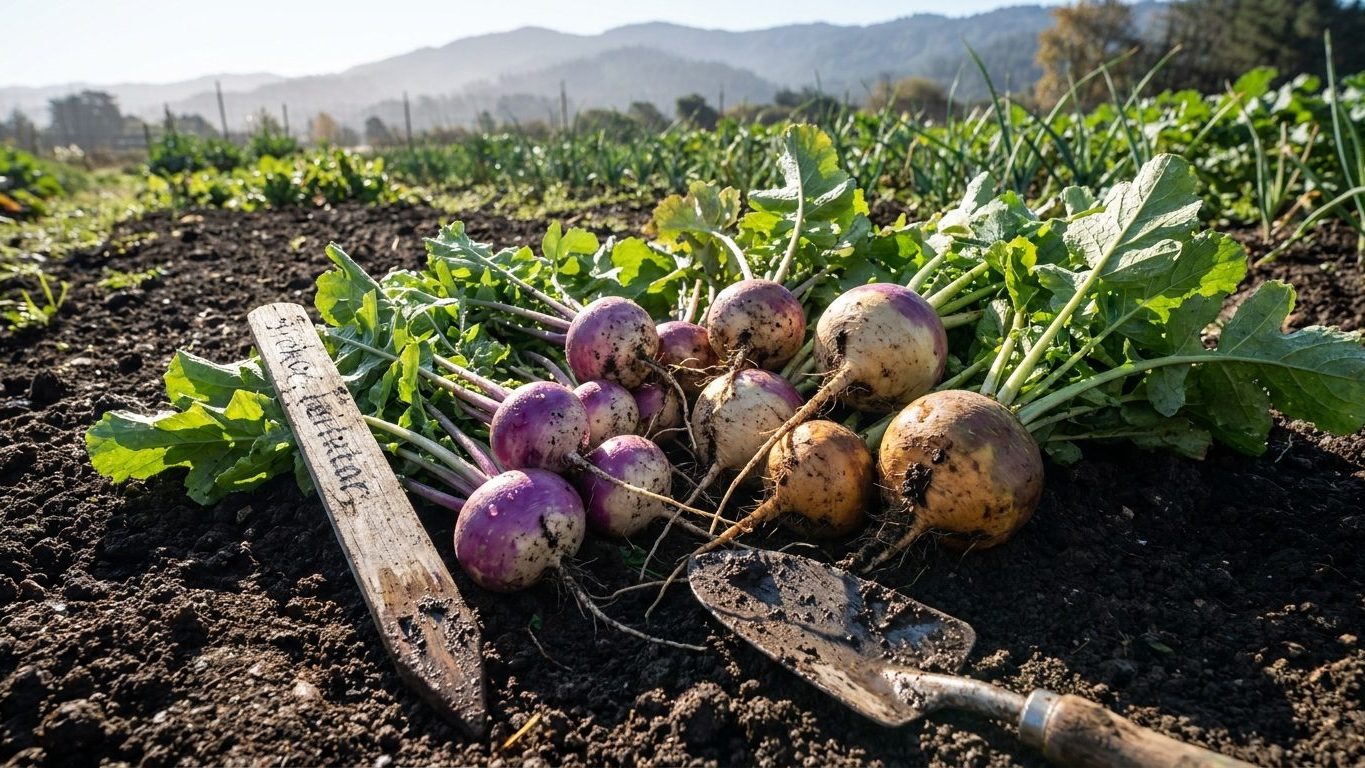

Missouri gardeners get two windows for Turnips and Rutabaga, and they are not the same length. Fast turnip varieties fit the short spring gap before summer heat; rutabaga and slower turnip types belong almost entirely to the fall planting, timed off the state’s later frost date.
The short answer for Missouri
Turnips split into two camps here, and the split matters more than any single “best” variety. Quick-maturing salad turnips (the Hakurei type and similar white varieties bred to size up in 35 to 45 days) are the only turnips reliable enough for a spring sowing in Missouri, because they can reach harvest before the heat of early summer turns the roots woody and sharp. Standard storage turnips like Purple Top White Globe run closer to 55 days and do better started in late summer for a fall harvest than squeezed into the spring gap.
Rutabaga is a different animal entirely. It needs 80 to 100 days of cool growth to bulk up a root worth eating, and it actually improves in flavor after a light frost rather than being ruined by one. Given the state’s first fall frost lands between October 18 and October 29, a rutabaga sown in early July has time to finish before the ground freezes hard, and gets sweeter as the nights cool down through September and October. Trying to run rutabaga as a spring crop in Missouri means racing 90 days of growth against a last frost that can hold until April 20, and losing that race to the humid heat that typically arrives by mid-June.
So the practical decision by type: plant fast salad turnips in very early spring or again in August, plant standard storage turnips in August for fall harvest and winter keeping, and treat rutabaga as a fall-only crop sown in the first half of July. None of the three do well as a mid-summer planting, and none of them tolerate a compressed timeline once the spring frost date runs late.
What will not work here

The mistake that shows up most often is planting a slow rutabaga variety in spring and expecting it to finish before summer. Do the math from the state’s own frost data: if the last spring frost holds until April 20 in a given year, and rutabaga needs 90-plus days, that root isn’t ready until late July, right in the middle of Missouri’s hottest, muggiest stretch. The result is a woody, bitter, cracked root instead of the sweet one the plant is capable of producing. Standard storage turnips pushed into that same late window fare only slightly better; they bolt or turn pithy under sustained heat above the mid-80s.
Watering on a weekly schedule is another failure point specific to this climate. Missouri summers alternate between soaking rain and stretches of dry heat, and turnip and rutabaga roots that dry out and then get flooded tend to split. A single deep watering once a week is not enough during a dry August stretch; the roots need more consistent moisture to size up without cracking, which is one more reason the cooler, generally more even rainfall of September and October favors the fall crop.
Close spacing is a third trap, and it’s a humidity problem more than a frost problem. Missouri’s summer air holds enough moisture to encourage flea beetle damage and foliar disease on crowded turnip greens, especially where airflow is blocked by fences, dense plantings, or shade from taller crops. Wider spacing than a seed packet from a drier state would suggest is usually the safer call here.
Finally, don’t count on rutabaga or turnips surviving the winter unprotected in the ground for storage. The coldest month’s average nightly minimum runs 19.5°F, cold enough to damage unmulched roots left in place past hard frost. A layer of straw mulch over the row, or pulling the roots into a root cellar or refrigerator, protects the harvest better than hoping the soil insulates on its own.
What changes across Missouri
Missouri is not one garden, and its hardiness zone range makes that obvious: the state spans USDA zones 5b through 7b, a spread wide enough that a planting date good for one corner of the state can be two or three weeks off in another. The Kansas City reference station anchors the frost dates used above, but that station sits well north of the city itself, and its readings run about five days later in spring, and correspondingly earlier in fall, than the downtown station closer to the urban core.
Southern Missouri runs milder again on top of that difference. A gardener in the Bootheel or the southern Ozarks is likely working with a longer frost-free season than the Kansas City numbers suggest, which means more room to push a fall rutabaga sowing later into July, and an earlier shot at a spring salad-turnip crop before the ground fully thaws farther north.
The reverse holds for northern Missouri and any higher-elevation pockets in the state: a shorter effective season means shifting the fall planting date earlier, toward late June, rather than waiting for the first week of July, so rutabaga still has its full 80 to 100 days before frost shuts things down. There is no single planting date that fits Kirksville and the Missouri Bootheel equally well, and treating the Kansas City-anchored dates in this article as a statewide rule will run a northern garden late and a southern garden unnecessarily cautious.
Where to check this for your own county
This page describes Missouri at the state level, built from one reference station’s climate data. A county extension office works from trial plots and local frost records specific to that county, and that recommendation will beat this one every time it’s available. The University of Missouri Extension service is the place to look next.
Once there, search for two things specifically. First, the local vegetable planting calendar for the county or region closest to the garden in question, which will give a fall sowing window tighter than the “October 18 to October 29” range cited here, because it accounts for local microclimate rather than one airport station. Second, look for any list of turnip or rutabaga varieties that county agents have actually trialled in Missouri conditions; extension offices often publish notes on which cultivars held up to local flea beetle pressure or local summer heat, information no statewide article can replicate.
If the county-level page and this one disagree on a planting date, defer to the county page. A county-specific frost date reflects real local station data or grower reports, while a state-level figure like the ones used here is necessarily an average drawn from a single reference point. Treat this article as the starting framework, useful for understanding why fall favors rutabaga and spring favors fast turnips, and treat the extension office as the source for the exact date to mark on a calendar.
Checking this against your own garden
No frost date on this page, or any extension calendar, replaces what a gardener can see and feel in their own bed. Three signs are worth tracking, and none require a thermometer or any other tool.
Soil that crumbles loosely and feels cool but not cold to the touch, rather than sticking together in a cold, wet clump, is ready for direct seeding turnips or rutabaga. Working ground that’s still soggy from spring melt invites rot before the seed ever germinates, regardless of what the calendar says.
The appearance of true leaves, the second set that shows up after the small rounded seed leaves, is the next signal. If those true leaves show up within 10 to 14 days of seeding and keep growing steadily, the plant is on a normal cool-season pace. A long stall between seed leaves and true leaves usually means the soil was too cold or too wet at planting, a sign to wait longer next season before sowing.
Last, watch for a flower stalk shooting up out of a turnip or rutabaga bed earlier than expected, before the root has bulked up. That’s bolting, and it’s the plant’s own signal that heat arrived faster than the growth cycle could handle. A garden that bolts consistently on spring turnips is a strong argument for dropping the spring planting altogether and running both Turnips and Rutabaga as fall-only crops going forward, which is already the safer bet across most of Missouri.