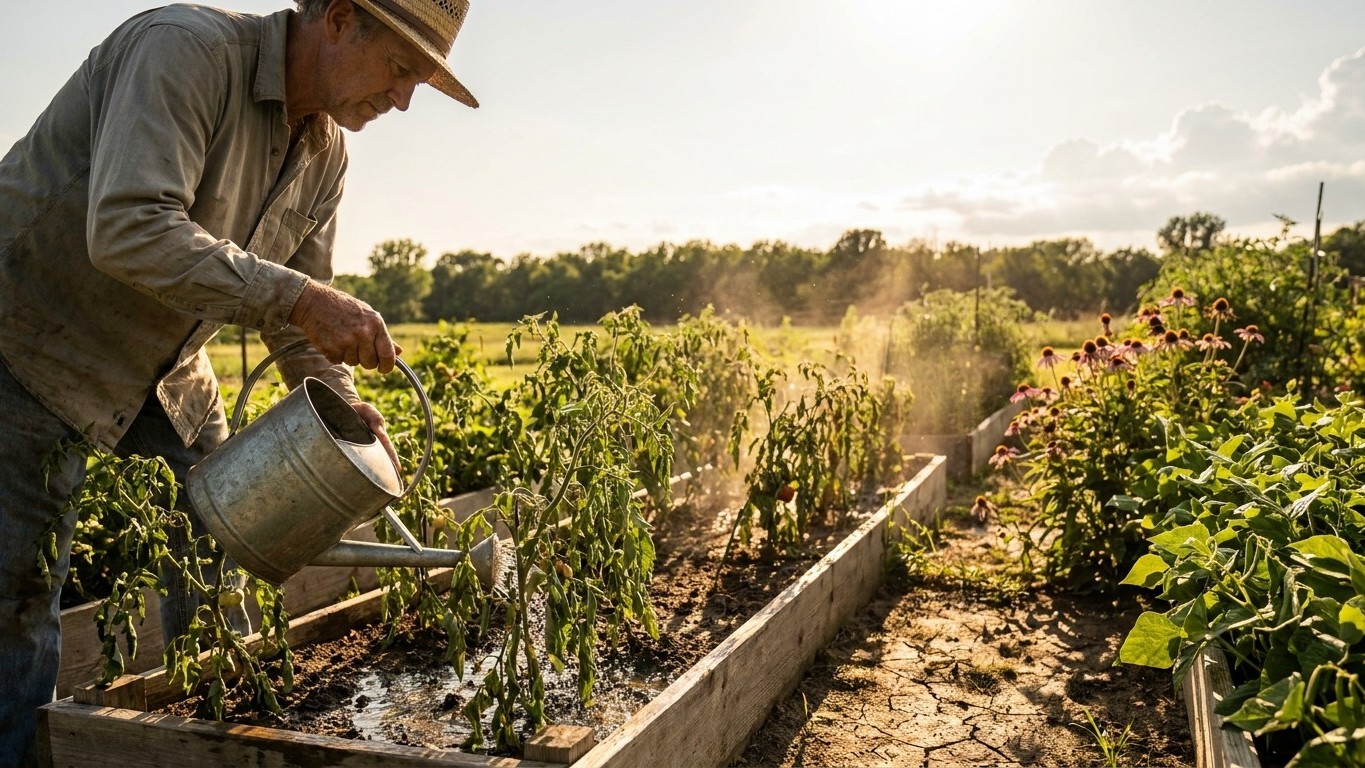

Missouri gardens live and die by two things: heat and unpredictable rain. The state’s growing season runs roughly six months, and a big chunk of it lands in temperatures that pull moisture out of soil faster than most gardeners expect. Here’s what that means for your watering can, your hose, and your water bill.
What the climate asks of you

Start with the number that changes everything: Kansas City, used here as the reference station, averages 32.7 days a year at 90F or hotter, according to NOAA’s 1991-2020 Climate Normals. That’s not a handful of scorchers in late July. That’s better than a month of the year when soil surfaces bake, leaves transpire hard, and container plants can wilt by early afternoon even after a morning soak.
That heat load is the real driver of watering demand here, more than any single rainfall total. Missouri summers don’t deliver rain on a predictable schedule. Some weeks bring a soaking thunderstorm and a cooldown. Other weeks, especially when a heat dome parks over the Midwest, deliver nothing for ten days straight while the mercury sits above 90F. A garden bed doesn’t care about the seasonal average. It cares about the week it’s actually living through. That’s why NOAA’s monthly totals for your specific county, or a call to your local extension office, matter more than a statewide rule of thumb, and it’s also why gardeners who rely heavily on pots and raised containers need their own approach, as outlined in this guide to Watering Pots and Containers in Missouri.
Zones and frost dates set the calendar
Missouri spans USDA Hardiness Zones 5b to 7b, a wide range for one state. Kansas City sits roughly in the middle of that band, but a gardener in the Bootheel near the Arkansas border is working with a noticeably milder, longer season than someone near the Iowa line. Any watering schedule built around the Kansas City area will need adjusting further south and further north.
Frost dates bracket the season. At the Kansas City reference station, the last spring freeze typically falls between April 6 and April 20, and the first fall freeze arrives between October 18 and October 29. Downtown stations tend to run about five days earlier in spring, and southern Missouri stays frost-free even longer. That gives most of the state a six-month stretch, roughly mid-April through late October, when a garden depends entirely on rainfall and irrigation working together. Miss that window on either end and you’re either watering a bed that isn’t ready for it or neglecting one that still needs it.
How much, how often
The rule gardeners hear most often, an inch of water a week, is a starting point, not gospel. What actually matters is getting water down to where roots live, four to six inches deep for most vegetables and perennials, and doing it consistently enough to carry your beds through, as this guide to Watering Through a Dry Spell in Missouri explains, even when the rain doesn’t cooperate for days at a time rarely enough that roots are forced to chase moisture downward instead of clustering at the surface where afternoon heat cooks them.
Shallow, daily watering is the single most common mistake in Missouri gardens. A five-minute sprinkle every evening feels responsible. It isn’t. It trains roots to stay in the top inch of soil, which is exactly the layer that dries out fastest once a 90F day hits. Deep, infrequent watering builds a root system that can ride out a dry week.
Soil texture changes the math. Sandy ground, the kind found in parts of the Bootheel from old river deposits, drains fast and holds little reserve; it needs shorter, more frequent soakings than clay. Heavy clay, common across much of northern Missouri’s loess plains, holds a week’s worth of water but drowns roots if it’s watered again before it’s had a chance to dry. Working or soaking clay while it’s still wet compacts it, which makes the next dry spell worse, not better.
With nearly 33 days a year hitting 90F or higher, plenty of July and August weeks will need a full inch of supplemental water because rain simply isn’t showing up when the heat peaks. Here’s a sequence that works across most Missouri soils:
- Check before you water. Push a finger or a trowel two inches into the soil near the root zone. If it’s dry at that depth, water. If it’s still damp, wait a day and check again.
- Water at the base, in the morning. Aim the hose or drip line at soil level, not the leaves, and do it early so foliage dries before evening, cutting down on fungal disease.
- Apply roughly one inch per session for average garden soil, adjusting downward to shorter, more frequent soakings on sandy ground and upward in duration (but not frequency) on clay.
- Let the soil dry between waterings, especially in clay, where re-wetting saturated ground suffocates roots and invites rot.
- Watch the plant, not the calendar. Wilting in the cool of morning, rather than just the afternoon heat, is the signal that watering is overdue.
Restrictions and rules
Watering restrictions aren’t rare in Missouri, particularly during the hottest, driest stretches of July and August when municipal water systems come under pressure from irrigation demand on top of everyday household use. Some water districts and municipalities impose odd-even day watering schedules, time-of-day limits, or outright bans on outdoor watering during declared drought emergencies. Others have no standing rules at all until a drought is officially declared.
Because these rules vary by utility, by county, and by year, there’s no single statewide answer that holds up. What’s accurate for a Kansas City suburb this summer may not apply in a rural water district two counties over, and rules that existed in past drought years may have lapsed or tightened since. The only reliable move is checking directly with your local water provider or municipal utility before you set an automatic timer or run a soaker hose on a fixed schedule.
Given how many summer days climb past 90F here, and how unevenly rain falls once that heat sets in, this is a state where checking first is worth the ten minutes it takes. The University of Missouri Extension Service, at extension.missouri.edu, is a solid starting point for finding your local water authority and current guidance on outdoor watering during dry spells.
Using less
Cutting water use in a Missouri garden isn’t about watering less when plants need it. It’s about making every gallon you do apply go further, so you’re watering less often without stressing anything.
- Mulch, two to three inches deep. A layer of shredded bark or straw over the root zone slows evaporation dramatically, which matters most on the days temperatures push past 90F and bare soil can dry out within hours of a morning soak.
- Drip irrigation or soaker hoses. Delivering water at soil level instead of overhead cuts losses to wind drift and evaporation, and it keeps foliage dry, which matters in Missouri’s humid summers where wet leaves invite fungal disease.
- Group plants by water need. Deep-rooted perennials and drought-tolerant natives shouldn’t share a zone with thirsty vegetables or annuals; mixing them means overwatering one group to satisfy the other.
- Work organic matter into the soil. Compost improves both extremes at once, it helps sandy soil hold water longer and helps clay drain a little faster, softening the texture problem that drives so much of Missouri’s watering trouble.
- Rain barrels, where local rules allow them. As a general rule of thumb, an inch of rain falling on a 1,000-square-foot roof yields roughly 600 gallons of runoff. Missouri’s summer rainfall doesn’t arrive on a predictable schedule, so a barrel can fill fast after a single thunderstorm and then sit empty through a two-week dry stretch during peak heat. Checking your local monthly rainfall totals, through NOAA or your extension office, gives a realistic sense of how much a barrel will actually cover versus how much you’ll still need to carry from the tap.
Common questions
How often should I water my Missouri garden in July and August?
Check soil moisture at two inches deep every day or two rather than following a fixed schedule. With close to a month’s worth of days above 90F most years, soil can dry out faster than a routine calendar allows for, especially in sandy ground.
Is it better to water in the morning or evening?
Morning. Watering early lets foliage dry before nightfall, cutting the risk of fungal disease in Missouri’s humid summers, and it gives roots moisture before the day’s heat sets in.
Does Missouri have statewide watering restrictions?
No single statewide rule applies. Restrictions are set locally by municipalities and water districts, often triggered by drought conditions in summer. Check with your local water provider or the Missouri Extension Service before assuming a rule applies or doesn’t.
Does my part of Missouri matter for watering decisions?
Yes. The state spans USDA zones 5b to 7b, and frost dates shift by roughly a week or more between the northern border and the Bootheel. A schedule built around the Kansas City area will likely need adjusting further north or south.