
Missouri gardens need roughly an inch of water a week through summer, but the state’s own numbers complicate that simple rule. August, the driest summer month, delivers 4.24 inches of rain at the reference station, while 32.7 days a year climb past 90°F, pulling moisture back out of the soil almost as fast as it lands. The gap between what falls and what evaporates is what decides your watering schedule, not the calendar.
What changes here

Two numbers set the stage for every watering decision in Missouri: 4.24 inches of rain in August, the driest month of summer, and 32.7 days a year that reach 90°F or higher, both drawn from the Kansas City reference station’s 1991-2020 normals. Read together, they mean the sky delivers a decent amount of water on paper, but heat pulls much of it back out before roots can use it.
Do the arithmetic. A vegetable bed or a bed of annuals wants about an inch of water a week. August has roughly 4.3 weeks in it, so 4.24 inches divided across the month works out to just under an inch a week on average, about 0.99 inch. That number looks reassuring until you remember it’s a monthly total, not a weekly delivery schedule. Missouri’s summer rain mostly arrives as thunderstorms: a half-inch here, an inch-and-a-half there, then a stretch of ten or twelve dry days while the mercury sits above 90°F on more than 32 days a year. A garden can go through a two-week dry spell in a month that averaged out to “enough” rain.
June and July are wetter on paper, at 5.25 and 4.58 inches, and the three-month summer total comes to about 14.1 inches against an annual 39.3 inches. That’s more rain than plenty of drier Western states see all year. But volume isn’t the same as availability. With nearly a third of the year’s 90-plus-degree days packed into June through August, evaporation from soil and transpiration from leaves both spike right when the rain is least reliable.
The available figures for this territory don’t break down soil composition, and soil texture, how much sand versus clay sits under a given yard, changes how far that inch actually reaches. Sandy ground lets water drain through within hours, so an inch delivered by a single storm doesn’t stick around long enough to matter a week later. Heavy clay, common in parts of the state, holds water far longer but drains slowly, so an inch that falls on already-saturated clay can sit at the surface and suffocate roots rather than soak in. A gardener who knows their own dirt has already answered half the watering question before touching a hose.
How to water when it matters
The method that works in Missouri’s climate is deep and infrequent, applied at the base of the plant, in the morning. Each part of that sentence answers a specific problem this state’s weather creates. Deep watering pushes moisture down past the top few inches, encouraging roots to follow it downward where they’re insulated from the heat driving those 32.7 days above 90°F. Infrequent watering lets the surface dry between sessions, which matters on clay soils that hold moisture long enough to drown shallow roots if watered too often. Watering at the base, rather than overhead, keeps water off the foliage, and morning timing gives leaves time to dry before evening, when Missouri’s humid summer air is already primed to help fungal disease take hold overnight.
Checking whether the soil actually needs water beats watering on a schedule. A finger pushed two inches into the ground, or a trowel pulled up near the root zone, tells the real story better than the look of the surface, which can appear bone-dry on clay while staying damp an inch down, or look damp on sand while the root zone below is already parched.
Soil texture changes the rhythm more than anything else. Sandy ground holds little water and drains fast, so it asks for shorter, more frequent soakings rather than one big weekly dose. Heavy clay can hold close to a week’s worth of water in reserve, but watering it again before it’s had the chance to dry invites root rot rather than growth. Since the figures for this territory don’t specify a dominant soil type, treat your own yard as the deciding factor, not a statewide average.
A reasonable starting point, given August’s 4.24 inches of rain arriving unevenly across the month: plan for about one inch of total water a week between rainfall and hosing, delivered in one or two deep sessions rather than daily sprinkles. Check the soil before adding more, and adjust from there.
- Push a finger or trowel two inches into the soil near the root zone before watering; if it’s dry at that depth, water now, if it’s still moist, wait.
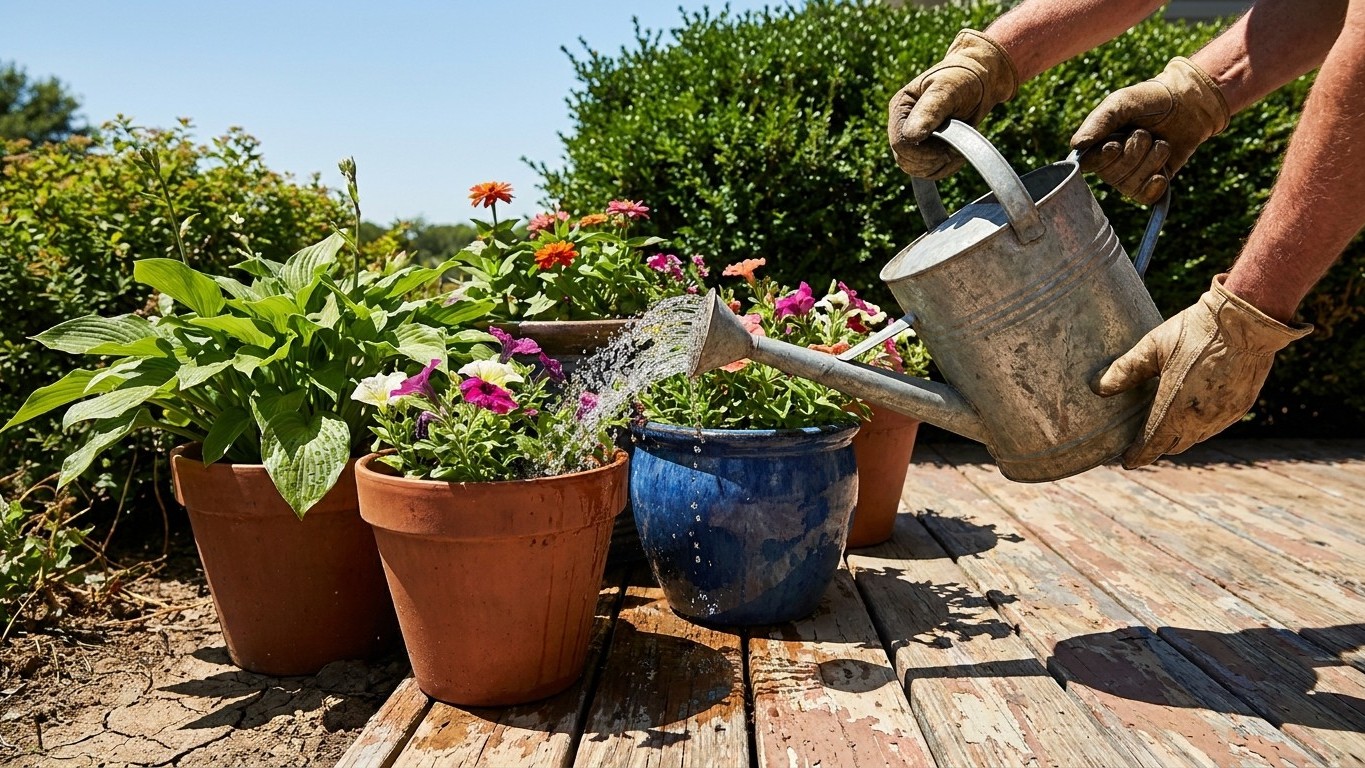
- Water at the base of the plant, not over the leaves, using a soaker hose, drip line, or the spout of a watering can held low.
- Water in the morning, ideally before 10 a.m., so foliage and surface soil dry out well before evening humidity sets in.
- Aim for a deep soak of roughly one inch total per week on average soil, split into two sessions on sandy ground or in containers, which dry out faster.
- Skip the scheduled watering entirely after a storm that clearly soaked the ground, then recheck with a finger two or three days later rather than watering on autopilot.
What goes wrong
“I water a little every day, just to be safe”
Daily light sprinkling wets only the top inch of soil, training roots to stay near the surface where Missouri’s 32.7 days a year above 90°F bake them dry within hours. Deep, less frequent watering is what pushes roots downward into cooler, more stable soil instead.
“I water in the evening so it doesn’t evaporate in the heat”
Evening watering keeps foliage wet overnight in a state where summer humidity already runs high, which is exactly the environment fungal diseases like powdery mildew and blight need to spread. Morning watering lets leaves dry within a few hours instead.
“It rained yesterday, so I skipped watering”
A quick thunderstorm can look like a soaking rain while wetting only the top half-inch of ground, especially on compacted or clay-heavy soil where water runs off before it sinks in. Checking two inches down with a finger, rather than trusting the sky, is the only way to know if that storm actually reached the roots.
“I don’t bother with mulch”
Bare soil left exposed through a Missouri summer, with more than 32 days a year above 90°F, loses moisture to evaporation almost as fast as it’s applied. A two- to three-inch layer of mulch slows that loss and keeps the soil temperature more stable between waterings.
Given how unevenly Missouri’s summer rain arrives, against a driest month of just 4.24 inches spread across sporadic storms, the costliest mistake here is usually letting a bed dry out between those storms and assuming the next one will catch up. The opposite mistake, watering clay soil that hasn’t yet drained from the last storm, costs fewer gardens here but still drowns roots when it happens.
Local help
For soil testing, plant-specific watering guidance, and questions specific to a county, the University of Missouri Extension is the state’s land-grant resource, staffed by horticulture agents who know local conditions county by county. Watering restrictions during dry spells are set by individual water utilities and municipalities, not the state as a whole, and they change year to year. Check with your own water provider before assuming any blanket rule applies to your address.
Common questions
How often should I water my garden in Missouri during summer?
Check the soil two inches down before watering rather than following a fixed schedule. Given August’s 4.24 inches of rain arriving unevenly, most beds need a deep soak once or twice a week on average soil, more often on sandy ground or in containers.
Is Missouri rainfall enough to skip watering altogether?
Not reliably. The three summer months bring about 14.1 inches combined, but with 32.7 days a year above 90°F pulling moisture out through evaporation, that rain rarely arrives evenly enough to replace regular checking and watering.
What time of day is best for watering in Missouri?
Morning, before the heat of the day sets in. It lets foliage dry before evening, cutting down on the fungal disease risk that comes with Missouri’s humid summer nights.
Do containers need different watering than garden beds here?
Yes. Containers dry out faster than ground soil because they hold a smaller volume and are more exposed to air on all sides, so they often need water more frequently, sometimes daily, during stretches with several days above 90°F.