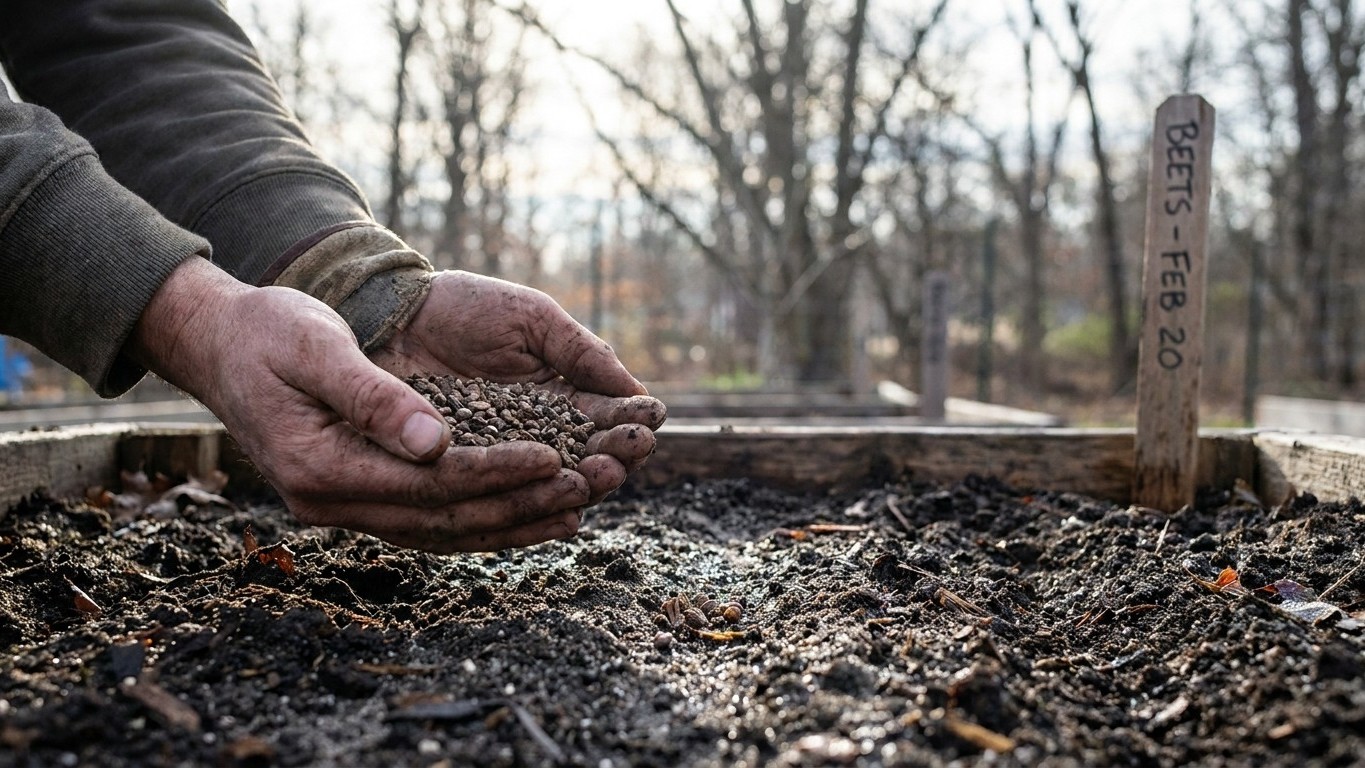

Beets go into Montana ground about two to three weeks before the last spring frost, which for the state’s mildest valley lands falls between April 29 and May 10. That timing matters more here than in most places, because what the seed meets in its first six weeks, cold clay, a late snap, a dry wind, decides whether the root grows sweet or splits into something you’d rather compost than cook.
The short answer
Montana’s official state soil is the Scobey series, a Mollisol, the same family of deep, dark prairie ground that built the Corn Belt further east. Where it’s mapped, the surface runs close to neutral, about pH 7.0, and it’s clayey: 35 percent sand, 31 percent clay, 34 percent silt, with roughly 2.0 percent organic matter and good drainage. For a beet, that’s a mixed bag. Beets want deep, sandy, well-drained soil carrying plenty of organic matter, and Scobey’s drainage rating checks that box. But 31 percent clay is heavier than a beet root would choose for itself. Clay holds water longer after a spring rain, which can crust hard once it dries, and a beet seedling pushing up through a crusted cap struggles in a way it wouldn’t in looser, sandier ground.
The organic matter figure, about 2.0 percent, sits below what a beet bed benefits from. Utah State University Extension recommends working in composted organic matter, up to 1 inch per 100 square feet, worked into the top layer before seeding. On Scobey-type ground, that amendment isn’t optional polish, it’s the difference between a crust the seedling breaks through and one it doesn’t.
On heat, the published data for this page doesn’t include a count of days a year the reference valley spends above 90 F, so that number isn’t repeated here as if it were tracked. What is documented is the threshold that matters for the root itself: heat above 85 F combined with water stress makes a beet root woody, dense and fibrous rather than tender. That’s a late-season risk more than an early one, and it’s worth holding separate from the bolting risk that shows up in the first six weeks after sowing, discussed next.
| Factor | Scobey series (state soil) | What beets want |
|---|---|---|
| Texture | 35% sand / 31% clay / 34% silt | Deep, sandy, well-drained |
| Drainage | Well drained | Well drained |
| Surface pH | About 7.0 | Not specified in this data |
| Organic matter | About 2.0% | Amended, up to 1 in. per 100 sq ft |
None of this stands in for a soil test from your own yard. A state spans hundreds of mapped soil series, and Scobey is a starting point for talking about Montana ground in general terms, not a reading of the bed you’re about to dig. River bottoms, hill country, and any lot a builder has cut and filled will run differently, sometimes completely differently, from the mapped series that carries the state’s name.
The six weeks that decide it here
Sowing beets two to three weeks ahead of the last frost puts the newly emerged seedling’s first six weeks squarely inside Montana’s spring, and that spring has a reputation for swinging rather than settling. A week of warm, dry wind can pull moisture out of a seedbed fast, and a week later a cold front can drop temperatures back near freezing before the ground has fully warmed. For a beet, the risk in that window isn’t the cold by itself, it’s the combination of thirst and stress. Utah State University Extension is specific on this point: water stress during the first six weeks after sowing is what triggers premature flowering, known as bolting, in beets. A beet that bolts stops putting effort into the root and starts pushing up a seed stalk instead, and once that switch flips, there’s no coaxing the root back into growing.
That’s why the six-week window sown around the Billings-area last-frost date (April 29 to May 10) deserves more attention than the calendar date itself. If that stretch turns dry and windy, as Montana spring often does in patches, the seedbed needs supplemental water even if the calendar says it’s still technically spring. If it turns unusually wet, the same clay-heavy ground that drains well on paper can still puddle around a shallow seed row long enough to rot it before it germinates.
The practical takeaway isn’t a fixed rule, it’s a habit: check soil moisture at the seed depth, not just the surface, through those first six weeks, and don’t assume that because the seed went in at the textbook time, the job is done. Mountain valleys elsewhere in the state complicate this further, since they can see a hard frost in almost any month, which means a gardener working from the Billings date alone, rather than a locally observed one, is sowing on borrowed information.
What Goes Wrong here
- Seedlings bolt instead of bulking up. A dry spell in the first six weeks after sowing is enough to trigger this, even if rain returns later. The remedy is steady moisture at the seed row from day one, not just after the seedling has emerged and started showing stress.
- Roots turn woody late in the season. This happens when a stretch of heat above 85 F lands on a bed that’s also short of water. It is a separate failure from bolting, caused later and by heat rather than cold, and the fix is the same principle applied at a different time: keep water consistent through hot spells rather than letting the bed dry out between waterings.
- Clay-heavy soil crusts over before seedlings can push through. On ground built like the Scobey series, with roughly a third clay in the surface, a hard rain followed by dry wind can seal the top into a crust fine beet seedlings can’t break. Working in composted organic matter, up to 1 inch per 100 square feet, before sowing loosens that surface enough to let seedlings through.
- Standing water after a wet stretch. Even soil rated well drained on paper can pool briefly in low spots or compacted rows, especially where clay content runs high. Raised rows or slightly mounded beds in the wettest corners of a garden reduce this without changing the rest of the bed.
- Sowing by a date that doesn’t match the actual valley. The April 29 to May 10 window applies to one of Montana’s milder locations. Gardeners in mountain valleys working from that same date, rather than their own observed last frost, risk sowing into ground that’s still weeks from safe.
Common questions
How long do beets take to mature once sown in Montana?
Beets typically run 60 to 80 days from seeding to harvest, according to Utah State University Extension. That count starts at the day the seed goes into the ground, since beets are sown directly in place rather than started as transplants and moved later.
Should I sow before or after the last frost date?
The two to three weeks before the last frost is the target window discussed here, based on the region’s April 29 to May 10 range. Sowing after that date still works, but it pushes the six-week vulnerable window later into the season, closer to the heat that causes woody roots rather than the cold that causes bolting.
My valley frosts later than Billings. Does this timing still apply?
Not directly. Mountain valleys elsewhere in Montana can see frost in any month, and the April 29 to May 10 range reflects one of the state’s milder locations, not a statewide figure. Local observation of your own last frost is the better guide than borrowing a date from a warmer valley.
Does the state soil mean my garden is clay-heavy too?
Not necessarily. The Scobey series is Montana’s official state soil, representative of one mapped set of conditions, but a state spans hundreds of soil series. Garden beds near rivers, in hill country, or on any site that’s been graded or filled can differ completely from what the state soil describes. A soil test of your own bed is the only way to know your actual texture and pH.