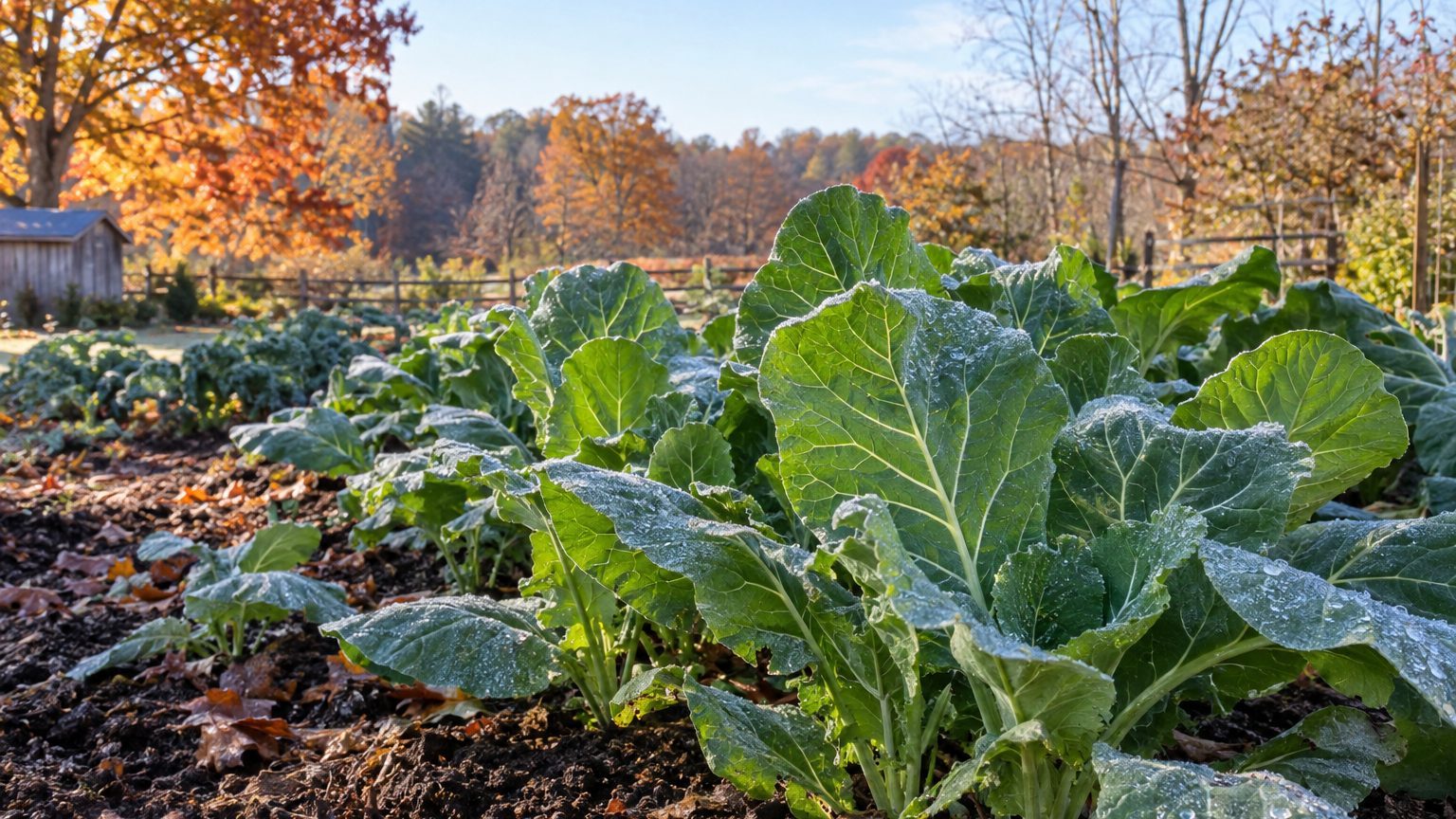

Collards go into Montana gardens as transplants around the last spring frost, with seed started indoors before that. A second planting in early summer can carry a fall crop up to the first frosts. The leaves shrug off a light freeze, which makes a short, late-ending spring workable. Two probability windows, one in spring and one in fall, set the whole schedule.
The short answer for Montana
What the frost dates measure
At the Billings reference station, the last spring frost falls between April 29 and May 10, and the first fall frost between October 1 and October 14. Both come from the NOAA 1991-2020 Climate Normals and are probabilities of a 32°F freeze, taken from the 30-70% band. Neither is a date when frost stops or starts. Each is the stretch of days when the odds of a freeze run between 30 and 70 percent, so a freeze before the spring window or after the fall one is still possible. Billings is also one of the milder valleys. Mountain valleys elsewhere in Montana can frost in any month.
Collards tolerate light frost, so there is no reason to wait for the spring window to close. Transplants that have been hardened off can go out as the window opens, with a cover on hand for a hard night.
Spring and fall sowing windows
Spring work runs backward from the last-frost window. Seed started indoors in March to early April gives sturdy transplants by late April. Direct seeding works once the soil has warmed and can be worked. The fall crop is sown in early summer so the plants have size before the October window.
| Task | Timing | Anchored to |
|---|---|---|
| Start seed indoors | March to early April | Several weeks before transplanting |
| Set out hardened-off transplants | Late April through mid-May | The April 29 to May 10 last-frost window |
| Direct-sow in the garden | Early to mid-May | Soil that has warmed and drained |
| Sow for a fall crop | June to early July | The October 1 to October 14 first-frost window |
A spring planting can be harvested for leaves from midsummer on, a few at a time from the bottom of the stem. For the full growing routine, see Growing Collards in Montana.
What will not work here
Short seasons punish slow plants. With a first-frost window opening October 1, a collard sown in late July has only a few weeks of real growth left, and brassicas planted that late stall at seedling size. Frost sweetens collards, but only a plant with a full set of leaves has anything to sweeten. Planting dates borrowed from the Deep South, where collards go in during late summer and stand through winter, miss Montana’s season by months.
Planting out in early April because the weather turned mild is the opposite mistake. Before April 29 the odds of a 32°F freeze drop below 30 percent, but they are not zero, and cold soil stalls transplants even when the air feels springlike. Seedlings that stop growing are easy targets for wind and a late cold snap. A cover on a hard-freeze night saves a planting, but it is a patch, not a plan.
Overwintering is a bigger gamble than it looks. The mean daily minimum of the coldest month at Billings is 17.9°F. That is an average, so the cold nights in a typical winter go well below it. Southern gardeners leave collards standing from fall to spring and harvest all winter. In Montana, plan on one season per planting, and treat anything still alive in March as a bonus rather than a crop.
Watering habits matter as much as dates. Seedlings sown in June have to germinate in warm, dry air, and a surface that dries out between weekly soakings will cost you a stand. The seed bed needs light, frequent moisture until the seedlings are up. After that, deeper, less frequent watering builds roots. Dry air and wind in open sites pull moisture out of leaves faster than gardeners from wetter regions expect, which is why a thick mulch pays off in midsummer.
The last trap is spacing for a climate Montana does not have. Tight spacing works against fungal leaf problems in humid summers, and the same rule is sometimes repeated for drier regions, where the leaf-spot risk is smaller. Here the stronger argument for wider spacing is water. Fewer plants sharing the same soil moisture means each one keeps growing through a dry spell.
What changes across Montana
Montana does not have one gardening climate. The USDA Plant Hardiness Zone Map (2023, built on 1991-2020 normals) places the state anywhere from zone 3a to 6a. That is three full zones, and no single planting date fits across it. The dates above belong to Billings, and the farther a garden sits from that reference, the more they need to shift.
The zone system rests on one variable, the average annual extreme minimum temperature. It describes winter cold, not the length of the frost-free season. Two gardens in the same zone can have different last-frost dates, because cold air pooling in a low spot, a north-facing slope, or a windy ridge can move a frost date by weeks. Collards, a crop grown for one season, care far more about those frost dates than about the winter minimum.
Gardeners in the north or at altitude should shift in a consistent direction. Spring transplanting moves later, sometimes well past mid-May. Indoor seed starting gives more of a head start, since the outdoor season is shorter on both ends. The fall crop moves earlier, so plants reach size before the first freeze arrives in September rather than October. Frost protection, such as a row cover or a cold frame, stops being an occasional rescue and becomes part of the routine. In milder valley spots near the Billings reference, the windows above fit more closely.
Readers who want to know their own zone should look it up on the USDA Plant Hardiness Zone Map by ZIP code. Think of the zone as one signal about winter, and your own frost history as the one that sets the calendar.
Where to check this for your own county
Montana State University Extension is the place to confirm everything above for a specific county. The extension service runs offices statewide, and the one covering your county knows the local frost pattern, the soils, and which seasons ran short in recent years. A county recommendation beats a state one. The windows in this article come from a single reference station, which makes them a reasoned starting point, not a replacement for local advice.
Two things are worth looking for. The first is the local planting calendar, or vegetable planting guide, for your county or the nearest one. Check how its spring and fall dates for cool-season crops compare with the Billings windows, and move your own dates by the difference. The second is the list of varieties trialled in your area. Collards are not grown everywhere in Montana, so a trial report that includes brassica greens at an elevation like yours is worth more than any national seed catalog.
When you call or visit a county office, ask three direct questions. What is the typical last spring frost in your part of the county? Has anyone grown collards or kale there, and when did they plant? How late into fall do greens usually stay harvestable? Local extension staff and experienced growers can answer those from memory. Once you have a county date, the variety question is the next step, and The Best Collards and Greens for Montana covers which types suit a short season.
Checking this against your own garden
Your own observations outrank every date in this article. Three are worth watching, and none needs a gadget.
- Soil warmth by feel. Push a bare hand a few inches into the bed in the morning. If the soil feels cold and clings in a wet clump, direct-sown seed will sit and sulk. If it feels cool but crumbly and drains freely, sowing is safe. A bed that warms earlier than the neighbor’s has a sunny, well-drained microclimate. A bed that stays cold has a late one, and you should push every planting date back accordingly.
- The first true leaves. Seedlings first show two rounded seed leaves, and the first true leaves, shaped like a small collard leaf, come after. When those appear, seedlings can be thinned, and indoor-started plants are close to ready for outdoor hardening. How fast they appear tells you whether your windowsill or greenhouse is warm enough, or whether growth is lagging.
- Where frost lingers. Notice which part of the yard still has white on the grass or a frosted car windshield when the rest has thawed. The low corner, or the spot at the bottom of a slope, is where cold air settles. Plant collards in the higher, warmer section in spring, and cover the frosty spot first in fall.
Keep a note of the date each of these shows up for a season or two. After two years, you have a calendar built for one yard, which is better than any regional estimate.
Some gardeners also time this by the Moon: when to plant collard greens by the moon, as almanac tradition rather than fact.
Common questions
Can I sow collards directly in the garden in Montana?
Yes, once the soil has warmed and can be worked, usually early to mid-May near Billings. Direct seeding is the easiest path for a summer sowing aimed at fall harvest. For a spring crop, indoor-started transplants get more of the short season.
How late can I plant collards for a fall harvest?
Sow in June or early July. The first fall frost window at Billings runs October 1 to October 14, and the plants need to reach good size before it arrives. Sowing later than midsummer produces small plants. In colder northern or high-elevation gardens, count backward from an earlier frost.
Will collards survive a Montana winter?
Do not count on it. The mean daily minimum of the coldest month at Billings is 17.9°F, and many nights run colder than that. Treat collards as a one-season crop here, and finish harvesting in fall.
Does frost hurt collards?
A light frost does not damage them and tends to sweeten the leaves, because the cold pushes the plant to convert starch to sugar. A hard freeze is another matter, so cover plants on nights forecast well below freezing and pick the leaves you want before the hardest freeze of the season arrives.