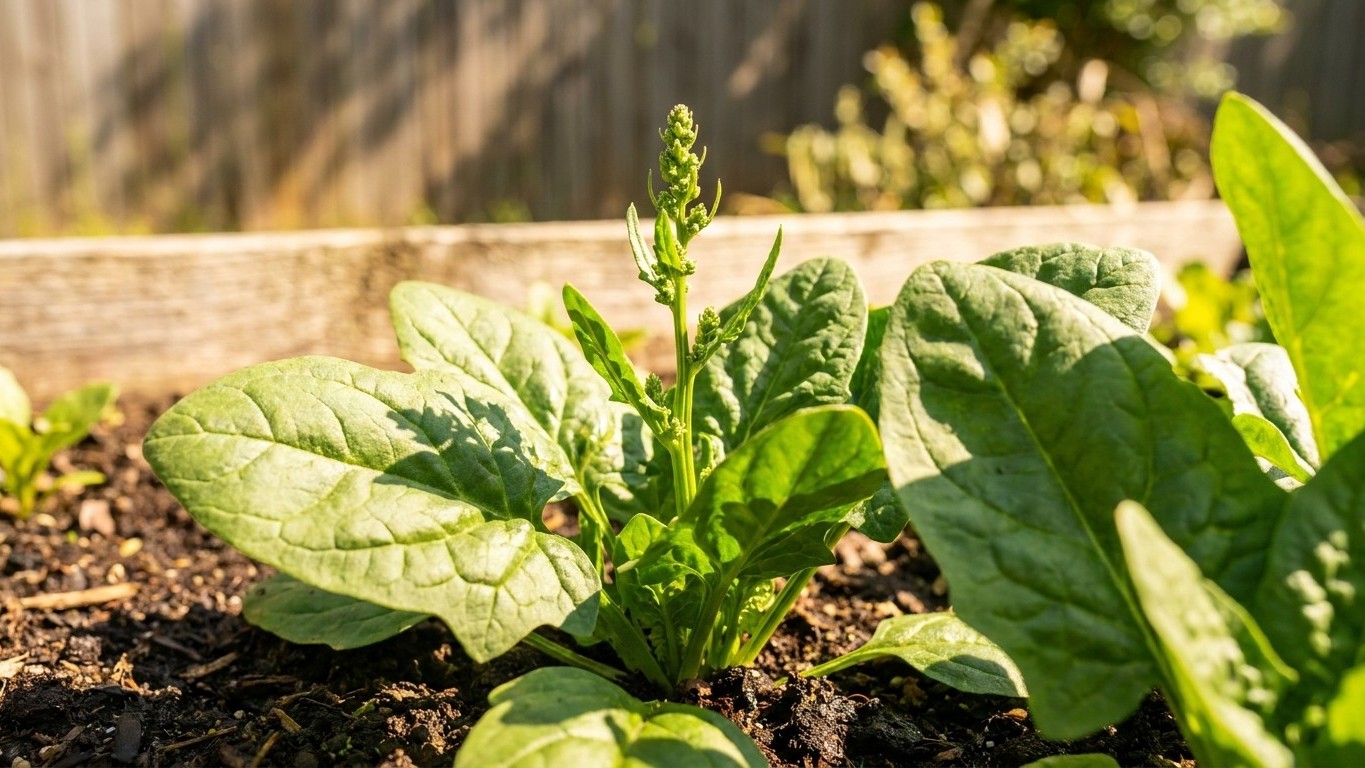

Yes. Around Billings, Montana, spinach will bolt early no matter how mild the summer feels, because the trigger is daylight, not heat. On the longest day of the year, this part of Montana logs 15 hours and 32 minutes of sun, well past the point that pushes leafy greens into flowering mode. Add 28.3 days a year when the thermometer tops 90°F, and spinach faces pressure from two directions at once: long days force the bolt, and any lingering heat locks it in with bitter, tough leaves. Timing, not variety choice, decides whether you get a real harvest.
The short answer
Fifteen hours and thirty-two minutes. That’s how much daylight the Billings area gets on the summer solstice, and it’s the single number that explains why spinach struggles here through midsummer. Spinach reads day length the way a clock reads hands moving forward: once the hours of daylight climb past a certain point, the plant switches from making leaves to shooting up a flower stalk. That switch happens on its own schedule, driven purely by the sun’s angle, and it happens whether the air feels like a cool spring morning or a scorching July afternoon. A mild Montana summer does not slow this process down. The calendar keeps stretching the days toward that 15-hour-32-minute peak regardless of what the thermometer says, so gardeners who assume a cooler summer buys extra growing weeks are working from a false comfort.
Heat compounds the problem rather than replacing it. Spinach grows best when temperatures stay under 75°F, and Billings averages 28.3 days a year at 90°F or hotter. Once that heat load builds, typically as the day-length clock is already pushing the plant toward flowering, the two pressures stack: long days start the bolt, and heat both accelerates it and turns the remaining leaves bitter. So the honest answer to what limits spinach here is both factors acting together, not one or the other. Day length sets the deadline; heat makes sure nothing salvageable is left once that deadline passes.
Some spinach varieties, including Bloomsdale, Melody, Teton, and Olympia, are commonly sold as slower to bolt than others. Utah State University Extension names these varieties but publishes no data on how many extra days or weeks each one actually buys under long-day conditions. That means variety selection can be part of a strategy, but it isn’t a documented fix, and nothing available lets a gardener count on a specific number of bonus days from switching seed packets.
How long the spring window really is
- Start from the last frost. NOAA’s 1991-2020 climate normals put the last spring freeze for the Billings area somewhere between April 29 and May 10. That range is the anchor for everything else in the spring calendar, and it’s worth remembering that Billings sits in one of Montana’s milder valleys; mountain valleys elsewhere in the state can see frost in almost any month.
- Back up two to three weeks for sowing. Utah State University Extension recommends putting spinach seed in the ground two to three weeks ahead of the last expected frost. Applied to the Billings frost window, that puts realistic sowing dates somewhere between roughly April 8 and April 26.
- Track the 75°F growth ceiling. Spinach stops growing well once temperatures push past 75°F. Billings racks up 28.3 days a year at 90°F or hotter, and while those extreme days concentrate later in summer, the climb toward the 75°F ceiling starts well before then, narrowing the comfortable growing stretch faster than most gardeners expect.
- Add in the day-length climb. Independent of temperature, daylight is lengthening every single day between the spring sowing window and the June solstice, when it peaks at 15 hours 32 minutes. That climb alone is enough to trigger bolting, so it’s working against the crop even during weeks when the weather still feels cool.
- Total it up. Sown in mid-April, spinach gets roughly six to eight weeks of usable growth before the lengthening days and building heat converge, typically somewhere around late May to mid-June. That’s the entire spring window: a season measured in weeks, not months.
The autumn crop, and when the soil lets you sow
Montana gardeners who lose the spring crop to bolting get a second shot in autumn, but that window is bounded by two separate obstacles rather than one, and both have to be worked out before a sowing date makes sense.
Soil temperature blocks early sowing
Spinach seed germinates poorly once soil temperature climbs above 80°F, according to Utah State University Extension. That single fact rules out sowing a fall crop the moment summer ends on the calendar. Billings averages 28.3 days a year at 90°F or hotter, and those days cluster in the hottest stretch of summer, which means soil temperatures likely stay above that 80°F germination threshold well into late summer even after air temperatures start easing. Practically, that pushes the realistic start of fall sowing later than a simple frost-date calculation would suggest, since the ground itself needs time to shed the heat it absorbed during the hottest weeks.
The first fall frost sets the deadline
On the other end, NOAA’s 1991-2020 climate normals place the first fall freeze for the Billings area between October 1 and October 14. Utah State University Extension’s guidance for a fall crop is to sow 50 to 75 days before the date you want to harvest. Counting back from a harvest target sitting right at that October 1-14 frost window gives a sowing range of roughly mid-July to late August. Overlay the soil-temperature obstacle on top of that math, and the workable part of the range shrinks toward the later end, meaning early-to-mid August is a more realistic target than mid-July for most home gardens in this area. Sow too early and the seed struggles to germinate in soil still holding summer heat; sow too late and the first freeze arrives before the crop has matured.
Common questions
Can spinach be grown through a whole Montana summer here?
No. Long days push the plant toward bolting on their own schedule, and heat above 75°F adds bitterness and stress on top of that. The realistic growing stretches are spring and fall, with summer itself being the gap between them rather than a growing season.
When is the best time to sow spring spinach in the Billings area?
Roughly April 8 through April 26, based on sowing two to three weeks ahead of the area’s last spring frost window of April 29 to May 10.
When should fall spinach be sown for a real harvest before frost?
Counting back 50 to 75 days from the first fall frost window of October 1-14 points to mid-July through late August, but soil temperatures above 80°F reduce germination, so early-to-mid August tends to be the more workable target once summer heat has eased.
Do certain spinach varieties resist bolting better in this climate?
Bloomsdale, Melody, Teton, and Olympia are commonly marketed as slower to bolt, but Utah State University Extension, the source relied on here, publishes no specific data on how many additional days or weeks any of these varieties actually delay flowering.