
In Montana, winter squash goes into the ground (or into pots for later transplanting) between late April and mid-May, timed to the last spring frost at your local station. The exact window moves by two full weeks depending on where you garden, and by how many days of real summer heat your valley gets afterward. Here is what actually sets that window, and why the calendar date alone won’t save a slow-maturing squash.
The short answer for Montana
Start winter squash seed indoors three to four weeks before your last spring frost, then transplant outside once that frost risk has passed. Based on the reference station (Billings), the last spring frost falls somewhere between April 29 and May 10, and the first fall frost arrives between October 1 and October 14. Those dates aren’t guarantees. They mark the band where a 32F freeze has a 30 to 70 percent chance of happening on any given day, according to NOAA’s 1991-2020 Climate Normals. Outside that band, frost is either unlikely or fairly likely, but never off the table entirely, especially this far north.
Do the arithmetic on that window and you get roughly 144 to 168 days between the latest possible last frost and the earliest possible first frost. That sounds workable until you remember what winter squash actually asks for. Many hubbard and banana squash varieties want 100 to 110 days just to reach maturity, and winter squash needs extra time after that to cure a hard rind for storage. Cut it close by direct-seeding outdoors on May 10, and a slow variety is racing the calendar with almost no margin if the first fall frost lands on the early side of its own range.
That’s the case for starting indoors. A transplant that’s already four weeks old when it goes into the garden effectively adds a month to the usable season, without changing the actual frost dates at all. It’s a way of working around a short growing season rather than fighting it. Direct seeding still works for the faster-maturing acorn and delicata types, which can finish in 80 to 90 days, but even then, waiting until the risk of frost has genuinely passed (not just until the calendar date) is what separates a full harvest from a patch of squash cut down by a late cold snap in early June.
One more thing worth saying plainly: these frost dates come from one reference station. They describe Billings, one of the milder valleys in the state. If your garden sits in a different valley, at higher elevation, or somewhere with cold air pooling overnight, your actual frost risk can run weeks longer on both ends of the season. Treat the April 29 to May 10 window as a starting point for research, not a fixed rule for your own plot.
What will not work here

The single biggest failure mode in Montana is choosing a variety that needs more season than the calendar can give it. A squash rated for 110 or 120 days to maturity, planted outdoors on the safe side of the frost window, is still gambling on a first fall frost that could arrive as early as October 1. Even with a month’s head start from indoor sowing, some of the slowest hubbard and banana types are pushing the edges of what a 144-to-168-day season allows. This isn’t a minor scheduling inconvenience. It’s the difference between a rind hard enough to store through winter and a squash pulled green and soft right before the first freeze.
Watering on a schedule instead of by need
The second failure is treating summer watering like a chore you do once a week and forget. Montana’s growing-season rainfall averages about 4.3 inches across June, July, and August combined, with August, the peak of fruit-set and sizing, delivering just 0.87 inches on its own. Pair that with an average of 28.3 days a year reaching 90F or hotter, and you have a stretch where evaporation is working against the plant while rainfall is doing almost nothing to help it. A weekly watering routine that might be fine in a wetter, cooler state leaves Montana squash short on moisture right when the fruit needs it most.
Soil texture decides how badly this hurts. On sandy soil, that scarce rain drains through within a day, so a garden already needing supplemental water on a weekly schedule may actually need it every two to three days once the heat sets in. On clay, the same rain (and the same irrigation) sits longer, buying more time between waterings. Neither soil type gets a pass on the underlying problem: with only 0.87 inches of rain in August and nearly a month of 90-plus-degree days scattered through the season, this isn’t a climate where winter squash can be left to fend for itself once it’s transplanted.
What changes across Montana
Montana’s hardiness zones run from 3a to 6a on the USDA Plant Hardiness Zone Map, a range built entirely on one measurement: the average annual extreme minimum temperature. That’s not a small spread. A zone 3a garden and a zone 6a garden in the same state can differ by 20 degrees or more in how cold their coldest nights typically get, and that difference doesn’t stay confined to winter. It shapes how early the ground warms in spring and how much margin exists before the first hard freeze in fall.
No single planting date fits both ends of that range. A gardener at the milder, lower-elevation end of the state’s zone spread is working with conditions closer to the Billings normals already cited. Someone at higher elevation, or further north and west into the colder end of that 3a-6a band, should expect the safe frost-free window to open later in spring and close earlier in fall than the April 29 to May 10 and October 1 to October 14 dates given here.
What should shift in practice: gardeners in colder zones benefit from leaning harder into shorter-season varieties, starting transplants closer to four weeks ahead rather than three, and holding off on setting plants outside even a bit past the stated window if a valley has a history of late frost. None of this replaces knowing your own zone. It’s a reason to check it before locking in a date, not a signal to guess.
Where to check this for your own county
Montana State University Extension maintains county-level guidance that goes well beyond what a statewide page like this one can responsibly claim. That’s the source to use, and it’s worth going straight there rather than trusting a search result that might route to an outdated page.
Once there, look for two things specifically. First, a local or county planting calendar, which will reflect actual frost data for your area rather than a single reference station. Second, look for variety trial results or recommended cultivar lists specific to your county’s growing conditions. Extension offices often run their own field trials, testing how particular winter squash varieties perform under local heat, soil, and season-length conditions, information no statewide summary can substitute for.
A county recommendation will beat a state one every time, for a simple reason: it’s built on data closer to your actual garden. Your county extension office works from local frost records and, in many cases, direct field trials. If the two sources disagree on a planting date or a variety recommendation, treat the county source as the more reliable one.
Checking this against your own garden
No planting calendar, including this one, knows what’s actually happening in your soil this particular spring. Three things you can check by hand and by eye will tell you more than any date on a chart.
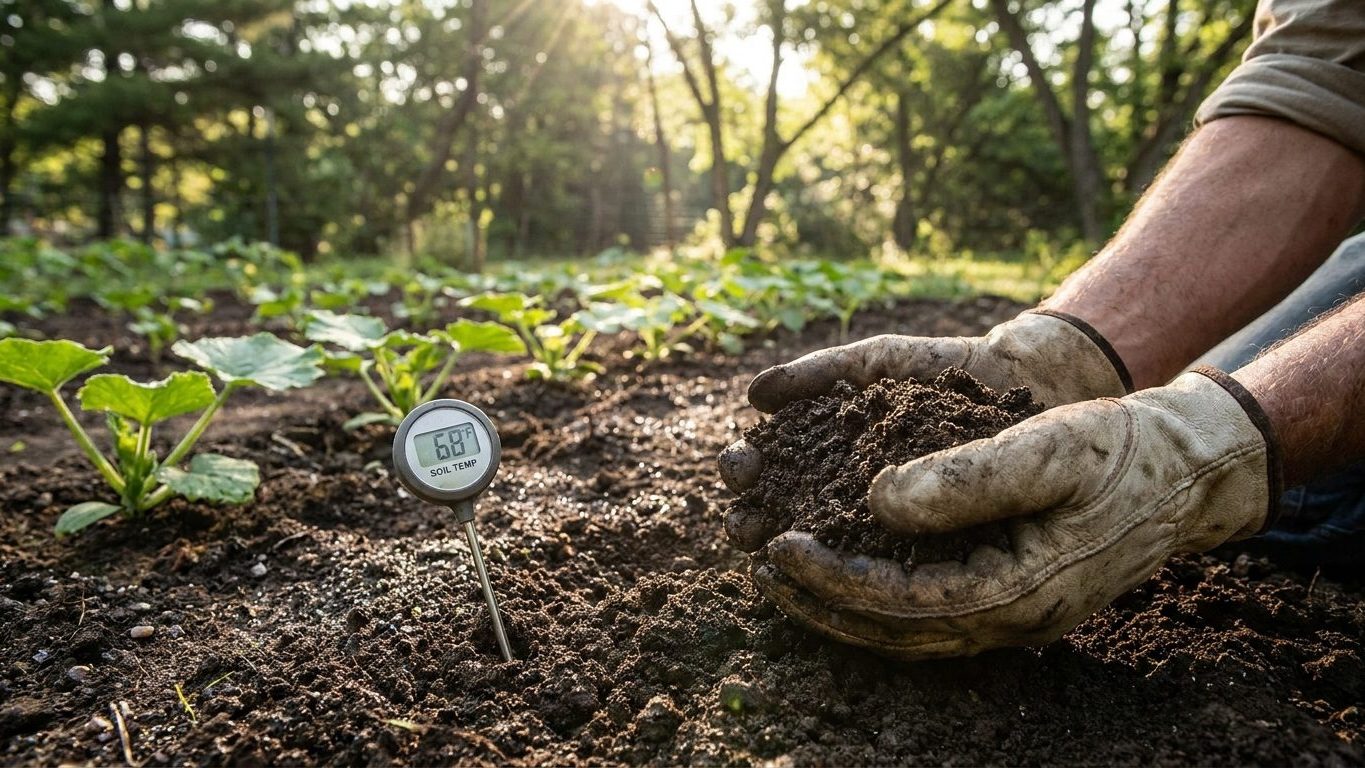
- Soil warmth by feel: push a finger a few inches into the bed in the morning. If it still feels cold to the touch well after your local frost date has passed, the soil hasn’t caught up to the calendar yet, and squash seed or transplants will sit and sulk rather than grow.
- The first flush of male flowers: winter squash typically produces male flowers before female ones. Their appearance signals the plant has shifted into active reproductive growth, a sign the season is warm enough to keep pushing rather than pulling back on care.
- The first true leaves: the rounded seed leaves that emerge first aren’t the plant’s real leaves. Watch for the next set, the ones with the characteristic squash-leaf shape, to appear. Their speed of emergence after transplanting is a rough gauge of how favorable your particular microclimate is this year, faster in a warm pocket of the yard, slower in a low spot where cold air settles.
Any one of these observations, made on your own plot, outranks the frost-date ranges cited earlier. The dates describe a probability at one weather station. Your soil, your flowers, and your leaves describe what’s actually happening where the squash is growing.
The Moon calendar is a separate, older custom: see when to plant winter squash by the moon, written as tradition rather than fact.