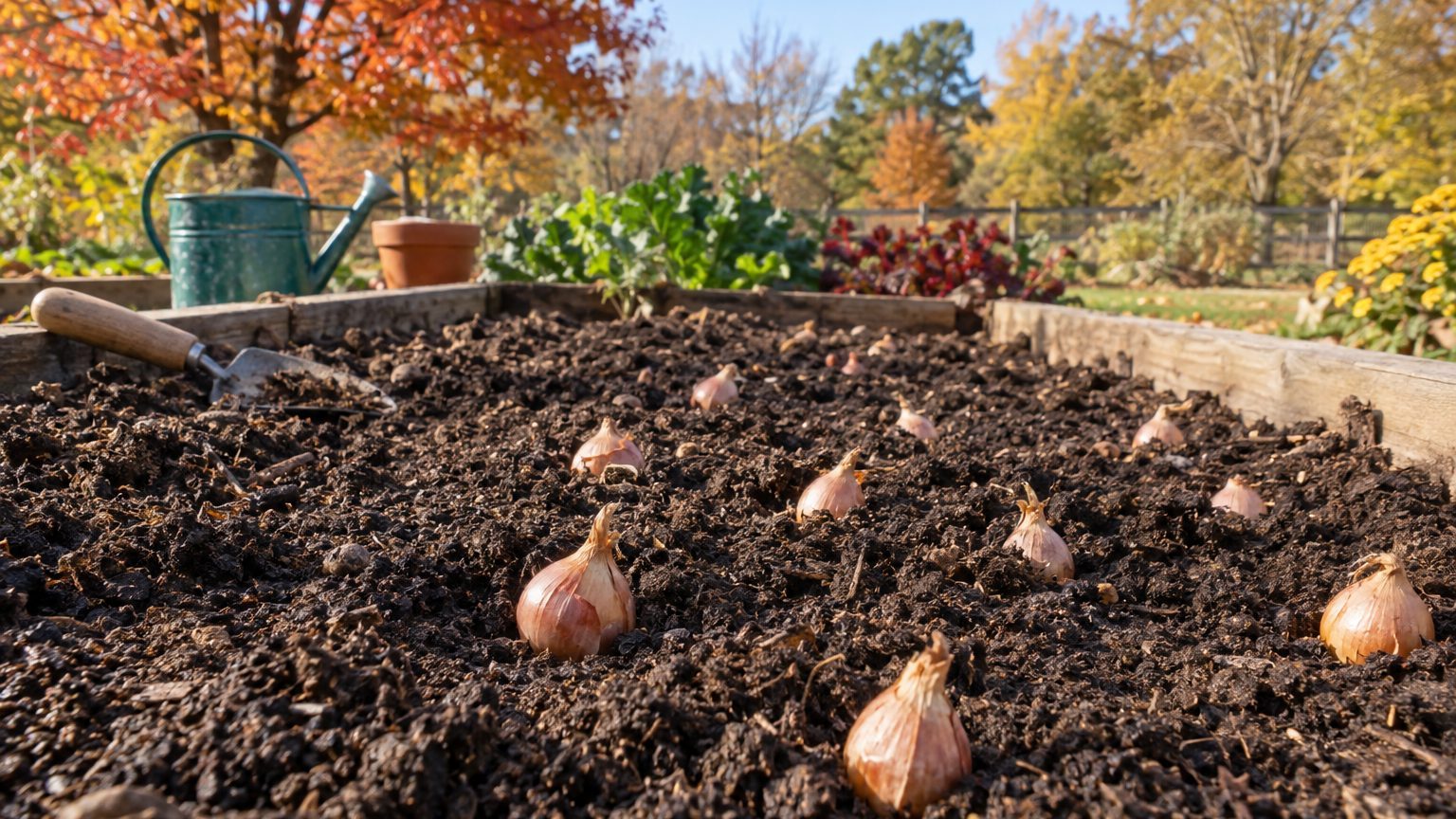

Plant shallots in Nebraska in October, in the weeks around the first fall frost, or in spring as soon as the soil can be worked, usually late March to mid-April. Fall planting generally gives larger bulbs because the roots get a head start. Spring planting works well too, especially in the colder north and west.
The short answer for Nebraska
Two windows work: October for fall planting and late March through mid-April for spring planting. Both sit close to the frost dates for Omaha, the reference city. The airport station there shows a last spring freeze between April 12 and April 23, and a first fall freeze between October 15 and October 26.
Those dates are probabilities of a 32°F freeze, taken from the 1991-2020 NOAA climate normals. They mark the band where the odds of a freeze sit between 30 and 70 percent. A freeze can still come before or after the band. Treat them as the middle of the range, not as limits.
They also describe an airport in a city. Suburban and rural gardens usually get their last spring frost later and their first fall frost earlier, often by one to two weeks, and more at elevation. A farm lot twenty miles outside town may see its last freeze closer to the first days of May.
Shallots shrug off frost, so these dates anchor the calendar rather than block it. The goal in fall is a bulb that grows roots but sends up very little top before the ground freezes. The goal in spring is a bulb in the ground early, while the weather is cool, so it has time to size up before long, hot days trigger bulbing.
| Planting season | Window for most Nebraska gardens | What it is tied to |
|---|---|---|
| Fall | Early to late October; earlier in the north and west | First fall freeze, Oct. 15 to Oct. 26 at the Omaha reference station |
| Spring | Late March to mid-April, once soil crumbles | Last spring freeze, April 12 to April 23 at the Omaha reference station |
Fall-planted bulbs sit through a winter where the average daily low in the coldest month is 15.2°F at the Omaha reference station. That is cold enough to want a mulch of straw or shredded leaves about 3 to 4 inches deep, applied after the ground starts to freeze. For the varieties that handle this climate best, see The Best Shallots to Grow in Nebraska. For the whole growing cycle from planting to curing, start with Growing Shallots in Nebraska.
What will not work here

Planting in August or early September fails. Warm soil pushes the bulbs to grow a full set of green leaves. A hard freeze in November or December then catches tall, tender tops, and the bulb has spent its energy above ground. Wait for the soil to cool.
Planting too late in fall fails as well. Bulbs set into frozen or nearly frozen ground make no roots before winter, and with an average coldest-month low of 15.2°F, they are the ones that heave out of the soil during freeze-and-thaw swings. A bulb sitting on top of the ground in February is a dead bulb. Anything planted after the first week or two of November is a gamble, even in a mild year.
Why does late spring planting give small shallots?
Shallots form bulbs in response to lengthening days and warming weather. A bulb planted in mid-May has only a few weeks of cool growth before heat arrives, so it stops growing leaves early and makes a small bulb. The last spring freeze at the reference station falls between April 12 and April 23, which means the soil is workable well before the frost danger ends. There is no reason to wait for the last frost, since shallot tops tolerate light freezes.
Does the airport frost date work for a rural garden?
Only as a starting point. The Omaha numbers come from an airport in the state’s most urban corner. Someone who plants on October 25 because that is the reference-city date may end up planting into soil that is nearly frozen. Move the fall planting earlier by one to two weeks.
Planting in the same spot where onions, garlic, or leeks grew last year is another loser. All of them are alliums, and diseases that overwinter in the soil build up fast. A three-year gap between alliums in the same bed is the usual advice.
Finally, planting shallots too deep wastes spring. In heavy clay that stays cold and wet through April, a bulb buried several inches down comes up late. The tip should sit just at or barely below the soil surface, with the mulch doing the protecting.
What changes across Nebraska
Nebraska does not have one answer. The USDA Plant Hardiness Zone Map (2023 edition, built on 1991-2020 climate data) puts the state in zones 4a through 5b. That spread is based on the average annual extreme minimum temperature, and it covers a gap of two full zones in the coldest winter nights.
The southeast corner, with Omaha and Lincoln, sits at the warm end. The northern tier and the high ground of the Panhandle sit at the cold end. A gardener farther north or west should expect the ground to freeze earlier and thaw later.
In practice, that shifts the calendar in four ways:
- Fall planting moves earlier, toward the start of October or the last days of September in the coldest areas.
- Mulch gets thicker, closer to 4 inches, and goes on as soon as the surface begins to freeze.
- Spring planting moves later by a week or two, since the soil thaws and dries out more slowly.
- Gardeners in the coldest areas may do better with spring planting alone, because a fall planting there takes more winter protection to carry through.
The zone boundaries run through counties, and a hillside or a river valley can sit in a different zone from the town next to it. The USDA map lets anyone look up their ZIP code. Use that rather than guessing from the nearest big city.
Where to check this for your own county
The best local source is University of Nebraska–Lincoln Extension. Extension offices operate in counties across the state, and educators there work with local growing conditions every day. Search the site for vegetable planting calendars, garlic and onion guides, and any shallot or allium trial results.
Look for two things. The first is a local planting calendar, which gives dates for the specific region and not for Omaha. The second is a list of varieties tested in that area, since a shallot that performs well in the southeast may not suit a colder, drier county.
A county recommendation beats a state one. A county office knows the soils, the typical last freeze in that area, and the quirks of its own weather, such as late frosts in a low river bottom or early freezes on an exposed ridge. If the website has no shallot page, ask about garlic and onions. Shallots follow nearly the same pattern.
Checking this against your own garden
Dates are a starting point. What the garden itself shows should carry more weight, and three simple observations are enough.
Soil in the hand. In spring, grab a handful from the bed and squeeze. If it crumbles when poked, it is ready. If it holds a slick, muddy ball, wait. In fall, the soil should feel cool all the way down a few inches, not warm like midsummer. A bed that stays warm and workable well into October is sheltered or south-facing, and it can take planting a week or so later than a cold, shaded corner.
Other plants. Local spring signals work as a calendar built by the weather itself. When daffodils are up and lilac buds are swelling, the soil is usually workable. If the neighbor’s garden is greening up a week before yours, your spot runs cold, and you should plan accordingly. In fall, the first cottonwood and ash leaves turning yellow tell you the soil is cooling toward the planting window.
The first true leaves. Check fall-planted bulbs in late autumn. Green tips an inch or two high are fine. Tall leaves mean the bulbs went in too early or the fall ran warm, so plant a little later next year. In spring, watch for the first green shoots poking through the mulch. If they show in late March, the bed warms early. If nothing appears by late April, the spot is a cold pocket, and next year’s planting should go in earlier or the mulch should come off sooner.
Common questions
Can you plant shallots in spring in Nebraska?
Yes. Plant them as soon as the soil is workable, usually late March through mid-April. Shallots tolerate light frost. Bulbs will be smaller than fall-planted ones in most years.
What is the last day to plant shallots in fall?
There is no fixed date, but the soil needs to be workable and cool, with enough time left to grow roots. The reference station’s first fall freeze falls between October 15 and October 26. Rural and northern gardens often freeze one to two weeks earlier, so aim for the first half of October there. Anything going in after early November is risky.
Do fall-planted shallots survive Nebraska winters?
Usually, with mulch. The coldest month averages a daily low of 15.2°F at the Omaha reference station, and the state ranges from zone 4a to zone 5b. A layer of straw or shredded leaves 3 to 4 inches deep keeps the soil from heaving. In the coldest northern and western areas, spring planting is the safer choice.
Should I use the Omaha frost dates for my own county?
Use them as a rough guide only. They come from an airport station. Rural gardens typically see the last spring frost one to two weeks later and the first fall frost one to two weeks earlier. Check with your county office at University of Nebraska–Lincoln Extension for a local calendar.