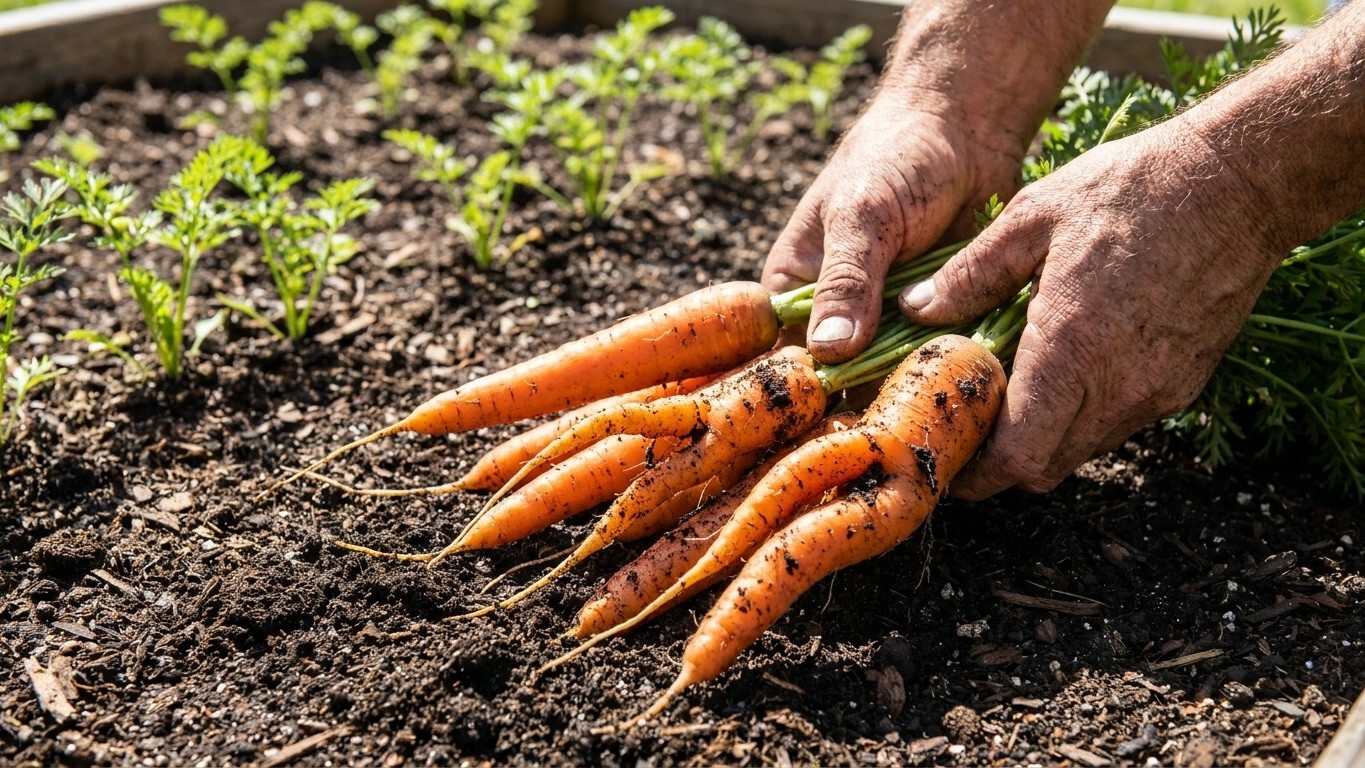

Nevada’s last frost date swings by weeks depending on elevation, from the low desert floor around Las Vegas to high mountain valleys near Elko, and no single number covers the whole state. Carrots are sown directly in the garden and need 70 to 100 days from seeding to mature, counted from the day the seed goes into the ground, never from a transplant date since carrots don’t transplant. Once that local date is set, what happens next depends less on the calendar and more on what sits under the seed: the soil.
The short answer
Nevada’s official state soil is the Orovada series, an Aridisol, the kind of dry-climate soil that forms under low rainfall and tends to run alkaline and carry salts near the surface. USDA soil survey data puts the surface horizon at a pH around 7.5, which is alkaline, with a texture that’s 66 percent sand, 8 percent clay and 26 percent silt. Organic matter sits at about 1.4 percent, and drainage is classed as well drained. The series carries the honor of representing the state under Nevada law, chosen through USDA’s State Soils program.
For a carrot, that texture is actually on the favorable side. Utah State University Extension is blunt about what carrots want: deep, sandy, well-drained soil rich in organic matter. Heavy or rocky ground is what makes a root fork instead of growing straight down. Orovada’s low clay content and good drainage mean the classic forking problem, the one caused by dense, compacted or stony ground, is less of a risk here than it would be in a heavier soil type. That’s the good news.
The catch is organic matter. At 1.4 percent, Orovada falls well short of what “rich in organic matter” implies for a root crop that spends its whole life pushing through the ground it’s planted in. Thin, sandy soil with almost no organic content drains fast, which sounds good until you realize it also dries out fast and holds fewer nutrients between waterings. The fix Extension recommends for difficult ground, working in plenty of compost, still applies here even though the texture itself isn’t the problem. A gardener working straight Orovada-type soil should dig in compost before sowing, and anyone dealing with a hardpan layer or unusually compacted patch should consider a raised bed instead of fighting the native ground.
None of this is a diagnosis of any one backyard. Nevada spans hundreds of mapped soil series, and a state soil is a snapshot chosen to represent the state’s character, not a survey of every plot within it. River bottoms, mountain foothills and any yard a builder graded and filled decades ago can look nothing like the Orovada profile. This is a starting point for guessing what the regional ground tends to do, not a substitute for checking your own dirt.
The test that settles it in your own garden
The only way to know what you’re actually planting into is to look at it yourself. None of the numbers above are a stand-in for a shovel and a few minutes outside.
- Dig a hole in the bed where the carrots will go, going as deep as your shovel allows. Note whether you hit a hard, dense layer that stops you, since that layer is exactly what a carrot root will hit too.
- Look at what comes out. Pull out any stones or rock fragments and set them aside, then look at how many there are relative to the soil itself. A handful of pebbles is normal; a shovelful that’s half rock is a sign the bed needs amending or replacing with a raised frame.
- Take a handful of the moist soil from partway down the hole and squeeze it. Sandy soil falls apart and won’t hold a shape. Clay-heavy soil forms a slick ribbon between your fingers and holds together stubbornly. Most garden soil lands somewhere between the two, and where it lands tells you how much compost it needs.
- Fill the hole with water and watch what happens. Water that disappears within a reasonable stretch of time tells you the ground drains. Water that sits for a long while, hours after you’d expect it to be gone, points to poor drainage and a strong case for a raised bed.
- Repeat the dig-and-feel test in more than one spot in the yard. Soil character can change from one end of a lot to the other, especially on ground that’s been graded, filled or built on.
What goes wrong here
- Forking in heavy or compacted ground. Even where the regional soil leans sandy, individual yards can carry pockets of dense or compacted dirt, especially near foundations or driveways where fill soil was brought in. The root splits around whatever it can’t push through. The remedy is the same one Extension gives for any heavy soil: work in generous compost and double dig the bed before sowing, or skip the fight entirely and build a raised bed filled with looser soil.
- Poor germination during a hot stretch. Carrot seed is slow to sprout under the best conditions, and a run of hot, dry days on top of thin, sandy, low-organic-matter soil dries the surface faster than the seed can take up the moisture it needs to germinate. Keeping the seed bed consistently damp during germination, rather than letting it dry and rewetting it in cycles, gives the seed the steady moisture it needs to come up evenly.
- Splitting from uneven watering. A root that grows through a stretch of dry soil and then gets a heavy soak swells too fast for its own skin and cracks. Sandy, fast-draining ground like Orovada makes this more likely because it dries out between waterings faster than a heavier soil would. A steady, even watering schedule rather than a feast-or-drought pattern keeps the root growing at a consistent pace.
- Low vigor from thin organic matter. Soil sitting around 1.4 percent organic matter has little reserve to feed a root crop over 70 to 100 days in the ground. Working compost into the bed before sowing, not after the seedlings are up, gives the roots something to draw on for the whole stretch of the growing season.
Common questions
Can I sow carrots straight into unamended Orovada-type soil?
You can, since the sandy texture and good drainage avoid the worst forking risk, but the low organic matter means the roots won’t have much to feed on. Working compost into the bed first gives you the texture benefit without the nutrient shortfall.
Where do I find my own local last frost date?
That figure isn’t published on this page, and it isn’t the same across Nevada’s elevation range, so a statewide number would be misleading either way. Check records for the weather station closest to your own garden rather than relying on a single date for the whole state.
Do carrots need a different sowing approach if my soil is alkaline?
The soil data here shows the state soil surface running alkaline, around pH 7.5, but no specific carrot pH tolerance is established on this page. Treat that pH figure as a description of the regional soil, not a target or a warning for your own bed.
Is a raised bed always necessary in Nevada?
No. It depends on what your own dig-and-feel test turns up. Sandy, well-drained ground with reasonable organic matter after composting can grow straight carrots in open soil. A raised bed becomes the more reliable option when your own test finds compacted, rocky or poorly draining ground that a shovel and compost can’t fix.