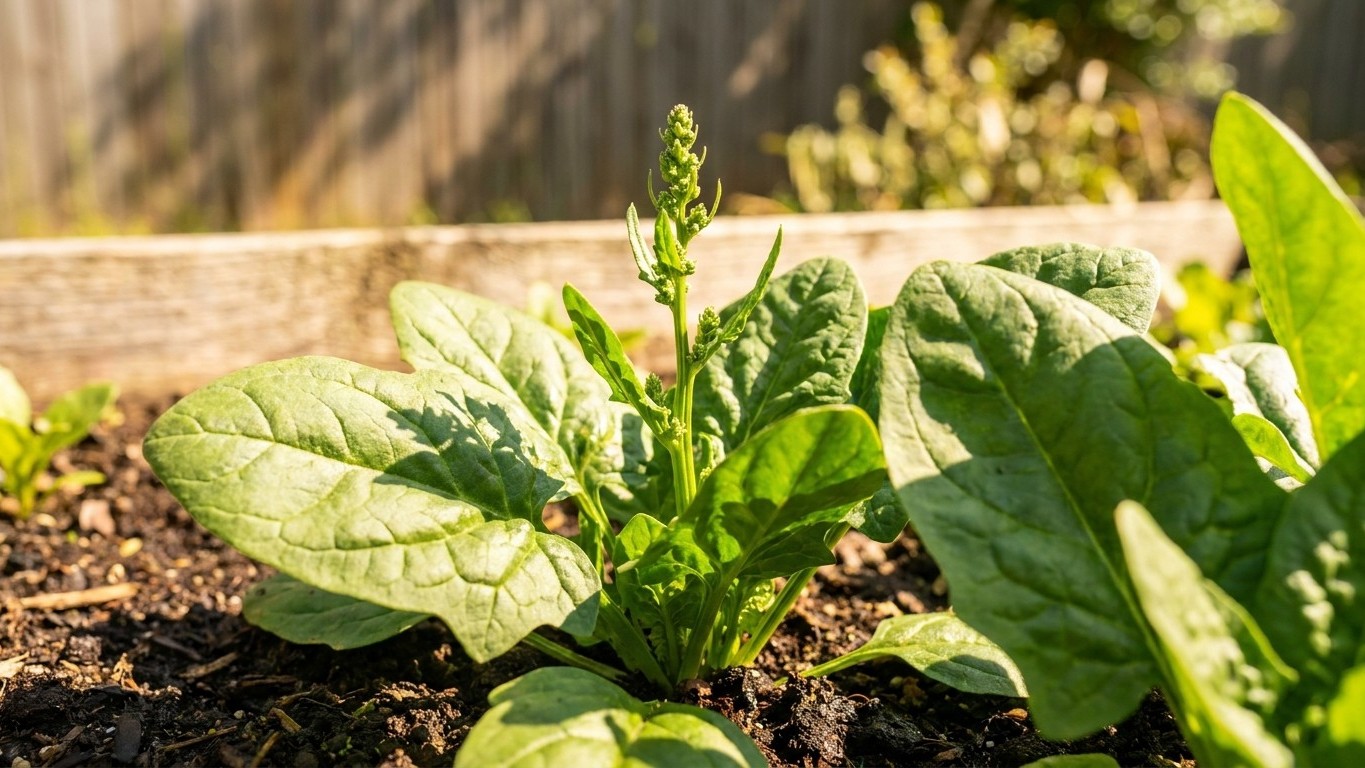

In most of Nevada, yes: spinach bolts early, and it isn’t really about how hot your particular yard gets. The trigger is day length, and Nevada summers deliver plenty of it. Add to that a state that swings from scorching low desert to cold high-elevation valleys, and the plant ends up squeezed on both ends of the calendar no matter where you garden.
The short answer
On the longest day of the year, the reference city used for these figures gets 14 hours and 27 minutes of daylight. That number matters more than any thermometer reading, because spinach flowers, or bolts, in response to long days as much as to warmth. A cool, mild summer does not buy you extra weeks here. Once the days stretch out past a certain point, the plant starts putting energy into a seed stalk instead of leaves, and there is no amount of shade cloth or clever watering that reverses that signal.
So is the limit day length, heat, or both? Both, and they arrive at almost the same time. Nevada’s low-elevation valleys, the kind of terrain the reference station sits in, average 131.3 days a year at 90 F or hotter. That is not an average summer temperature, it is a count of how many days the heat load is high enough to stress a cool-season crop, drive up water demand, and push soil and air temperatures well past the point spinach tolerates. Utah State University Extension puts spinach’s comfortable ceiling at 75 F, above which growth quality drops and the leaves turn bitter. In a place where a third of the year runs hotter than 90 F, that ceiling gets crossed early and often.
Layer the day-length trigger on top of that heat load and the timing gets tight. By the time Nevada’s low deserts are reliably warm enough to plant many other vegetables, the days are already long enough to push spinach toward flowering. Higher-elevation parts of the state, Reno, Carson City, and similar valleys, run cooler and see fewer 90-degree days, but they sit at very similar latitudes, so the day-length signal arrives on close to the same schedule. Elevation buys you lower heat. It does not buy you shorter days.
That combination, long days plus a low heat ceiling, is why spinach behaves more like a narrow-season specialty crop in Nevada than a plant-it-and-forget-it green. Growers who treat it like lettuce, sowing once in spring and expecting a long harvest, usually watch it bolt within weeks. The plants that do well are the ones timed around two short windows, spring and fall, rather than one long season.
How long the spring window really is
Because Nevada spans desert basins and mountain valleys, there is no single “Nevada” last-frost date. NOAA climate normals for the reference low-desert station put the last spring freeze somewhere between January 7 and February 1, but that figure reflects an urban desert extreme and should not be used as guidance for the rest of the state. Reno, Carson City, and other higher valleys freeze weeks to months later in spring. Anyone gardening outside the low desert should check their own county extension office for a local frost date rather than borrow this one.
Once you have that local date, the spring math works the same way everywhere in the state:
- Start counting from your area’s typical last spring frost date, whatever that is locally, not the desert figure above.
- Sow spinach seed 2 to 3 weeks before that date. Spinach tolerates cold soil far better than heat, so an early, slightly risky sowing usually beats a late, safe one.
- Expect good growth only as long as daytime temperatures stay under roughly 75 F. Track your local forecast, not the calendar, since a warm spell can end the window early even if frost season is technically still open.
- Watch day length as it lengthens through March and April. Even if temperatures stay mild, the approach toward that long midsummer day length is already nudging the plant toward bolting.
- Plan to harvest before both limits close in, since in most of Nevada the two arrive within a matter of weeks of each other, not months apart.
In practice, that leaves a spring window best measured in a handful of weeks rather than a full season. Low-desert gardeners often find the workable stretch closes almost as soon as it opens, since heat and lengthening days arrive together in March and April. Higher valleys get a bit more breathing room because summer heat arrives later, but the day-length clock is running on nearly the same schedule as the desert floor below.
The autumn crop, and when the soil lets you sow
Fall is where spinach tends to perform better in Nevada, but it comes with its own timing puzzle, and it isn’t frost that opens the door.
Soil too warm to germinate
Utah State University Extension notes that spinach seed germination drops off once soil temperatures climb above 80 F. That is the real obstacle to an early fall sowing in Nevada, not the calendar and not the fear of an early freeze. In low-desert soil that has spent all summer absorbing 90-plus-degree days, ground temperature can stay above that 80 F threshold well into the start of autumn. Sowing into that warm soil often means poor or spotty germination, regardless of how carefully the seed is watered. The practical fix is to wait until soil has actually cooled, checking it directly with a soil thermometer a few inches down rather than assuming that cooler air temperatures mean cooler soil. Mulching or shading a bed in late summer can help nudge that cooling along, but the underlying limit is the same: no germination-friendly soil, no fall crop, no matter how mild the days get.
The frost that ends the season
The other boundary is the season’s close. At the reference low-desert station, the first fall freeze arrives sometime between December 8 and December 23, but again, that figure is a desert urban-heat-island extreme and should not be treated as a statewide date. Higher-elevation Nevada valleys see their first freeze far earlier in the fall, sometimes by two months or more, so a Reno-area or Carson City gardener needs a local figure from their county extension office rather than this one.
Once you know your realistic local harvest target, usually a date shortly before your area’s typical first freeze, Utah State University Extension’s guidance is to count backward 50 to 75 days from that target to find your sowing date. No days-to-maturity figure is published for spinach by that source, so this 50-to-75-day planting window is the guidance to use rather than any maturity number borrowed from another crop or seed catalog. In a low desert with a mid-December frost, that math points toward a sowing sometime in the fall once soil has cooled below 80 F. In a higher valley with an earlier frost, the same 50-to-75-day count simply gets shifted earlier on the calendar to match.
Four spinach varieties commonly discussed by Utah State University Extension are Bloomsdale, Melody, Teton, and Olympia. The source does not publish comparative data, days-to-maturity, or performance notes for any of the four, so no variety can be recommended over another from this information alone. Choosing among them comes down to what’s available locally and personal preference rather than any documented difference in bolt resistance.
Common questions
Does shade cloth stop spinach from bolting in Nevada?
Shade can lower leaf and soil temperature somewhat, which helps with the heat side of the equation, but it does nothing about day length. Since long days trigger flowering on their own, shade cloth alone won’t prevent bolting once the calendar moves deep into late spring.
Is fall or spring the better season for spinach in Nevada?
Fall generally gives a longer, more forgiving window, because the plant is heading into shortening days rather than lengthening ones. The main obstacle in fall is soil that’s still too warm from summer, not the arrival of cold weather.
Can I use the Las Vegas frost dates for my area?
No. Those dates reflect a desert urban-heat-island extreme and are not representative of Reno, Carson City, or other higher-elevation parts of the state, which freeze earlier in fall and later in spring. Check with your county extension office for a local frost date.
How do I know when fall soil has cooled enough to sow?
Check soil temperature directly with a soil thermometer a few inches deep rather than guessing from air temperature. Germination drops once soil runs above 80 F, so wait until readings fall consistently below that mark before sowing.