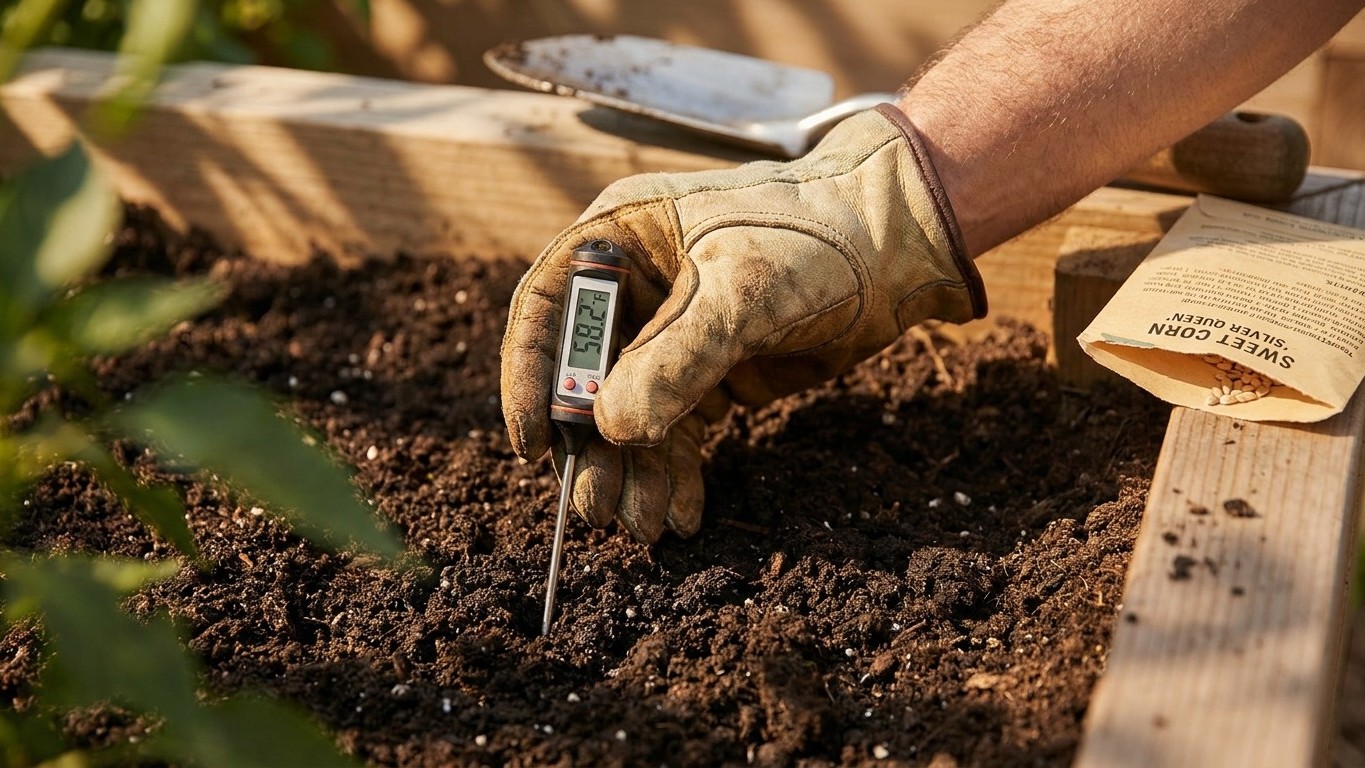

Sweet corn in Nevada waits on soil temperature, not the calendar. Seed needs soil holding at 60°F before it will germinate reliably, and that day lands well after your last frost, not on it. From there, count 60 to 90 days to harvest, depending on variety, and check that span against your first fall frost. Because Nevada stretches from low desert valleys to high mountain benches, the soil-warming date shifts by months across the state, so the real answer comes from your own ground and your county extension office.
The short answer
Here’s where most planting calendars go wrong: they hand you the last frost date and tell you to plant. Sweet corn doesn’t care about frost once it’s past. It cares about soil temperature, and that number, 60°F, arrives weeks after the ground stops freezing. A patch of soil can be frost-free and still too cold for corn seed to do anything but rot. That gap between “no more frost” and “warm enough to plant” is where a lot of Nevada gardeners lose a season before it even starts.
NOAA climate normals from the Las Vegas reference station show a last spring frost landing anywhere from January 7 to February 1, and a first fall frost arriving between December 8 and December 23. Those dates describe an extreme, low-desert, urban-heat-island climate. They are not a statewide planting window, and treating them as one would be a mistake for most of Nevada. Reno, Carson City, and any spot with real elevation see frost linger far later into spring and arrive far earlier in fall, sometimes by months rather than weeks. If you garden in the Truckee Meadows or up toward Lake Tahoe, your frost-free window looks nothing like the Las Vegas Valley’s.
What that means practically: in the low desert, the frost-free stretch is so long that soil crosses 60°F early and stays warm for the better part of a year, leaving plenty of room for a 60 to 90 day crop. At elevation, the same math doesn’t hold. Cold soil lingers into late spring, and the first cool nights of fall can arrive before a slower variety finishes filling its ears. Add in the heat load itself: the Las Vegas area averages 131.3 days a year at 90°F or higher, a measure of how hard the sun works on soil moisture and plant stress once the season does get going. That heat drives irrigation demand and can stall pollination in the hottest weeks even when the calendar says there’s time left to mature a crop.
So the short answer splits in two. If you garden low and hot, your soil crosses 60°F early enough that a full 90-day corn can ripen well before the year’s last frost risk returns. If you garden at elevation or anywhere the ground stays cool into late spring, you’re working a tighter, harsher window, and you need your county extension office’s local soil and frost data before you commit to a variety.
Does a late variety fit here?
Variety choice in Nevada isn’t a taste decision first, it’s a calendar decision. The gap between a 60-day corn and a 90-day corn is a full month of warm-season weather, and in a state where the frost-free window can run from roughly a year in the low desert to a few compressed months at altitude, that month decides whether you get a harvest at all.
A 60-day variety
A quick 60-day corn is the safer bet almost anywhere in Nevada. It asks the least of the season: soil needs to hit 60°F, then it has roughly two months to tassel, fill, and ripen before cool weather sets back in. In the low desert, where soil warms early and stays warm for months, a 60-day type has room to spare, and gardeners there could even manage two plantings if they space them out. At higher elevations, where the growing season is shorter and soil takes its time warming, a 60-day variety is often the only realistic choice, since it’s the one type of sweet corn built to fit a compressed window without racing the first fall frost.
A 90-day variety
A 90-day corn asks a lot more of the calendar. It needs a full extra month of frost-free, warm soil beyond what the quick variety requires, and that’s exactly where geography in Nevada splits sharply. In the low desert, where the frost-free stretch runs long and soil temperature holds well above 60°F for months at a stretch, a 90-day type fits comfortably. At elevation, where the growing season is already tight and soil is slow to warm, a 90-day variety often does not fit. Planting it there risks tassels forming just as nights start cooling, or ears left unfinished when the first fall frost arrives. If you garden anywhere with a short, cool season, the late variety is the one to skip, and your county extension office can tell you how tight your local window actually runs.
| Criteria | 60-day variety | 90-day variety |
|---|---|---|
| Days from planting to harvest | About 60 days | About 90 days |
| Fits low desert Nevada (long frost-free window) | Yes, with room to spare | Yes, generally |
| Fits high elevation Nevada (short, cool season) | Best option | Often does not fit |
| Ripeness signs to check | Dry brown silks, moist green husks, milky kernel juice | Dry brown silks, moist green husks, milky kernel juice |
What goes wrong here
- Soil sown too cold. Planting the day the frost risk passes, instead of waiting for the ground itself to reach 60°F, is the most common misstep. Seed sits in cold soil, rots or germinates unevenly, and the whole planting comes up patchy. The fix is simple: check actual soil temperature with a probe rather than trusting a frost date alone, and hold off until it holds at 60°F.
- A variety too late for the season. Choosing a 90-day corn in a part of the state where the frost-free window is short sets the crop up to run out of warm weather before the ears finish filling. The remedy is matching the variety to the local window: a 60-day type where the season is tight, a 90-day type only where the frost-free stretch is genuinely long.
- Sweetness lost when types tassel together. This one has nothing to do with climate. Standard (su), sugary-enhanced (se), and supersweet (sh2) sweet corn types cross-pollinate if their tassels shed pollen at the same time, and the result is starchy, disappointing ears even though the plants looked healthy all season. The fix is timing, not distance: stagger planting dates so the types don’t tassel together, or grow only one type per season if your garden is small. Planting in blocks of three or more rows, rather than one or two long rows, also helps each block pollinate itself rather than drift into a neighboring planting.
Common questions
Can I go by the last frost date alone?
No. Sweet corn seed needs soil holding at 60°F, and that point comes after the last frost, sometimes well after it. Frost passing is not the same signal as soil being warm enough to plant.
How do I know Nevada’s dates apply to my yard?
They likely don’t apply evenly. The state’s frost data swings from an extreme low-desert pattern to conditions months apart at elevation, so a date that works in the Las Vegas Valley can be badly wrong in Reno or Carson City. Your county extension office holds the local figures.
How do I tell when an ear is actually ready?
Look for three signs together: dry, brown silks; husks that are still moist and green; and milky juice from a punctured kernel. One sign alone isn’t reliable, and picking too early or late is common when gardeners rely on just one cue.
Does heat during summer affect the harvest?
It can. Areas that average well over a hundred days a year at 90°F or higher put real stress on corn during pollination, even when the season is technically long enough to finish the crop. Extra water during the hottest stretch of summer helps carry ears through that window.