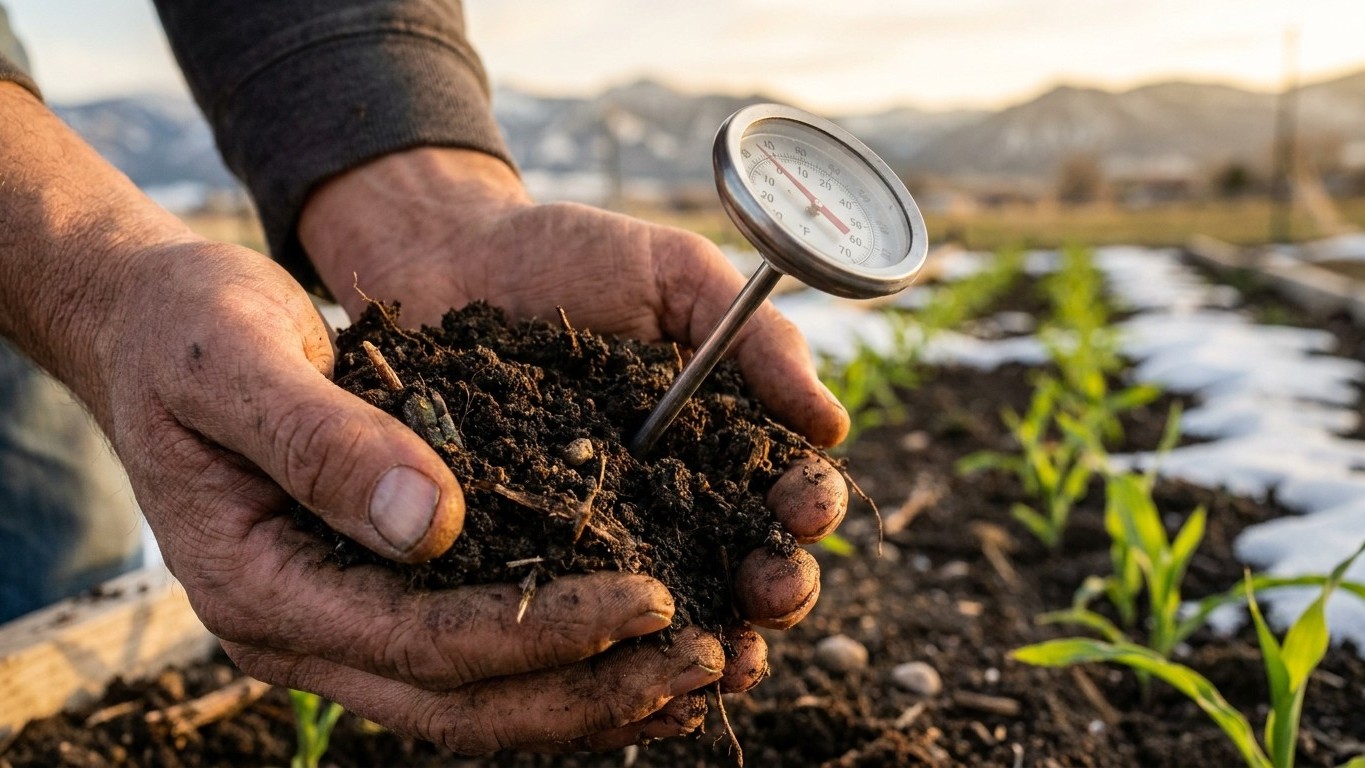

Yes, in the low desert valleys around Las Vegas. Much less certainly everywhere else. Nevada’s growing season swings from one of the longest frost-free stretches in the country to one of the shortest, depending on whether a garden sits in a heat-trapped valley floor or a mile-high bench near Reno or Carson City. Sweet corn needs soil above 60°F and a run of 60 to 90 days before frost returns. Will Sweet Corn Ripen in Nevada? Whether that math works depends entirely on which Nevada a gardener actually lives in.
The short answer
Soil and air don’t warm on the same schedule. The last spring frost marks when the air stops dropping to 32°F, but bare ground takes weeks longer to reach corn’s real starting line, a steady 60°F down at seed depth. At the Las Vegas airport, NOAA’s 1991-2020 climate normals put that last spring frost somewhere between January 7 and February 1, an unusually early date driven by pavement and urban heat trapped in a desert valley. That figure is a poor stand-in for the rest of the state, and it shouldn’t be read as Nevada guidance at all. Reno, Carson City, and any garden sitting at elevation see frost linger months later in spring and arrive months earlier in fall than anything a desert airport records.
The same caution applies to the other end of the season. Las Vegas’s average first fall frost falls between December 8 and December 23, again an extreme shaped by urban heat rather than a number that travels. Nowhere in the published data is there a soil-temperature or frost date specific to Reno, Carson City, or the high mountain valleys where a lot of Nevada gardening actually happens. That gap matters more than the Las Vegas numbers themselves.
So does the 60 to 90 day window fit before autumn shuts things down? In the low desert extreme, the frost-free stretch implied by those two dates is long enough that both ends of corn’s maturity range have room to work. But that same heat load brings an average of 131.3 days a year at 90°F or hotter at the reference station, and that’s a separate problem from frost. Heat stress during silking and pollination can stall a corn crop just as effectively as an early freeze, so a long frost-free window doesn’t automatically mean an easy one. At elevation, the calculus flips: no specific soil-warming or frost date is published here for those areas, and a gardener there needs their own county’s numbers before trusting any statewide window.
Does a late variety fit here?
Maturity length is the variable a gardener actually controls once the season length is known, so it’s worth working through both ends of the range against what Nevada’s climate can offer, starting with When to Sow Sweet Corn in Nevada.
A 60-day variety
A variety that finishes in roughly 60 days from planting needs the least amount of frost-free room, and it’s the safer bet almost everywhere in the state. In the desert valley extreme, where the frost-free window appears long, a 60-day type closes out with margin to spare, even accounting for a stretch of 90°F-plus days slowing things down mid-season. At elevation, where the exact frost bracket isn’t published here but is known to run tighter on both ends, a 60-day variety is the one with realistic odds of finishing before the first fall freeze returns. Confirming the actual soil temperature at planting time, rather than guessing from a calendar, matters more here than the variety label itself.
A 90-day one
A 90-day variety asks for roughly a month more open ground than the 60-day type, and that extra month is exactly what elevation gardens in Nevada tend not to have. In the desert floor extreme, where the frost-free stretch runs unusually long, a 90-day variety might still close out its season, though the added weeks of peak summer heat raise the odds of stress during pollination. Everywhere else, especially at elevation around Reno, Carson City, and the state’s higher valleys, a 90-day variety does not reliably fit the season. The published frost data for those areas isn’t available here, but the general pattern, frost arriving earlier in fall and lingering later in spring, points the same direction: a late-season type is a gamble that a shorter-maturity choice avoids.
What goes wrong here
- Soil sown too cold. Seed set into ground that hasn’t reached 60°F rots or germinates unevenly, regardless of how mild the air felt that morning. The remedy is a soil thermometer at planting depth rather than a date on the calendar, since the 60°F mark arrives well after the last frost and on its own timetable in every valley.
- A variety too late for the season. A 90-day type planted where the frost-free window is short simply runs out of time, with ears caught unfinished by the first fall freeze. The remedy is matching maturity length to the actual local window rather than the desert-floor extreme, and defaulting to a shorter-season type wherever that window is uncertain.
- Sweetness lost to tasseling overlap. This one has nothing to do with climate. Standard (su), sugary-enhanced (se), and supersweet (sh2) types cross-pollinate if they tassel at the same time, and the result is starchy, disappointing corn even when everything else went right. The remedy is keeping only one type tasseling at a time in a given garden, staggering planting dates between types, and always sowing in blocks of three or more rows rather than a single skinny row, since block planting is what lets the wind and gravity pollinate the ears evenly in the first place.
Checking this against your own county
None of the frost or soil-warming figures published for Nevada as a whole apply evenly across the state, and that’s the honest limit of what a general guide can offer. A garden outside Las Vegas, in the Truckee Meadows, or up in a mountain valley is working with a different frost calendar entirely, and the only way to know the real planting window is to ask locally. University of Nevada, Reno Extension (extension.unr.edu) keeps county-level frost data, soil temperature guidance, and variety recommendations suited to specific elevations across the state. Before ordering seed, a quick call or visit to the county office answers the two questions that actually decide the outcome: when the soil there reliably reaches 60°F, and how many frost-free days follow.
Common questions
How do I know when sweet corn is actually ripe?
Look for three signs together, not one alone: silks that have turned dry and brown, husks that are still moist and green, and milky (not clear, not chalky) juice from a kernel pierced with a fingernail. Any single sign by itself can be misleading.
Is the 60 to 90 day figure the same as the timing for picking?
No, and mixing them up is a common mistake. The 60 to 90 days from planting answers whether the crop fits the season at all. A separate window, roughly 17 to 24 days after silks first emerge, is what tells a gardener which week to actually start checking ears for the three ripeness signs above.
Can I grow two different types of sweet corn in the same garden?
Only if they don’t tassel at the same time. Standard, sugary-enhanced, and supersweet types cross and lose sweetness when their tassels overlap, so stagger planting dates between types or grow just one type per season if there’s any doubt.
Does elevation matter more than which part of Nevada I’m in?
Often, yes. A valley floor and a bench a few hundred feet higher a few miles away can have meaningfully different frost dates, which is exactly why county-level extension guidance matters more here than any statewide average.