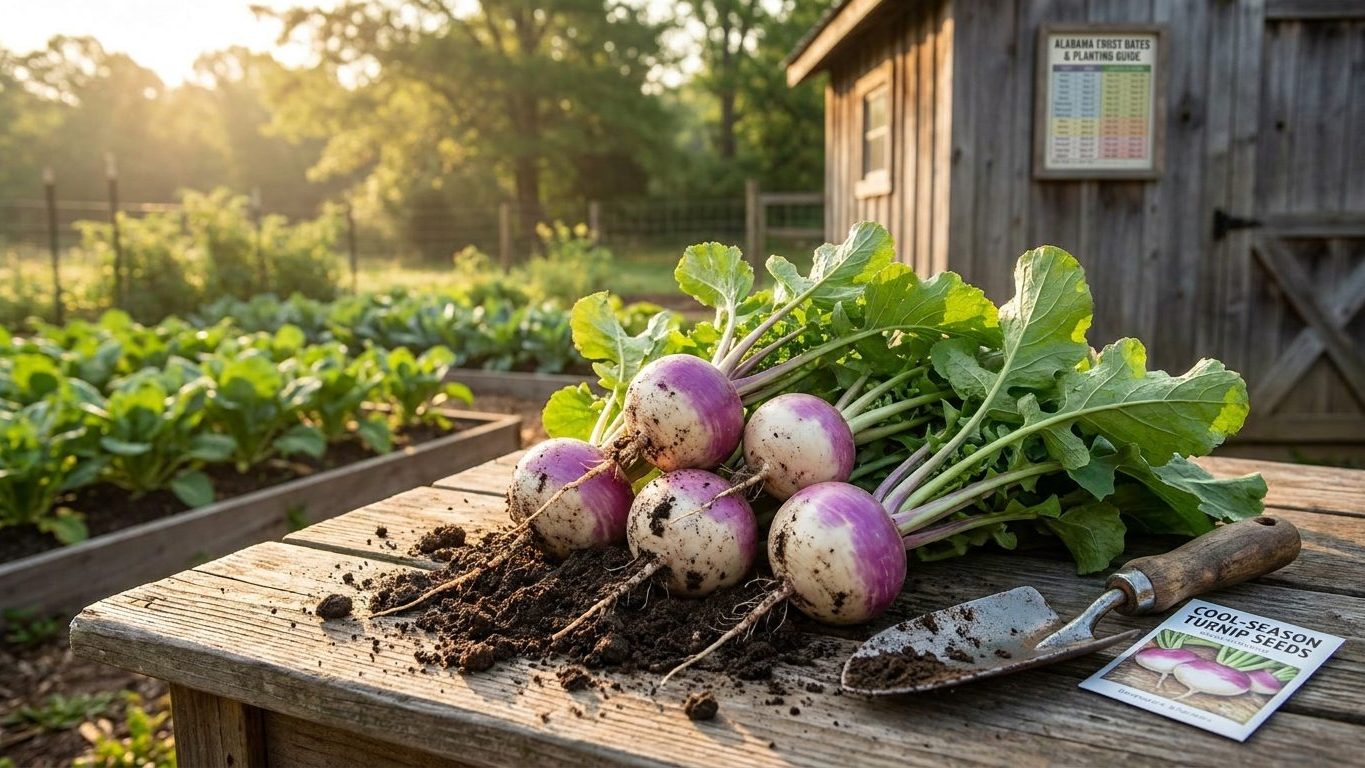

Nevada does not run on one turnip calendar. The state stretches from low desert basins to high mountain valleys, and USDA hardiness zones swing from 4a to 10a within its own borders. Turnips are a cool-season crop: sow in spring as soon as the ground can be worked, or in late summer for a fall crop timed to finish before hard frost. The right week depends on where you garden, so treat what follows as the shape of the season, not a fixed date.
The short answer for Nevada
NOAA’s 30-70% freeze-probability window for a Las Vegas reference station puts the last spring frost between January 7 and February 1, and the first fall frost between December 8 and December 23. Those dates look strange for a spring or fall vegetable calendar, and that’s the point: this is a desert airport reading, warmed by pavement and city heat, and it does not describe Nevada as a whole. Reno, Carson City, and anywhere with real elevation see frost arrive months earlier in autumn and let go months later in spring than those numbers suggest.
Because of that gap, this page cannot hand you one statewide sowing date, and it would be doing you a disservice to pretend otherwise. What it can give you is the general turnip rule that applies no matter which part of Nevada you garden in: sow in spring as soon as soil can be worked, and for a fall crop, count backward 6 to 8 weeks before your area’s first fall frost so the roots size up before cold shuts things down.
That backward count is the number worth writing down, because it travels with you. A desert-basin gardener and a high-valley gardener will land on very different calendar weeks, but both start from the same rule and adjust from their own first-frost date, not from the Las Vegas figures above. Those figures exist in the record, but using them as a stand-in for “Nevada” would mislead a grower in Washoe or Elko county far more than it would help one in Clark county.
The practical move is to treat the Las Vegas dates as one data point from one extreme corner of the state, not as guidance, and to get the actual local dates from your county extension office before you commit seed to soil.
What will not work here

Sowing on a desert clock in a mountain garden fails fast. A grower who copies the January-to-February “last frost” window from the reference station and applies it at elevation will lose the sowing to a hard freeze that arrives weeks or months later in spring than that number implies. The reverse is just as true in fall: a gardener at elevation who waits for December cold cues borrowed from the desert reading will run out of season before the crop matures.
Rutabaga is the crop most exposed to that mistake. It typically needs roughly 90 to 100 days to reach harvestable size, and a short high-elevation season simply does not always offer that many frost-free days if the seed goes in late. Slower turnip varieties carry the same risk, just with less margin for error, since a variety bred for a long, mild season can be caught by an early freeze before the roots finish sizing.
On the opposite end of the state’s range, low desert basins fail turnips a different way. The coldest month there runs a mean daily minimum around 39.6°F at the reference station, which tells you winters are mild enough that cold is rarely the problem. Heat is. A turnip sown too late into a desert spring hits triple-digit summer days before it has finished growing, and the roots respond by turning woody, cracking, and going bitter. Watering on a once-a-week schedule compounds the failure: with summer highs regularly well above 100°F, that interval leaves the root zone dry between waterings, and turnips stressed that way toughen up rather than fatten.
Close spacing is another desert-specific trap. Airflow matters more in low, warm valleys than it does at altitude, and packing turnips tight in a low desert bed invites the kind of humidity around the leaves that a cooler, higher garden simply doesn’t generate. What reads as safe spacing in a mountain garden can read as crowded in a desert one.
What changes across Nevada
A hardiness range of 4a to 10a is not a rounding error, it’s six zones of difference inside one state, and that spread is the reason a single sowing date can’t cover Nevada. Zone 4a sits at the cold end of the national system, built on average extreme minimum winter temperatures, and it describes a short, sharp growing season. Zone 10a sits near the warm end, describing mild winters and long, hot summers. Nevada has gardens near both ends and plenty of ground in between.
| Area type | Where it sits in the 4a-10a range | What that means for sowing |
|---|---|---|
| Low desert basins | Closer to zone 10a | Mildest winters, hottest summers, narrowest safe window before heat stress sets in |
| Mid-elevation valleys | Middle of the range | Frost arrives earlier in fall and lingers later in spring than desert dates suggest |
| High mountain valleys | Closer to zone 4a | Shortest frost-free season; least room for a late sowing mistake |
None of this tells you which zone your own yard sits in, and this page isn’t the place to guess that for you. The USDA Plant Hardiness Zone Map, built from 1991-2020 climate normals, is the tool for that. Find your ZIP code there, note the zone, and shift the general spring and fall sowing rules toward the colder or warmer end depending on what you see. A gardener who confirms they’re near the cold end of Nevada’s range should sow earlier for fall and later for spring than the general rule implies; one near the warm end can push both directions the other way.
Where to check this for your own county
The University of Nevada, Reno Cooperative Extension is the authority this page defers to, and it’s worth going there before you buy seed: https://extension.unr.edu/. Look specifically for two things once you’re on the site: a county-level planting calendar with actual local frost dates, and any variety trial results for turnips or rutabaga run in your part of the state.
Those two documents will beat this page every time, because they’re built from the ground you actually garden in, not from a statewide range that has to average across a 4a to 10a spread. A county calendar reflects the real frost pattern of that county’s elevation and microclimate; a variety trial tells you which turnips have actually sized up and stored well under local conditions, rather than which ones perform well somewhere else in the country.
This page exists to explain the shape of the problem, the why behind the dates, and the mechanism that makes Nevada hard to generalize about. It is not a substitute for the county-specific numbers, and treating it as one would be a mistake in either direction, whether you garden in a Clark county desert lot or a Washoe county mountain valley.
If your county extension office doesn’t publish a turnip-specific calendar, a phone call to the local office usually gets you a faster answer than searching further online, since the person answering can tell you what’s actually being planted successfully nearby this season.
The Moon calendar is a separate, older custom: see when to plant turnips by the moon, written as tradition rather than fact.
Checking this against your own garden
Every date on this page is a starting guess, and your own garden will correct it faster than any calendar. Soil warmth is the first check, and you don’t need a thermometer for it: dig down a couple of inches and feel the soil with your hand. Turnip seed wants soil that feels cool but not cold, more like a spring morning than a winter one. If it still feels chilled through midday, the ground hasn’t caught up to the calendar yet, wherever you are in the state.
Germination speed is the second signal. Watch for the first true leaves, the second set that follows the small rounded seed leaves, since their timing tells you how the soil temperature actually behaved rather than what the average said it should be. Slow, dragging germination in a bed you expected to warm quickly points to a colder microclimate than your zone map suggests, maybe from shade, elevation, or a north-facing slope.
The third thing to watch is early bolting, when a turnip sends up a flowering stalk before the root has bulked up. That’s the plant telling you it hit stress, usually heat or a late cold snap, sooner than the rule of thumb accounted for. A garden that bolts early two seasons running is giving you better data than any state-level date range ever could, and it’s worth adjusting your own personal sowing window around that observation going forward.