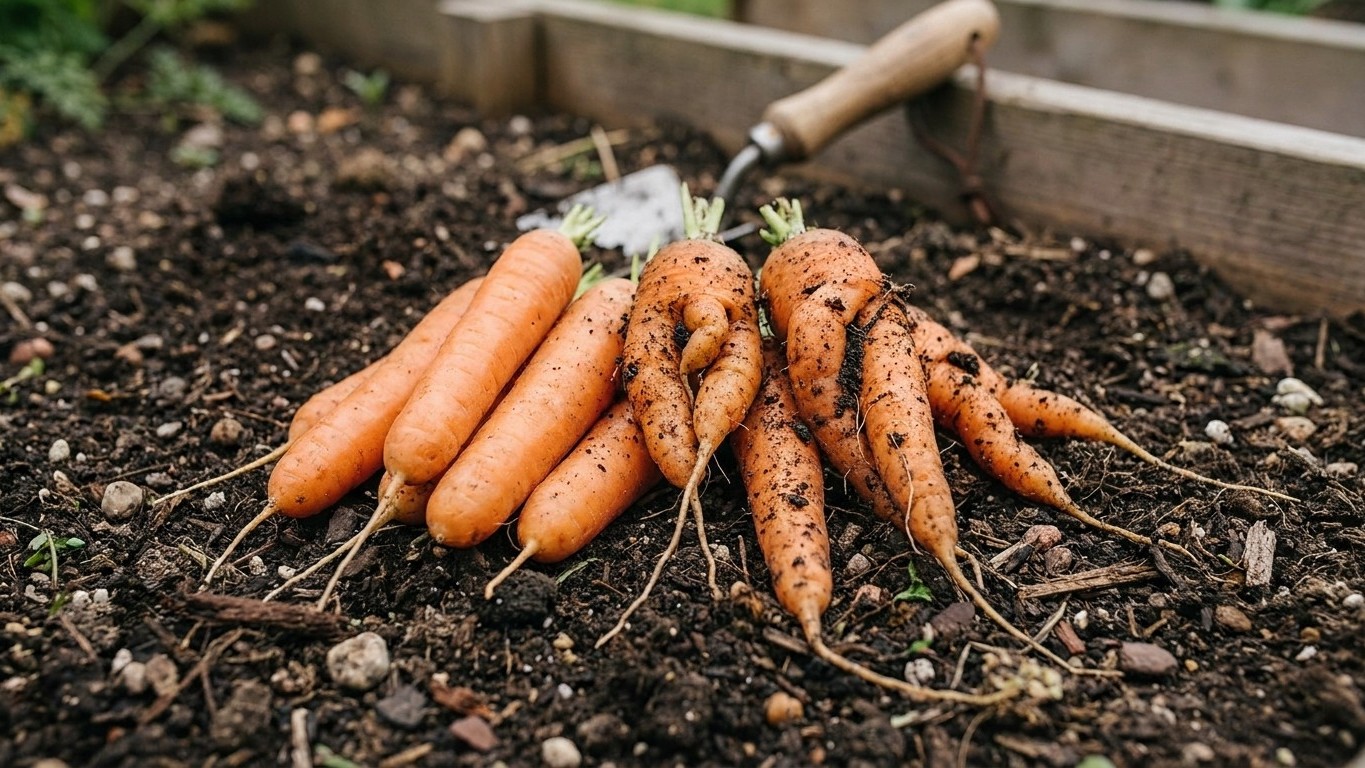

Count 70 to 100 days from the day you sow the seed, not from any transplant, because carrots are sown in place. Pull them when the roots reach the size you want. Clemson Cooperative Extension puts harvest at about 65 to 75 days after planting. To keep them, cut the tops off first, then store the roots at 33 °F with high humidity. Left with their tops on, they last only 10 to 14 days.
The short answer
Start with the ground the province is most often built on. Canada has no official provincial soil the way each American state does, so there is no single series to name. What the survey offers instead is a dominant profile. Across 418 mapped surface horizons from Agriculture and Agri-Food Canada’s Canadian Soil Information Service, the commonest soil order in New Brunswick is Podzol, covering 46 percent of the mapped surface, with Gleysolic next. A Podzol is the acid, leached soil that forms under conifers, where rain has washed the bases out of the surface. Its median surface pH is about 4.7, which counts as strongly acid.
The median texture is loam to silt: 47 percent sand, 16 percent clay and 37 percent silt. Organic matter comes to about 3.4 percent, and the drainage class is well drained.
Set that against what carrots ask for. Utah State University Extension describes the ideal as deep, sandy, well-drained soil rich in organic matter, and warns that heavy or rocky ground makes the root fork. With only 16 percent clay, a lot of sand and good drainage, the typical New Brunswick surface is not the heavy ground that forks carrots. So in the median profile, no, a carrot will usually not fork on account of texture. Rock is another matter. A stone in the path bends a root as surely as clay does, whatever the percentages say.
The Gleysolic soils, second in the ranking, are the ones to watch. Gleysolic soils are the wet, poorly drained type. If your garden sits on one, expect the heavy-ground problem. Utah State’s answer is plenty of compost and double digging, and I would add a raised bed where water lingers. Neither fix involves a different variety. The source names no variety, and swapping seed will not cure a drainage problem.
Even on good ground, compost earns its place. Carrots want organic matter, and 3.4 percent is a median, not a promise about your bed.
Treat all of this as a starting point, not a diagnosis. A province spans hundreds of soil series, and the survey covers its agricultural regions. River bottoms, muskeg and any ground a builder has scraped or filled can differ completely from the median. The pH of 4.7 is the median of the mapped surface horizons, never your pH. A soil test gives you your own number, and the lab can tell you whether the acidity needs correcting. For the longer look at texture and roots, see Will Carrots Fork in New Brunswick Soil?
The test that settles it in your own garden
The median says what the region’s ground tends to do. Your bed may do something else. An hour with a shovel tells you more than any survey, and it costs nothing. Do these steps in order, ideally when the soil is moist but not soaked.
- Dig a hole where the carrots will go, wide enough to see the wall of the hole clearly. Dig it as deep as you can go comfortably, because a carrot root needs a loose column of soil to grow straight down.
- Look at the depth. Note where the dark topsoil ends and where the color changes below. A thin dark layer over hard, pale or packed material is a warning, because the root will stop or turn when it reaches that change.
- Count the stones. Sift a few shovelfuls through your fingers or a screen. Stones, roots and chunks of old construction debris all fork a carrot. If you keep finding them, pick them out, or plan on a raised bed filled with clean mix.
- Feel the texture. Take a handful of moist soil and squeeze it. Gritty and falling apart means sandy. Smooth, floury and only loosely holding means silty. Sticky, shiny and holding a firm ribbon when you press it between thumb and finger means clay. Clay is the texture that calls for compost and double digging.
- Watch the water. Fill the hole with water and let it drain, then fill it again and watch. If water vanishes quickly, the ground drains freely. If it stands in the hole long after, you are dealing with poorly drained ground, which is the Gleysolic situation, and a raised bed is the safer route.
- Send a sample to a lab for your pH and nutrient numbers. You cannot judge acidity by eye or by feel, and the province-wide median of 4.7 tells you nothing certain about your bed.
No step here needs a measurement that I can hand you, and I have not invented any. Depths, drainage times and ideal pH all depend on your plot, which is the point of digging.
What goes wrong here
Good ground removes the biggest risk, not every risk. These are the failures this soil and climate produce, each with its fix.
- Forked or stubby roots in heavy or rocky pockets. Clay patches, stones and poorly drained Gleysolic spots all split the root. Work in plenty of compost and double dig, or build a raised bed and fill it with loose mix. Clear every stone you can reach. Changing varieties is not the answer.
- Poor germination in a hot spell. Carrot seed is slow to come up, and a crust or dry spell in the seedbed can stop it entirely. Because carrots are sown in place, there is no second chance from a tray. Keep the row evenly moist until the seedlings show, lay a board or a light shade cloth over it if the sun is fierce, and reseed gaps promptly. Your 70 to 100 days start from seeding, so a late reseed moves your harvest date with it.
- Splitting from uneven water. A dry stretch followed by a soaking rain makes a nearly full-size root swell faster than its skin can stretch. Well-drained ground like the typical Podzol dries quickly, so the swings are sharper. Mulch the bed after the seedlings are up and water on a steady schedule during dry weather. Pull the largest roots before a forecast downpour if the bed has been dry.
- Pest damage that looks like a soil problem. Tunnels and scarring can be mistaken for rough ground. What Eats Carrot in New Brunswick, and When walks through what to look for and the timing.
- Wilting and rot in storage. Leaves keep drawing moisture out of the root, which is why bunched carrots keep only 10 to 14 days. Cut the tops before storing, and keep the roots at 33 °F with high humidity. That temperature is just above freezing, not a cellar temperature. A reader who stores carrots at 50 °F loses them to sprouting and softening in a fraction of the time. Trimmed carrots kept cold and humid keep for months.
One limit on all of this: the frost date that ends the season is not published here. Check your own local source before planning a late pull, and read Growing Carrots in New Brunswick for the full season.
Common questions
How many days until carrots are ready to pull?
Count 70 to 100 days from seeding. Clemson Cooperative Extension gives about 65 to 75 days after planting for harvest, and for carrots “planting” means the day the seed goes in, since there is no transplanting. Use the range as a guide, then check the roots themselves.
Do I have to lift all the carrots at once?
No. You can pull a few at a time as they reach usable size and leave the rest in the row. Loosen the soil beside a root first so the carrot slides out without snapping. The catch is that carrots left in the ground are exposed to whatever weather and pests arrive later.
Should I trim the tops before storing carrots?
Yes, cut them first. The leaves keep pulling moisture out of the root, so a carrot with its tops on wilts sooner. Clemson says bunched carrots, meaning plants with tops on, keep about 10 to 14 days. Trimmed and kept cold and humid, they keep for months.
What temperature should I store carrots at?
Clemson Cooperative Extension says to store them at 33 °F and high humidity to prevent wilting. That is barely above freezing, colder than most cellars and closer to the back of a refrigerator. Warmer storage makes carrots sprout and go soft much faster. You can read the full guidance in the Clemson factsheet on carrots, beets, radishes and parsnips.