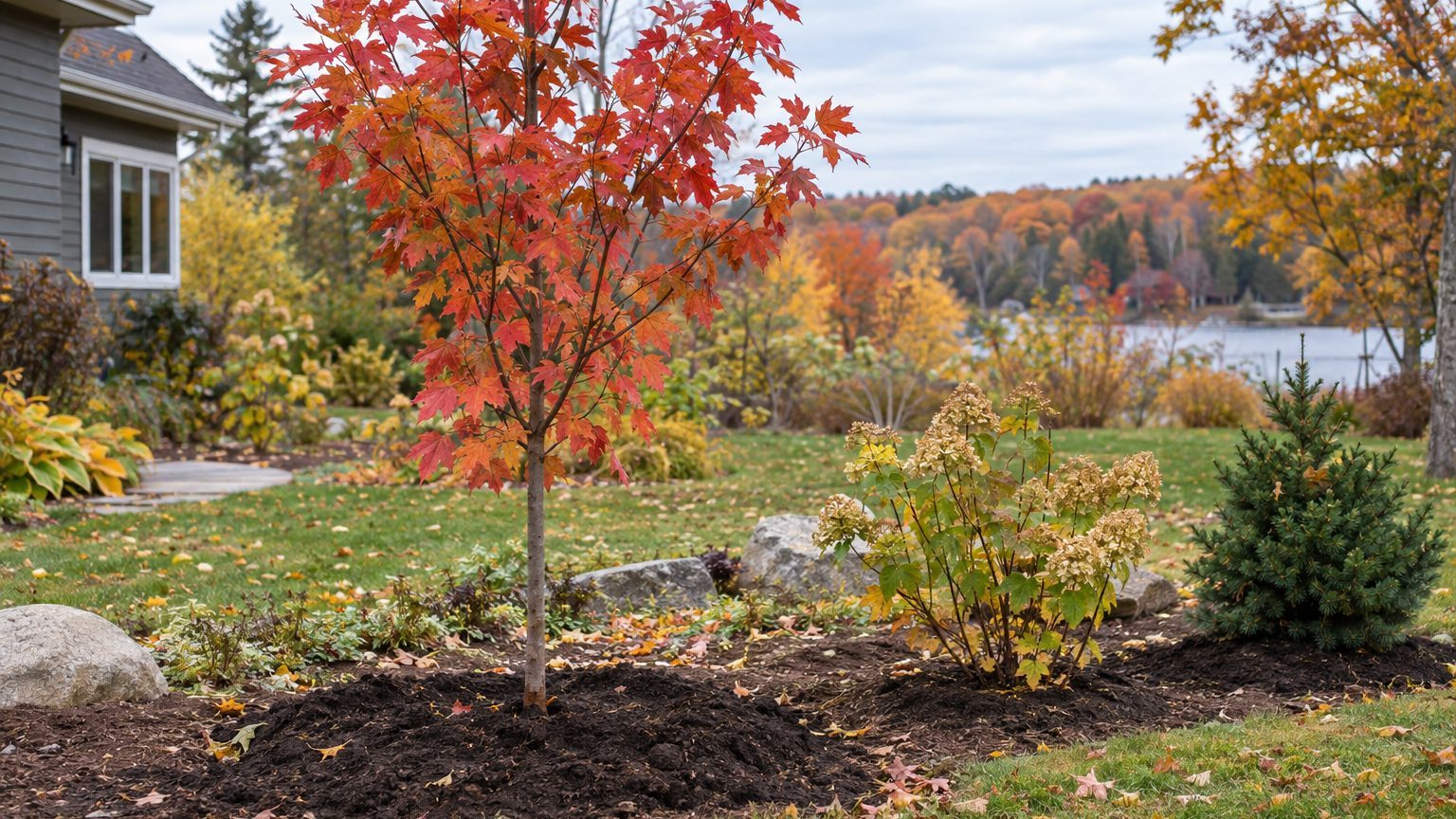

The safe target in New Brunswick is to get trees and shrubs in the ground at least six weeks before the first fall frost, which works out to around August 21 for the Moncton area. That is the conservative line, not a hard stop. Roots keep growing in cool soil well after the first frost, so fully hardy stock planted in late September or October can still take, as long as the ground hasn’t frozen. Once it freezes, the planting is a spring job.
The deadline in New Brunswick
Air and soil run on different clocks. A frosty morning tells you about the air, which cools in a night. Soil holds its heat for weeks, and as long as it stays workable and above freezing, roots keep pushing outward even after the leaves have colored and dropped. That slow soil cooling is the whole reason fall planting works. The plant is no longer spending energy on leaves, the ground is still warm enough to grow roots, and autumn rain does some of the watering for you.
Cornell Cooperative Extension (Orleans County) puts the rule this way: “Fall is an excellent time for transplanting, provided you get them to their new home at least 6 weeks before the ground freezes, allowing them time to establish roots before winter dormancy.” Notice what the clock counts back from. It is the day the ground freezes, not the first frost.
Working back from the first frost
Environment and Climate Change Canada’s 1981-2010 climate normals for the Moncton station put the first fall frost on average at October 2. That is a mean, the midpoint of a window. In one year out of two the frost arrives later, and in the other half it arrives earlier, so it is no guarantee of anything. Count six weeks back from October 2 and you land on August 21, the conservative planting deadline, built from Cornell’s rule applied to Moncton’s frost date.
That date is deliberately cautious. Because the ground freezes later than the air does, the true limit falls somewhere after the first frost, in the weeks before the soil locks up. Treat about August 21 as the safe target, and treat the day the ground freezes as the real limit. It is October 1 as this is published, so that safe target has already passed this year. Fully hardy container and balled stock can still go in now, and the sections below explain which plants make the best bet.
Moncton is one station, and New Brunswick is not one climate. Northern and upland districts run weeks behind it in spring and ahead of it in fall. A gardener there should expect the first frost earlier than October 2, and should plant earlier than the Moncton schedule suggests. The First and Last Frost Dates in New Brunswick page gives the fuller frost picture. One more caveat: Canadian normals cover 1981-2010, while the US figures elsewhere on this site cover 1991-2020, so the two shouldn’t be set side by side too tightly.
Why the deadline applies here
In a place where the ground never freezes, fall and even winter would be the best planting season, with no deadline at all. New Brunswick is not that place. Environment and Climate Change Canada puts the mean daily minimum of the coldest month at Moncton at -13.9 °C, and soil does freeze solid across the province. The six-week rule applies everywhere in New Brunswick.
The Moncton reference city sits in hardiness zone 5a, according to Natural Resources Canada’s plant hardiness site (1991-2020 normals). That is a Canadian zone, built from seven climate variables, and it does not convert to a USDA zone. Natural Resources Canada says as much: there are no simple conversions between the two systems. Read a plant tag carefully if it carries a USDA number. Gardeners in Prince Edward Island face a similar calendar across the Northumberland Strait, and How Late Can You Plant Trees and Shrubs in Fall in Prince Edward Island? shows how the same logic plays out there.
What to plant late, and what to wait on
Late planting favors stock that arrives with its roots intact and its hardiness never in question. A container-grown shrub or a balled-and-burlapped tree that is fully hardy for zone 5a has a root system ready to expand into new soil, and the cool, damp weeks of October suit it. The risky plants are the ones already working at the edge of their range, and the evergreens that keep losing water through their needles all winter while the ground is too cold to refill them.
The coldest-month figure explains the first group. A mean daily minimum of -13.9 °C is an average, so individual nights run colder than that. A plant rated for exactly zone 5a, or a little warmer, has no margin in its first winter, when the roots are still shallow. That is why the usual advice to plant borderline species in spring, after the worst cold has passed, carries extra weight in New Brunswick.
| Type of plant | Late fall verdict | Reason |
|---|---|---|
| Container-grown deciduous trees and shrubs, fully hardy for the zone | Good bet | Intact root ball, leaves already dropping, little water demand |
| Balled-and-burlapped hardy trees | Good bet if handled with care | Roots settle in cool soil; the heavy ball needs firm backfill and steady moisture |
| Plants rated at the edge of zone 5a | Wait for spring | No margin for a cold first winter with shallow roots |
| Evergreens, broadleaf and conifer | Plant early or wait | Needles keep losing water while frozen soil can’t resupply it |
Evergreens deserve the most caution. A pine or a spruce planted in August has weeks to build roots before the wind turns dry and cold. The same tree planted in late October has barely started, and every sunny, windy winter day pulls moisture out of needles that the roots can’t replace. Broadleaf evergreens such as rhododendrons and boxwood are even more exposed. If an evergreen has to go in late, pick a spot sheltered from the prevailing winter wind and away from road spray, and expect to protect it.
Plant fully hardy container and balled stock first, and hold borderline plants and big evergreens until spring. That one sorting rule prevents most of the failures. For the mechanics of setting a plant at the right depth, loosening circling roots and backfilling, the Planting and Caring for Trees, Shrubs and Perennials guide covers the full process.
Local nurseries in New Brunswick often mark down stock in fall. A discounted shrub is no problem if it is hardy and healthy. Check the roots when you can, and skip anything that has sat dried out in its pot or has roots circling the container wall.
Watering and mulch until the ground freezes
Fall planting hands the tree a different job than spring planting does. A spring planting grows leaves and shoots right away. A fall planting spends its first winter on roots, and anything above ground is just carrying cargo. The plant has no need to grow taller or fuller before spring. It needs to anchor itself and store enough reserves to leaf out when the soil warms.
Water deeply until freeze-up
Rain in October can look like enough, but a newly planted root ball is a small target, and a dry week can leave it parched while the surrounding soil stays damp. Soak the whole root zone slowly, so water reaches beneath the root ball rather than running off the surface. Then let the top inch or so of soil dry a little between waterings, because soggy soil is its own kind of trouble. Keep watering until the ground freezes, even after the leaves have dropped, since roots are still drinking.
Skip fertilizer and heavy pruning in fall. Both nudge the plant toward soft new growth that winter will only kill back. Remove dead or broken branches and leave the rest for spring.
Mulch in a ring, not a volcano
Mulch evens out soil moisture and temperature, which is exactly what a first-winter root system needs. NC State Extension’s Gardener Handbook gives the depth for weed control: “A 2-inch to 3-inch layer of mulch suppresses most annual weed seeds and makes it easy to hand-pull any that do germinate.” For trees specifically, it says: “Provide a 3-inch layer of mulch to reduce water loss and maintain uniform soil moisture and temperature around roots.” The two sentences have different purposes, but they point to the same order of depth. More isn’t better.
Shape matters as much as depth. Spread the mulch in a wide, flat ring over the root zone and pull it back from the trunk so the bark and the root flare stay visible. Piled against the trunk, mulch holds moisture against the bark, which invites rot, and it gives voles a sheltered place to chew through the winter. A volcano of wood chips is one of the most common mistakes in landscaping, and it is easy to avoid. The Mulching Without Killing the Plant guide walks through the details.
Timing matters too. Applying mulch while the soil is still unfrozen keeps the ground steadier through the freeze-thaw swings of early winter. Mulch applied after the ground has frozen mostly just covers frost.
What goes wrong
Most failed fall plantings trace back to one of four causes, and all of them are avoidable once you know the pattern.
Planting too late, and heaving
The first cause is timing. A tree planted after the ground has frozen, or just before it, has no time to grow roots, and the cold soil won’t let it. A planting made after the ground has frozen is a spring job, and the best thing to do with a tree you can’t dig in is to leave it in its pot, mulched in place or sheltered, until spring. In colder, upland and northern districts, the cutoff arrives earlier than Moncton’s figures suggest, so don’t assume the October 2 average applies.
Heaving is the second. A shallow root ball sitting in soil that freezes, thaws and freezes again can be pushed upward a little each cycle until roots are exposed to air and cold. Newly planted stock with little root growth is the most vulnerable. Firm backfill, a planting depth that matches the root flare and a ring of mulch all reduce the risk. If a plant has lifted by spring, press it back down and water it in.
Winter burn and a dry fall
Winter burn is the browning of evergreen needles and leaves that follows sunny, windy winter days. The foliage loses water, the frozen ground can’t resupply it and the tissue dries out. Fall-planted evergreens are the usual victims because their roots haven’t yet reached the moisture they need. Shelter from wind, steady watering until freeze-up and keeping the plant away from road salt spray all help.
A dry fall is the last trap. When rain stays away, a young plant can enter winter already short of water, and that deficit carries into spring. Check the soil before you trust the weather, and keep watering through a dry stretch. For the wider regional picture, the New Brunswick guides collect timing advice across the province’s gardening calendar.
Common questions
Can I still plant a tree in New Brunswick in October?
Yes, if the stock is fully hardy and the soil is still workable. At Moncton the first fall frost averages October 2 and comes later in half of all years, so early October is often fine there. The conservative target of around August 21 has passed, which means you are relying on the weeks between the first frost and the ground freezing. Northern and upland districts run weeks behind Moncton, so their window closes sooner.
Does a frost mean it is too late to plant?
No. Frost is an air temperature, and roots respond to soil. Cornell Cooperative Extension counts its six-week rule back from when the ground freezes, which comes later than the first frost. A light frost doesn’t end the season for roots, though it does shorten the margin you have left.
Is zone 5a in New Brunswick the same as USDA zone 5a?
No. The 5a for Moncton comes from Natural Resources Canada’s plant hardiness site, which uses seven climate variables. The USDA system uses one, and Natural Resources Canada states that there are no simple conversions between the two. Check which system a plant tag uses before you buy, and use the Canadian zone for New Brunswick.
Should I wait until spring instead?
Wait for spring if the ground has already frozen, if the plant is borderline for zone 5a or if it is an evergreen you can’t plant early and shelter. Spring planting is always a sound choice, and for the plants in those groups it is the better one. For hardy deciduous stock that can go in while the soil is open, fall planting works well and gives the roots a head start.