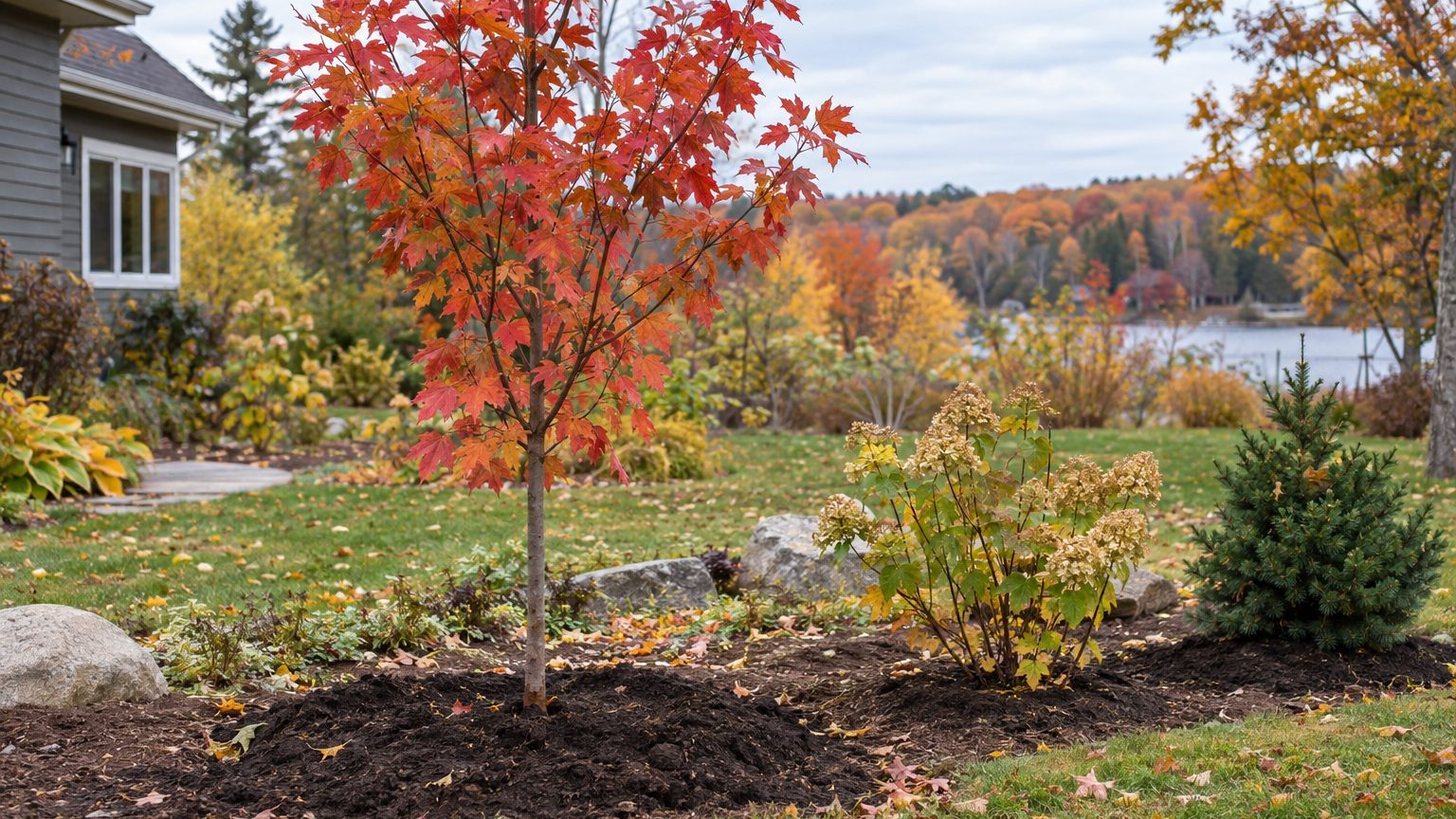

The conservative deadline for planting trees and shrubs in fall in Quebec is about six weeks before the first fall frost. At the Montreal/St-Hubert station, that frost arrives on average on October 5, so the safe target falls in late August. Plants that go in after that are not doomed, because roots keep working in cold soil until the ground locks up. But every week past the target eats into a margin that evergreens and borderline-hardy shrubs can’t spare.
The deadline in Quebec
Roots don’t follow the calendar the way leaves do. They keep growing as long as the soil is workable and above freezing, which can be weeks after the first frost has blackened the tomato vines. So the real deadline is several weeks before the ground freezes. Since nobody can read next winter’s freeze-up in advance, the first fall frost is the marker we use to work backward.
Environment and Climate Change Canada’s Canadian Climate Normals for 1981-2010 put the first fall frost at Montreal/St-Hubert A on average on October 5. That is a mean, not a promise. In one year out of two, the frost comes later than that, and in the other it comes sooner. Treat October 5 as the midpoint of a window, never as a date you can bank on.
The rule that does the heavy lifting comes from Cornell Cooperative Extension: “Fall is an excellent time for transplanting, provided you get them to their new home at least 6 weeks before the ground freezes, allowing them time to establish roots before winter dormancy.” Count six weeks back from the October 5 average and you land on August 24. Aim to finish planting by late August, six weeks before the first fall frost, and you are on the conservative side of the window.
That makes it the safe target, not the final cutoff. Cornell counts from the freezing of the ground, and the ground freezes later than the air does. A gardener near Montreal who plants a few weeks past the target still has some root-growing time, particularly with a hardy deciduous tree in a container. The margin just gets thinner with each passing week.
Location moves the date. The St-Hubert station stands for the Montreal area, and a province is not one climate. Farther north and at higher elevations, the first frost comes earlier, so the planting deadline moves earlier too, sometimes by weeks. Gardeners in those districts should pull their schedule forward rather than borrow Montreal’s. The First and Last Frost Dates in Quebec page is the place to check a local range.
The cold itself is not in question here. The mean daily minimum of the coldest month at Montreal is -14.1 °C (6.7 °F, if you are comparing with a US page), so the ground does freeze solid and the Cornell rule applies in full. Natural Resources Canada places the reference city in plant hardiness zone 5b, using the Canadian system, which is built on seven climate variables and does not convert to a USDA zone. One more caveat: Canadian normals cover 1981-2010, while the US figures elsewhere cover 1991-2020, so the two sets of dates are not strictly comparable.
What to plant late, and what to wait on
Timing is only half the decision. The other half is what you are planting, because the plants that tolerate a late start and the ones that punish it are quite different.
The safest late bets are container-grown and balled-and-burlapped trees and shrubs that are fully hardy for your Canadian zone. They arrive with most of their root system intact, so there is less to rebuild before the ground closes. Deciduous plants have an extra advantage: once the leaves drop, they stop losing water through their foliage and spend the cold months in dormancy. A hardy maple or serviceberry planted in mid-fall is asking far less of its roots than the same plant in July.
The risky group is a short list. Evergreens, both conifers and broadleaf types like rhododendron, keep their foliage all winter and keep losing water through it, even while the soil is too cold or frozen to resupply them. A late-planted evergreen with a thin root system can dry out before spring. Borderline plants, the ones rated right at the edge of what your zone allows, face the same problem from the cold side: a young root system and a hardiness gap make a poor pairing.
| Plant type | Late-fall outlook | What to do |
|---|---|---|
| Hardy deciduous trees, container or balled | Good, even after the safe target if the soil is workable | Plant, water deeply, mulch |
| Hardy deciduous shrubs | Good, with the same conditions | Plant, water deeply, mulch |
| Evergreens (conifers and broadleaf) | Risky, because foliage keeps losing water all winter | Plant by late August, otherwise wait for spring |
| Plants rated near the edge of your zone | Risky, with little root growth before the cold | Plant early or wait for spring |
Hardiness ratings need one more look before you buy. Quebec nurseries generally label with the Canadian zone numbers, but imported plants and online catalogs often carry USDA numbers. Natural Resources Canada says plainly that there are no simple conversions between the two systems, and its own comparison shows Canadian zone 4a overlapping nine USDA zones, from 3a to 7a. A tag reading “zone 5” tells you nothing until you know which system printed it. Match the plant to the Canadian zone for your town, which is 5b for the Montreal reference city.
Put evergreens and borderline plants in by late August; if you miss that range, hold them until spring and spend the fall on hardy deciduous stock instead. For the broader mechanics of getting any woody plant established, see Planting and Caring for Trees, Shrubs and Perennials.
Watering and mulch until the ground freezes
A fall-planted tree has one job before winter, and it isn’t growing taller. The top stops, the buds are already set, and the plant’s energy goes into roots reaching out from the root ball into the surrounding soil. Those roots are what carry it through the first winter and fuel the spring flush. That is why fall planting works at all, and why anything that starves the roots, like dry soil, undoes the benefit.
Water deeply, then keep doing it. Fall rain in Quebec can be generous or it can vanish for weeks, and a new root ball dries out faster than the native soil around it. Soak the whole area slowly enough that the water sinks in rather than running off, and check the soil a few inches down before watering again. Keep this up until freeze-up. A plant that goes into winter with moist soil around its roots is in much better shape than one that went in dry.
Mulch comes next, and the depth matters. NC State Extension’s Gardener Handbook says: “A 2-inch to 3-inch layer of mulch suppresses most annual weed seeds and makes it easy to hand-pull any that do germinate.” And for trees specifically: “Provide a 3-inch layer of mulch to reduce water loss and maintain uniform soil moisture and temperature around roots.” Two sentences, two purposes, and nearly the same depth. More is not better. Deeper mulch holds too much moisture against bark and gives mice and voles a cozy place to nest and chew.
The shape is the other half of the rule. Spread the mulch in a ring that covers the root zone, and pull it back from the trunk so the base stays visible and dry. A volcano of mulch piled against the bark invites rot and rodents, and it sheds water outward instead of letting it soak in. Mulch 2 to 3 inches deep in a ring, leave the trunk clear, and keep watering until the ground freezes. The details of materials and technique are covered in Mulching Without Killing the Plant.
Skip the fertilizer and the pruning. Both push top growth, and the first winter is about roots. A plant coaxed into new shoots in the fall has tender tissue the first hard freeze will kill.
What goes wrong
The most common failure is simply planting too late for the climate. Quebec winters are cold enough that the ground freezes solid, and a plant that goes in with too little time hasn’t grown the roots it needs. Nothing looks wrong in November. The damage shows in April, when the plant leafs out weakly or not at all. If you are well past the late-August target, choose hardy deciduous plants only, and accept that the odds are a little worse than a planting made earlier.
Winter burn hits evergreens hardest. On sunny, windy days in late winter, needles and leaves lose water faster than frozen roots can replace it, and the foliage turns brown or bronze. A young evergreen with a small root system has little reserve. Siting matters, because a spot exposed to the west wind or reflected sun off snow makes it worse. And going into winter with moist soil, which is why those fall waterings count, gives the plant something to draw on.
Heaving is the problem with shallow root balls. When soil freezes, thaws, and freezes again, it can push a poorly anchored plant upward, exposing roots to cold air. A plant set too high, or one whose roots haven’t knit into the surrounding soil, is the usual victim. If you spot a plant lifting in spring, press it back down gently and re-mulch rather than leaving the roots exposed.
Then there is the dry fall. A warm, dry October can feel like a gift, but a new planting dries out quickly, and a plant that enters freeze-up thirsty carries the stress through the winter. If the fall turns dry, keep watering through to freeze-up rather than trusting the weather.
Common questions
Can I still plant trees in October in Quebec?
It depends on the plant. The average first fall frost at the Montreal/St-Hubert station is October 5, which is well past the conservative late-August target, so you are working with a thin margin. Hardy deciduous trees and shrubs in containers or balled can still take, provided the soil is workable and you water them until freeze-up. Evergreens and borderline-hardy plants are better held for spring.
Does the October 5 frost date apply across Quebec?
No. It comes from the Montreal/St-Hubert A station, and it is an average for that area. Farther north and at higher elevations, the first fall frost comes earlier, and so does the planting deadline. For other towns, start with the Quebec guides and local weather records, then count back from the local frost range.
Is my plant’s hardiness tag using the right zone system?
Check. Natural Resources Canada’s zones, which place Montreal in 5b, are built on seven climate variables, while USDA zones rely on one. The two don’t convert. The same logic applies to frost dates: US figures cover 1991-2020, Canadian normals 1981-2010. A milder climate gives a different answer entirely, as the page on How Late Can You Plant Trees and Shrubs in Fall in Oregon? shows.
Is it better to wait for spring?
For hardy deciduous plants, fall planting works well when you hit the window, because roots establish before dormancy and the plant is ready for spring growth. For evergreens or plants at the edge of their zone, spring is the safer choice if late August has passed. One nuance worth keeping in mind: Cornell’s six-week rule counts from when the ground freezes, so the real deadline for any given year can run later than the conservative target, but you only learn that after the fact.