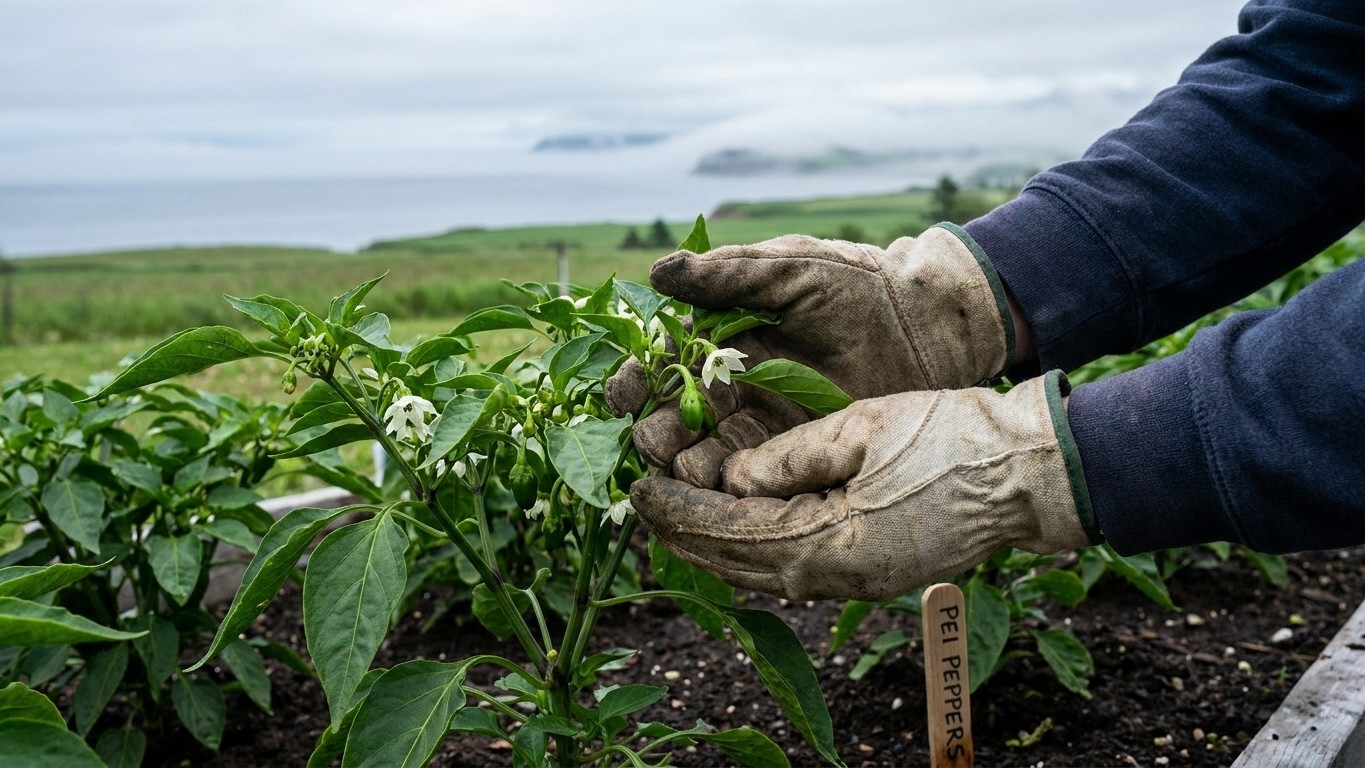

Peppers can produce a real harvest on Prince Edward Island, but the Island’s short, cool growing season changes how you play the whole game. The plants need a long head start indoors — see When to Start Pepper Seed in Prince Edward Island for the timing — plus a transplant date tied to soil temperature rather than the calendar, and close attention to the nights once fruit starts to set. Get those three pieces right and the rest is ordinary garden care.
The short answer

Start with the number that matters most for fruit set on the hot end: Charlottetown’s reference station records an average of 0.0 days a year at or above 90 F, based on the Environment and Climate Change Canada Climate Normals for 1981-2010. That is not a rounded figure or an approximation. It means the extreme heat that stalls pepper fruit set in warmer states almost never shows up here. If you have gardened peppers somewhere with regular 90-degree stretches, you can set that worry aside on PEI. Heat stress blossom drop is not the Island’s problem.
The cool end is a different story, and it is the one Island gardeners actually need to track. Pepper fruit set fails just as reliably when nighttime temperatures drop below 55 F as it does when daytime highs climb past 90 F, according to Utah State University Extension. Cool maritime nights, the kind PEI gets even in July on a clear evening with an onshore breeze, can sit right in that failure zone without any drama in the daytime forecast. Flowers open, look fine, and drop anyway.
Here is the part that matters for how you use this page: this site tracks days at or above 90 F for every territory it covers, but it does not carry summer night minimum temperatures. There is no published figure here for how many nights on PEI actually fall under 55 F in a given summer, and it would be a mistake to guess at one from the Island’s latitude or from its winter cold. Latitude tells you nothing reliable about a specific July night, and the coldest month of the year has no fixed relationship to summer night lows. For a closer look at how these cool nights disrupt pollination and fruit set, see Why Peppers Fail to Set Fruit in Prince Edward Island. If you want to know how your own garden’s nights are running, that means watching an actual outdoor thermometer at your own site through June, July, and August, not extrapolating from a climate normal built for something else.
Practically, this splits Island pepper growing into a heat-safe but cool-risk profile. You are not managing scorch and blossom drop from excess heat the way a grower in a hot southern state would. You are managing a plant that wants warmer nights than the Maritime coast reliably delivers, which pushes almost every other decision, from seed timing to variety choice to row cover use, toward protecting warmth rather than shedding it. Choosing among Pepper Varieties That Ripen in a Prince Edward Island Season is one of the most effective ways to work around that cool-night constraint from the start.
When to start seed here
Utah State University Extension’s guidance for peppers is to start seed 8 to 10 weeks indoors before transplanting, and to transplant only after the last frost and once soil has warmed to 60 F. On PEI, that arithmetic runs through a frost date that itself needs careful handling before you touch a calendar.
- Locate your frost reference point. The Charlottetown A station’s average last spring frost, per Environment and Climate Change Canada’s 1981-2010 Climate Normals, falls on May 16. That is a mean date, not a safe date: in one year out of two, frost arrives later than May 16 at that station. Treat it as the middle of a window, not a green light.
- Adjust for where you actually garden. The Charlottetown A figure describes one station. PEI is not one climate from coast to coast, and northern or inland districts commonly run weeks behind the Charlottetown reading. If you garden away from the immediate Charlottetown area, push your working frost date later rather than earlier.
- Wait for the soil, not just the calendar. Utah State’s transplant rule is frost passed and soil at 60 F, and those two conditions do not always land on the same day. A frost-free week with cold, wet soil is not a transplant week. Push a soil thermometer into the bed itself; air temperature is not a substitute.
- Count back 8 to 10 weeks from your realistic transplant date. If your working transplant date sits in the first half of June once you have adjusted for frost risk and soil warmth, count back 8 weeks for the earliest sensible indoor sowing date, and 10 weeks if you want extra-developed transplants with a stronger head start on the Island’s short season.
- Rerun the math every year. A mean frost date does not move, but the year it describes does. Some seasons will run warm and early, others will hang on to cold soil into June. Use the 60 F soil reading as your real trigger and treat the calendar count-back as a planning guide, not a fixed appointment.
This same sequence works in any Island county. Swap in your own observed frost pattern and your own soil reading, and the 8-to-10-week count-back still holds.
What goes wrong here
- Blossom drop from a cool night. This is the Island’s signature failure. Nights under 55 F can cause flowers to open and fall without setting fruit, even when the days look mild and pleasant. Since PEI averages effectively no days at or above 90 F, a hot-spell version of this failure is unlikely here, but it can still occur on an unusually warm, still afternoon. The remedy for the cool-night version is row cover or a cold frame held over the plants through cool stretches, and holding transplants back until nights have settled rather than rushing them out at the first mild week.
- Sunscald on exposed fruit. Where the sun sits strong and direct on fruit that has lost its leaf cover, whether from pruning, wind damage, or disease, the skin can develop pale, papery patches that later rot. The remedy is to leave the plant’s own foliage in place as shade rather than stripping leaves for looks, and to stake or cage plants so wind and rain do not knock cover away from developing fruit.
- Blossom-end rot from uneven watering. Peppers that get a dry stretch followed by a heavy soak often show a sunken, leathery patch at the blossom end of the fruit. This comes from inconsistent water delivery disrupting calcium uptake, not from a soil calcium shortage in most home gardens. The remedy is steady, even watering on a schedule, plus a few inches of mulch to keep the root zone from swinging between soaked and dry.
Checking this against your own county
Charlottetown’s climate normal is a single reference point for the whole province, and PEI’s coastal exposure varies enough from one shoreline to another that a garden ten or twenty miles inland or on a different coast can run a different pattern of frost and cool nights. Before you lock in a transplant date, check current guidance for your own county through Prince Edward Island’s Department of Agriculture, which tracks provincial growing conditions and can point you toward local extension contacts and current-season advisories.
That local check matters most for the two things this page cannot resolve for you: the actual night temperatures in your specific garden through the summer, and how far your local frost pattern drifts from the Charlottetown A station average. Both are worth a season of your own thermometer readings before you trust any general figure over what you are seeing at your own soil line.
Common questions
Do peppers need any special heat protection on Prince Edward Island?
Not for daytime heat. With an average of 0.0 days a year at or above 90 F at the Charlottetown reference station, extreme-heat blossom drop is rare here. The bigger concern is protecting plants from cool nights, using row cover or a sheltered spot rather than any kind of shade cloth.
How do I know if my garden’s nights are too cold for fruit set?
Put an outdoor min-max thermometer at plant height in your bed and check it through the season. Utah State University Extension notes that fruit set fails below 55 F at night, and this site does not publish local night minimums, so a direct reading at your own site is the only reliable check.
Is May 16 a safe date to transplant peppers on PEI?
No. May 16 is the average last spring frost at the Charlottetown A station from Environment and Climate Change Canada’s 1981-2010 Climate Normals, meaning frost falls later than that in about half of all years. Wait until frost risk has clearly passed in your area and the soil itself reads 60 F before transplanting.
Why do my pepper flowers drop without any fruit forming?
Flower drop without fruit almost always traces back to temperature at the moment of flowering, either nights that dipped below 55 F or, less commonly on PEI, an unusually hot stretch above 90 F. Since heat like that is rare here, check your night readings first before looking at any other cause.