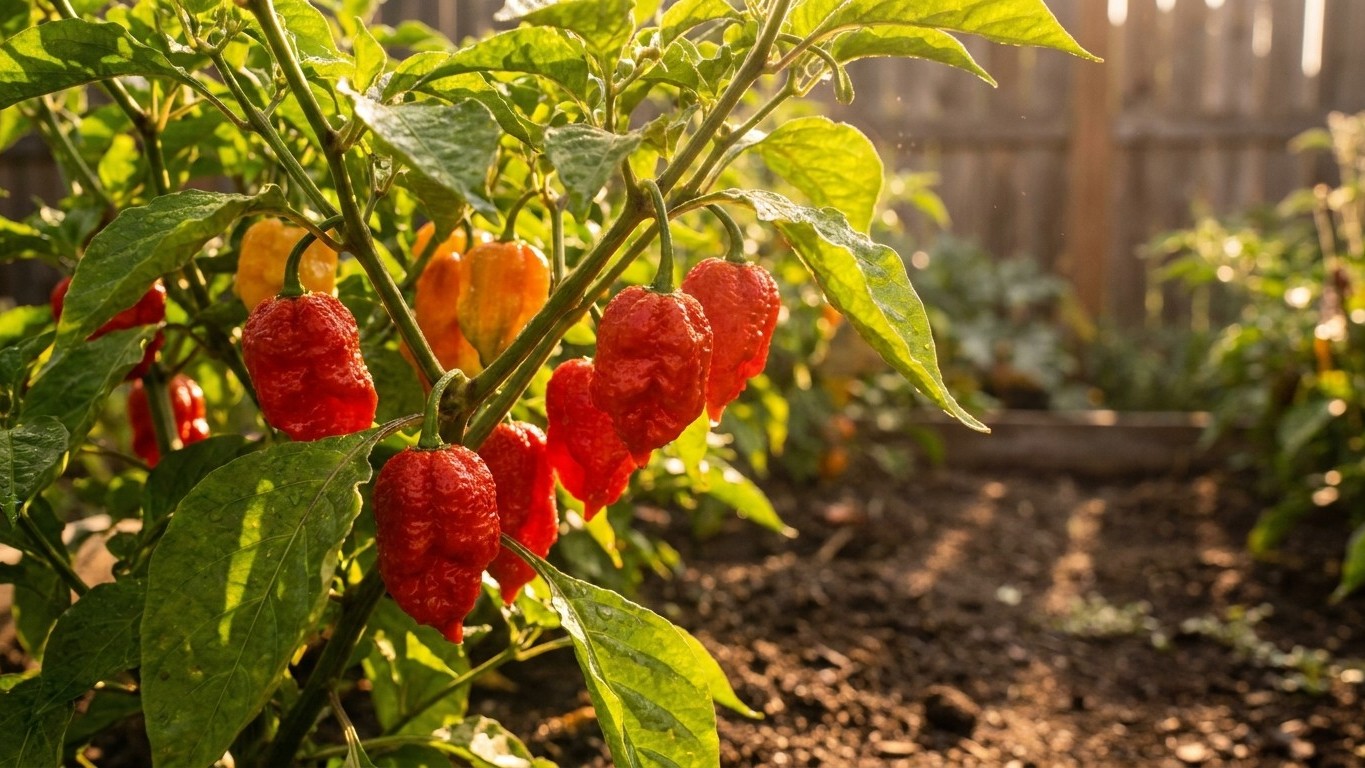

Pick peppers once they reach full size and feel firm, which Clemson Cooperative Extension puts at about 70 to 85 days after transplanting. Then keep them out of the refrigerator. The best storage range is 45 to 50 °F with 80 to 90 percent humidity, and a home fridge runs colder than that. Below about 45 °F, peppers pit and soften from chilling injury. In Florida, the bigger challenge comes earlier, because both heat and cool nights can shut down fruit set.
The short answer
Jacksonville, the reference station for north Florida, averages 73.2 days a year at or above 90 F, according to NOAA NCEI Climate Normals. That figure measures summer heat load, not the average summer temperature, and it bears directly on peppers. Utah State University Extension says pepper fruit set fails at both ends: days above 90 F and nights below 55 F. Flowers that open during a run of hot days tend to drop instead of turning into fruit.
Put 73.2 days in perspective and it comes to roughly one day in five. Not every pepper plant meets those days at the wrong moment, but any plant blooming through a hot stretch loses that round of flowers. It keeps growing, and it blooms again when the heat breaks. The practical goal is to get the first flush of flowers set before the hot days pile up.
The other end is nights under 55 F. This site carries the count of hot days for each territory but does not carry summer night minima, so there is no number here that tells you how often your nights fall that low. Do not guess from how far north or south you live, and do not borrow the answer from the coldest month of the year. A min/max thermometer left outdoors near the bed will show you what your own yard does, and a couple of weeks of readings beats any assumption.
That is why the picking date follows the plant’s schedule rather than the calendar. Clemson’s window runs 70 to 85 days from transplanting, and it assumes the flowers set along the way. When fruit is ready, look for full size and a firm, glossy skin. Cut the pepper off with pruners or scissors and leave a short stub of stem, since pulling can snap the brittle branches. Peppers can be picked green or left to color, but waiting for color means more weeks on a plant that may be under heat stress.
One caution about geography. The dates on this page come from Jacksonville, which is north Florida and an inland airport site. Central and south Florida are effectively frost-free, and there the growing calendar inverts: the main pepper season runs through winter, and summer is the hard part. Do not apply the north Florida window to Orlando or Miami. For the full breakdown of blossoms that refuse to turn into fruit, see Why Peppers Fail to Set Fruit in Florida.
When to start seed here
Utah State University Extension gives the rule in two parts. Transplant after frost, once the soil reaches 60 F, and start seed indoors 8 to 10 weeks before that day. The work is counting backward from a transplant date, and it goes like this for north Florida.
- Find the last spring frost. For Jacksonville, NOAA NCEI’s 32 F freeze probabilities in the 30 to 70 percent band put it between February 16 and March 7. The same airport record includes three of thirty falls with no freeze at all, so treat the window as odds, not a promise.
- Check the soil. Peppers need soil at 60 F, and soil can lag behind the last frost. A soil thermometer pushed a few inches down in the morning gives the honest reading.
- Choose the transplant date. Take whichever comes later, the end of your frost window or the day the soil reaches 60 F. For the example here, use March 7.
- Subtract 8 weeks, then 10 weeks. Eight weeks before March 7 is January 10. Ten weeks before March 7 is December 27. Seed sown between those two dates is the right age on transplant day. If your soil is warm enough to go in on February 16, the same subtraction gives December 8 to December 22.
- Add the harvest window. Clemson’s 70 to 85 days after transplanting turns a March 7 transplant into first peppers between May 16 and May 31.
To redo this for your county, swap in your own last-frost date and your own soil readings. This site publishes the frost window only for the Jacksonville reference station, so a county farther south or west needs its own numbers, and no figure for it is published here.
Count the weeks indoors honestly. A seedling started too early is root-bound and leggy by transplant day, while one started late arrives small and flowers later, closer to the hot days. The 8 to 10 week range exists because it produces a transplant that settles in quickly.
For central and south Florida, the arithmetic changes shape. With no meaningful frost to count back from, the question becomes how to get plants established and fruiting through the winter before summer heat arrives. This page does not publish dates for those regions. The parent guide, Growing Peppers in Florida, covers the regional split in more detail.
What goes wrong here
Most pepper failures in Florida trace back to temperature or water. Here are the ones to expect, with the fix for each.
- Blossom drop in a hot spell. Days above 90 F cause flowers to fall off, and with 73.2 such days a year at the reference station, it happens. Flowers already lost are gone, so the remedy is protecting the next round: afternoon shade cloth during a hot stretch, mulch to keep roots cool, and steady watering. Heavy nitrogen feeding pushes leaves at the expense of flowers, so ease off.
- Blossom drop on a cool night. Nights under 55 F do the same damage from the other direction. Since this site carries no summer night minima, check your own thermometer. When a cool night is forecast, a row cover over young plants helps, and if nights are still low at transplant time, waiting a week or two costs little.
- Sunscald. Fruit exposed to strong sun develops a pale, papery, sunken patch on the side facing the light. It usually happens when the leaf canopy has thinned. Keep the foliage intact, shade fruit during the hottest stretch, and avoid stripping leaves. If leaves are being chewed, the cause may be an insect, covered in What Eats Pepper in Florida, and When.
- Blossom-end rot. A dark, leathery, sunken patch at the bottom of the fruit signals calcium is not reaching it. The cause is often uneven watering rather than a shortage of calcium in the soil. Water on a steady schedule, mulch, test the soil before adding anything, and pick off affected fruit so the plant puts its energy elsewhere.
- Chilling injury after picking. This one happens indoors. Below about 45 °F, peppers pit and soften, and a standard refrigerator runs colder than that. Store them at 45 to 50 °F with 80 to 90 percent humidity if you can manage it, and otherwise eat them soon, or freeze or pickle the surplus.
That last item is the mistake nearly everyone makes. Clemson’s two to three weeks of storage life is a ceiling under ideal conditions, not a promise, and most Florida kitchens sit well above 50 F.
Common questions
How do I know a pepper is ready to pick?
Count first, then inspect. Clemson says peppers should be ready about 70 to 85 days after transplanting. At that point, look for full size for the variety, a firm feel, and glossy skin. Cut the fruit with a short stem stub. Picking regularly also keeps the plant producing.
Can I put picked peppers in the refrigerator?
It is a bad idea for whole peppers. The recommended storage range is 45 to 50 °F, and a domestic refrigerator is colder. Below about 45 °F, peppers develop pits and go soft, which is chilling injury. A cool spot at that range with 80 to 90 percent humidity is better, and for longer keeping, freezing or pickling works.
Can I use these dates in Orlando or Miami?
No. The February 16 to March 7 frost window belongs to north Florida, based on a Jacksonville airport station. Central and south Florida are effectively frost-free, and the calendar inverts: the main season runs through winter, and summer is the hard part. This page does not publish dates for those regions.
Do hot days or cool nights matter more for fruit set?
Both can stop it. Utah State University Extension names days above 90 F and nights below 55 F as the two limits. This site carries the count of hot days, 73.2 a year at the Jacksonville reference station, but no summer night minima, so for the cool end you need to read your own thermometer. Those readings are the only ones that count for your yard.