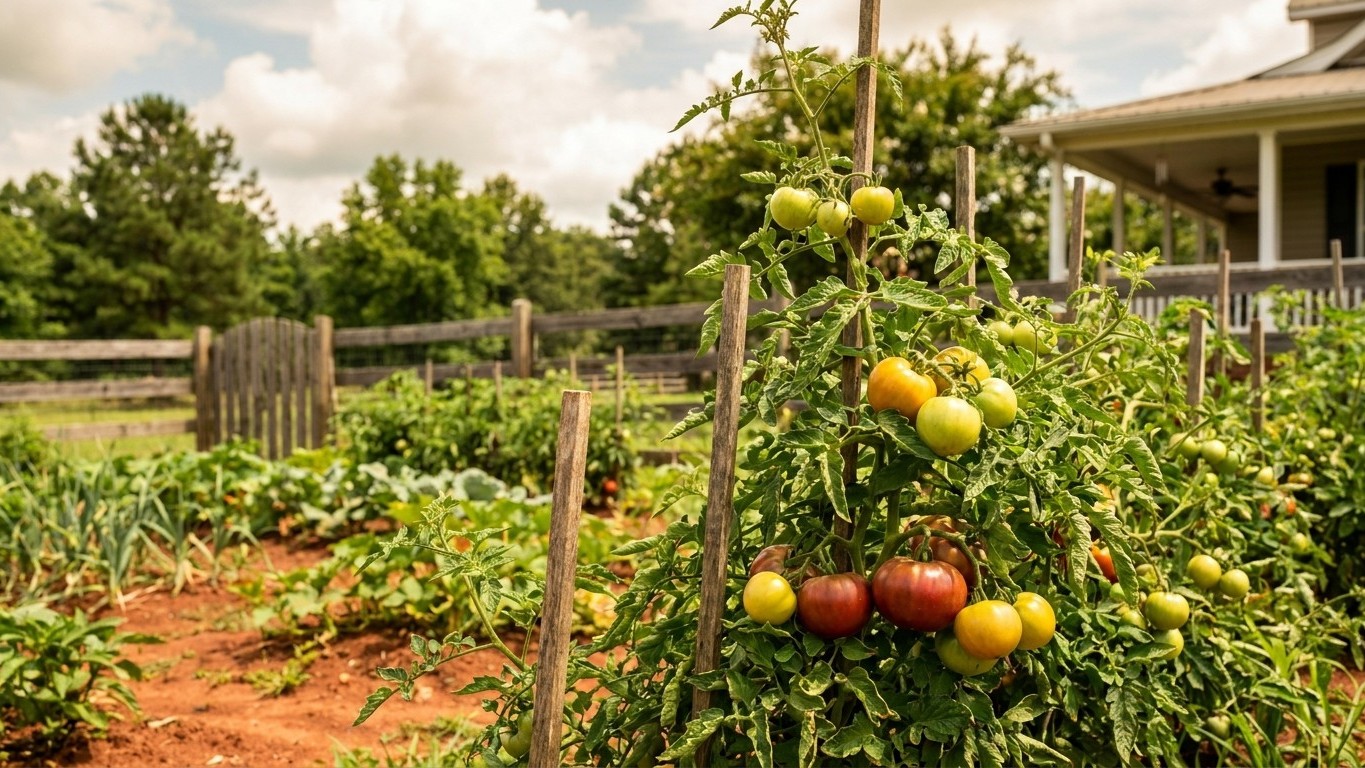

The short answer: pick most New Brunswick tomatoes at the “breaker” stage, when the skin just starts to blush, rather than waiting for full red on the vine. With the mean first fall frost landing around October 2 near Moncton, and that date sliding later or earlier by weeks depending on the year, waiting for perfect vine-ripening is a gamble most home gardeners lose at least every other season.
When to pick tomatoes in New Brunswick
The Moncton station puts the mean first fall frost at October 2, based on Environment and Climate Change Canada’s 1981-2010 Climate Normals. That number is a midpoint, not a promise. In one year out of two, the actual first frost at that station falls later than October 2, and in the other half, it falls earlier. Some seasons give you three extra weeks of open sky. Others cut the season short in mid-September. Treat October 2 as the center of a window, not a date to circle on the calendar.
The same caution applies to the other end of the season. The mean last spring frost at Moncton sits at May 23, which puts the average frost-free stretch at roughly 132 days when you count from May 23 to October 2. That figure looks generous on paper, but it’s an average of two averages, so the real gap in any given year can run shorter, sometimes considerably shorter, if either edge shifts.
Moncton sits in Canadian hardiness zone 5a, a rating from Natural Resources Canada that measures seven climate variables together, not the single-variable USDA system used across the border. That distinction matters here because a New Brunswick gardener reading a US tomato guide calibrated to a USDA zone number is working from an incompatible scale. Zone 5a describes Moncton specifically, not the whole province. Coastal spots along the Bay of Fundy often run milder and later into fall, while inland and northern districts, and anywhere with elevation, lose their growing window sooner.
Reading your own plants, not just the calendar
Because the frost window is a range and not a fixed line, the more reliable trigger for picking is the fruit itself and the short-term forecast, not a date. Once nights start dropping into the 40s Fahrenheit with any frost mentioned in a local forecast, it’s time to start clearing fruit that has any color at all, green with a hint of white or yellow at the blossom end included. Vines exposed to a hard frost lose the fruit still on them almost overnight, so the calculation shifts from “how ripe is this tomato” to “how many days do I actually have left.”
Fruit that has reached mature green, meaning it’s full-sized, has stopped growing, and shows a faint color shift at the base, will ripen off the vine reasonably well. Fruit that’s still small, hard, and uniformly dark green rarely ripens into anything worth eating; it tends to shrivel or rot instead of coloring up.
What to do with the green ones
Not every green tomato deserves the same treatment, and sorting them before frost hits saves a lot of disappointment in the kitchen later. Split what’s left on the vine into three rough categories before you decide what goes where.
- Mature green: full size, glossy skin, a pale color shift starting at the blossom end. These are the best candidates for indoor ripening and usually turn out close to vine-ripened flavor.
- Immature green: still smaller than typical for the variety, matte or fuzzy-looking skin, no color shift anywhere. These rarely ripen well and are better used green, in relishes, chutneys, or fried.
- Breaker stage: visible blush or streak of color, usually pink, yellow, or red depending on variety. These will ripen fastest and most reliably of the three.
When a hard frost is forecast within a day or two, the practical move is to strip the whole plant rather than pick selectively fruit by fruit. Cutting the vine at the base and hanging the entire plant upside down in a garage, shed, or basement lets fruit continue drawing on the plant’s remaining sugars while it ripens, which several home gardeners find gives better flavor than fruit picked individually and left loose in a box. This works best in a space that stays above roughly 55°F and out of direct sun.
For fruit that’s clearly immature green and won’t ripen into something worth eating fresh, there’s still use for it. Green tomato relish, chow-chow, and fried green tomatoes are standard uses across the Maritimes for exactly this end-of-season surplus, and they don’t require any color development at all. Sorting the harvest this way, rather than trying to ripen every last tomato on a windowsill, cuts down on the rot and mold that come from mixing immature fruit in with fruit that’s actually going to color up.
Whichever path you choose, handle the fruit gently. Bruised or nicked green tomatoes rot before they ripen far more often than fruit that’s been picked and stored without damage, since a broken skin gives mold an easy entry point during the slower ripening process ahead.
Ripening indoors, and how long they keep
Green and breaker-stage tomatoes ripen indoors through the same ethylene-driven process they’d go through on the vine, just slower and without direct sun. Sun is not required for ripening color, and in fact a sunny windowsill often does more harm than good, since the fruit can overheat and soften unevenly on the side facing the glass.
The setup that works
Spread fruit in a single layer, not stacked, in a box or on newspaper somewhere out of direct light, ideally between 55°F and 70°F. Anything colder than about 50°F slows ripening dramatically and can cause chilling injury that leaves the fruit mealy once it does color up; anything much warmer than 75°F speeds ripening but tends to soften the fruit before the flavor fully develops. A cool basement, an unheated but frost-free porch, or a spare room all work.
Adding a ripe banana or apple to the box speeds things along, since both fruits give off ethylene gas that pushes tomatoes toward color faster. Loosely covering the box, rather than sealing it airtight, traps enough of that gas to help without creating the humid, stagnant air that invites mold.
Check the box every couple of days and pull out anything that’s turned, since fully ripe tomatoes left in with green ones speed up spoilage in their neighbors and, if one starts to rot, the mold can spread to fruit touching it. Rotating and inspecting is the single biggest factor separating a box that yields good tomatoes for weeks and one that turns to mush in the corner of a basement.
How long they last
Once a tomato reaches full color, it holds for roughly a week at room temperature before quality drops, and a bit longer, up to around two weeks, if kept in a cool spot near 55°F rather than a warm kitchen. Fruit still green when picked can take anywhere from one to several weeks to color up fully, depending mostly on how mature it was at picking and how warm the storage spot runs. Breaker-stage fruit moves fastest, often coloring within a week; fruit picked at mature green but with no color break yet can take two to three weeks or more. Immature green fruit, as noted above, often never reaches a stage worth eating fresh.
What goes wrong here
The most common mistake is timing the harvest to a single frost date instead of a window. Gardeners who wait for October 2 specifically, treating the mean date as a safe deadline, sometimes lose an entire late crop to a frost that arrives two weeks early, since that date is only the middle of the range, not its edge.
Mold in storage is the second recurring problem, usually traced back to one of two causes: fruit packed too tightly with no airflow, or a damaged tomato left in with sound ones. A single soft, bruised, or split tomato in a box can take down several neighbors within days, so daily or every-other-day sorting matters more than any specific ripening technique.
Picking fruit too early, before it reaches even the mature green stage, wastes effort. Immature green tomatoes brought indoors typically shrivel, stay hard, or rot without ever developing usable color or flavor, which leads some gardeners to conclude indoor ripening “doesn’t work” when the real issue was picking stage, not method.
Splitting is common on fruit that ripens indoors after a stretch of uneven moisture in the garden beforehand, and it opens the door to the same mold problems as bruising. There’s not much to do about split fruit except use it quickly, cooked rather than fresh.
Finally, storing ripening tomatoes in the refrigerator is a frequent misstep. Cold temperatures below roughly 50°F halt the ripening process and can leave fruit with a mealy texture and flat flavor even after it’s brought back to room temperature. Refrigeration is fine for fruit that’s already fully ripe and needs a few extra days, but it works against fruit still trying to color up. For general growing conditions and season-length questions specific to New Brunswick, Agriculture and Agri-Food Canada‘s site is a reasonable starting point.
Common questions
Can I pick tomatoes before the first fall frost and expect them to still ripen well?
Yes, as long as the fruit has reached at least the mature green stage, meaning full size with a faint color shift starting at the blossom end. Fruit picked before that point rarely ripens into something worth eating.
Does the mean frost date of October 2 near Moncton apply across all of New Brunswick?
No. It’s specific to the Moncton station and reflects 1981-2010 normals from Environment and Climate Change Canada. Coastal areas often run milder and later, while inland, northern, and higher-elevation spots typically see frost earlier than that mean date.
What’s the best temperature for ripening tomatoes indoors?
Somewhere between 55°F and 70°F, out of direct sun. Colder spots slow ripening and can cause chilling injury; much warmer spots speed ripening but soften the fruit before flavor fully develops.
How long will a green tomato take to ripen once it’s picked?
It depends on how mature it was at picking. Breaker-stage fruit, with visible color already starting, often ripens within about a week. Mature green fruit with no color yet can take two to three weeks or longer, and immature green fruit frequently never ripens fully.